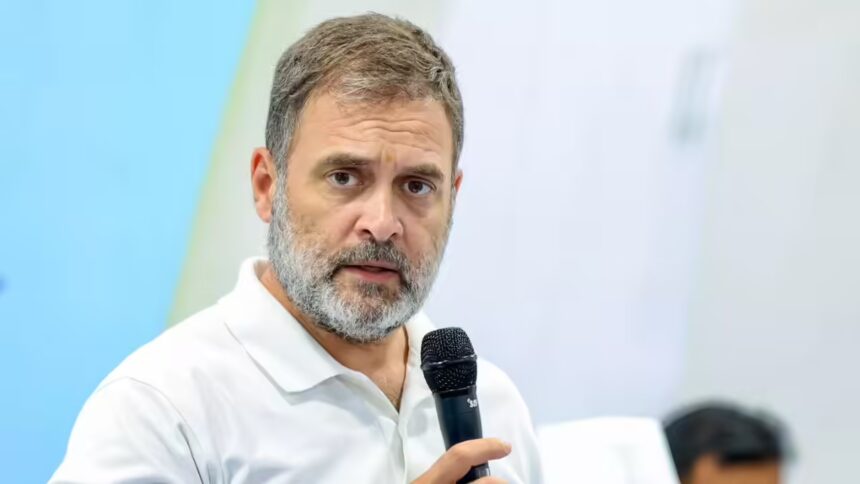
The political debate in Bihar has intensified following the publication of the final voter list by the Election Commission after the Special Intensive Revision (SIR). The BJP has sharply criticized Congress and Rahul Gandhi, asserting that claims of voter manipulation are misleading and politically motivated. Senior BJP leader Amit Malviya highlighted that the Congress did not file a single complaint or objection regarding the inclusion or deletion of any names during the voter revision process. The BJP framed this narrative as an attempt to mislead voters and undermine the credibility of the democratic process, emphasizing that the final voter roll confirms transparency and due diligence by the Election Commission. At the same time, Congress leaders have questioned the deletion of several voters from the final list, claiming lack of fairness and transparency in the process. The political tug-of-war over Bihar’s voter list underscores larger questions of accountability, electoral integrity, and the narratives political parties construct during sensitive pre-election periods. The controversy revolves around the Special Intensive Revision and its impact on voter inclusion and deletion, alongside broader concerns regarding electoral credibility and the democratic process in Bihar.
BJP Response and Accusations Against Congress
The Bharatiya Janata Party has launched a pointed attack on Rahul Gandhi and the Congress party following the Election Commission’s release of the final voter roll in Bihar. Amit Malviya, senior BJP leader and head of the party’s IT wing, stressed that Congress did not file a single complaint during the SIR process, either for adding names or for deletion. According to him, this exposes the disingenuous political tactics employed by Rahul Gandhi, whose Voter Adhikar Yatra was portrayed by the BJP as an effort to mislead the public rather than strengthen democracy. The BJP has labeled the ‘Vote Chori’ claims as a pretext aimed at covering impending electoral setbacks and damaging public faith in India’s democratic institutions. Malviya further suggested that the narrative appeared to draw inspiration from foreign strategies, referencing George Soros as an example of international political influence, implying that Rahul Gandhi’s approach is ill-conceived and aimed at reviving a struggling party rather than addressing genuine electoral concerns.
The BJP emphasized that the SIR process in Bihar was transparent, with the Election Commission executing its duties diligently. In a post on social media, Malviya stated that Congress’s silence during the process contradicted their later claims of voter manipulation. By failing to formally raise objections or complaints in the prescribed format, the party’s allegations were depicted as politically motivated rather than evidence-based. BJP leaders argue that the process, conducted by the Election Commission, ensured that all procedural safeguards were observed, and any claims of voter deletion or irregularities were unsubstantiated. The party framed its argument around the notion that Congress’s political statements were designed to influence public perception ahead of elections, rather than address genuine lapses in electoral management. In this context, the BJP’s narrative seeks to reinforce the credibility of the Election Commission and highlight its commitment to conducting a fair, transparent, and accountable electoral process.
Congress Concerns and Electoral Oversight Debate
On the other hand, Congress leaders have raised questions regarding the deletion of voters from Bihar’s final electoral roll. Bihar Congress chief Rajesh Ram criticized the SIR exercise, claiming it was deceptive and conducted without public demand or sufficient transparency. According to him, the voter revision process raised concerns over fairness and clarity, and Congress workers intend to assess thoroughly how many names were added or removed across the state. Ram’s comments emphasize the Congress party’s position that the SIR process may have overlooked critical procedural safeguards, potentially impacting voter representation. Senior Congress leader Manish Tewari similarly questioned the Election Commission regarding 47 lakh voters who were deleted from the final roll. He demanded granular data to distinguish voters who had shifted states, deceased individuals, or ghost voters, arguing that detailed transparency was necessary to restore credibility to the electoral process. These concerns underline the broader issues of accountability, as the deletion of voters—whether justified or not—has significant implications for electoral legitimacy and public confidence in the democratic system.
The Chief Election Commissioner, Gyanesh Kumar, addressed the broader political and public concerns by acknowledging the completion of the SIR process and thanking electors, political parties, and other stakeholders for their cooperation. According to official figures, the final voter list of Bihar comprises 7.42 crore electors, slightly reduced from 7.89 crore voters recorded in June. The publication of these figures reflects the ongoing adjustments and revisions intended to ensure accuracy in voter records. While BJP and Congress leaders interpret these numbers differently for political leverage, the Election Commission maintains that the process followed due diligence and procedural norms to ensure transparency and fairness. The debate highlights how political narratives are constructed around electoral data, with parties using the same facts to advance different perspectives regarding credibility, governance, and democratic integrity.
The controversy over voter deletion and alleged manipulation also brings attention to larger systemic challenges in electoral governance. Both parties—BJP and Congress—have used the situation to reinforce their respective political messaging. BJP emphasizes procedural integrity and accuses Congress of politicizing the voter list issue, while Congress points to potential lapses and the need for more granular data to assess transparency. The Election Commission’s role becomes critical in mediating between these claims, providing verified data, and ensuring that public confidence in electoral processes is maintained. Furthermore, the debate illustrates the complex interaction between political campaigning, voter mobilization, and administrative oversight in the lead-up to elections. The political discourse in Bihar reflects the stakes associated with voter perception and the narratives surrounding electoral integrity.
The Bihar voter list controversy exemplifies the intersection of electoral management, political strategy, and public trust in democratic institutions. While BJP frames Rahul Gandhi’s statements as attempts to mislead voters and politicize administrative procedures, Congress positions itself as a defender of transparency and accountability, questioning deletions and raising concerns about voter representation. The SIR process, a mechanism designed to update voter lists comprehensively, has thus become a focal point of political contention, with both parties using the outcomes to support their arguments. The release of the final voter roll is not only a technical administrative step but also a critical element shaping political narratives, electoral strategies, and public discourse ahead of the Bihar elections.
As political debates continue, the narrative surrounding voter manipulation, inclusion, and deletion remains central to electoral discourse. BJP’s insistence on procedural transparency and Congress’s focus on potential lapses create a layered understanding of governance, accountability, and democratic practice in India. While the Election Commission maintains that its processes are fair and accurate, the interpretation of data and its use in political messaging underscores the influence of perception, strategy, and communication in shaping electoral outcomes. The Bihar voter list issue highlights the challenges faced by democratic institutions in balancing transparency, accountability, and political competition while striving to maintain public trust.