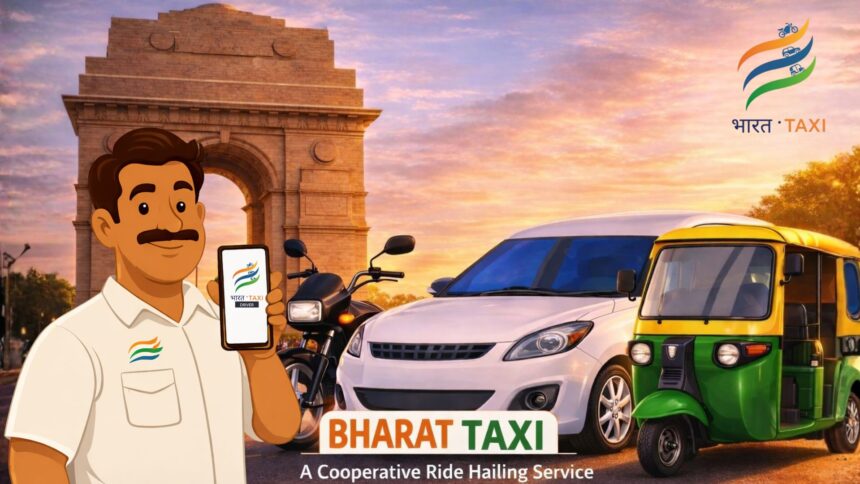
India’s urban mobility landscape is poised for a significant shift as Bharat Taxi, the country’s first cooperative-based ride-hailing application, prepares for its formal launch in Delhi on February 5, introducing a driver-owned platform that promises zero commission, lower fares for passengers, and a new alternative to established private aggregators.
The new app will be officially launched by Amit Shah at Vigyan Bhavan in New Delhi, marking an important milestone in the government’s effort to promote cooperative enterprises in emerging digital sectors. Designed as a people-centric mobility initiative, Bharat Taxi seeks to challenge dominant private players such as Ola, Uber and Rapido by reworking the economics of ride-hailing in favour of drivers and commuters alike. With nearly 2.5 lakh vehicles expected to be registered at launch across the Delhi-NCR region, the platform is entering the market at scale rather than as a limited experiment.
Cooperative ownership model reshapes driver participation and earnings
At the heart of Bharat Taxi is a cooperative ownership structure that fundamentally alters the relationship between drivers and the platform. Operated by Sahkar Taxi Cooperative Limited, the app treats drivers as shareholders instead of commission-based partners. Every driver associated with the platform holds five shares in the cooperative, ensuring direct ownership and participation in the collective growth of the service.
Unlike conventional ride-hailing platforms that deduct a percentage or fixed commission from every trip, Bharat Taxi follows a zero-commission model. Drivers are required to pay a flat subscription fee of Rs 30 per day to access the app, irrespective of the number of rides completed. Officials behind the initiative argue that this approach significantly improves drivers’ net income while offering predictability in costs, a key concern among gig workers who often face fluctuating earnings due to dynamic commission structures.
The cooperative framework is supported by some of India’s most prominent cooperative institutions, including IFFCO, Amul, NCDC, NABARD, NDDB, KRIBHCO, NAFED, and NCEL. This backing is expected to lend financial stability, governance strength, and long-term credibility to the platform as it expands beyond its initial markets.
According to officials associated with the project, the cooperative model is intended not only to improve daily earnings but also to provide drivers with a sense of security and long-term stake in the platform. Profits generated by Bharat Taxi are expected to be reinvested for driver welfare, operational improvements, and expansion, rather than being channelled solely to corporate shareholders. This approach aligns with broader policy goals of strengthening the cooperative sector and creating inclusive economic opportunities through digital platforms.
The concept was tested during a soft launch in December 2025 in Delhi and Gujarat, where the app reportedly handled an average of 5,500 rides per day. Of these, around 4,000 were airport trips, highlighting early acceptance among both drivers and passengers. More than 1.4 lakh drivers registered during the pilot phase, providing early momentum ahead of the national rollout.
Lower fares, safety focus and nationwide expansion roadmap
For passengers, Bharat Taxi positions itself as a more affordable alternative to existing ride-hailing services. Officials claim fares on the platform could be up to 30 percent cheaper than those charged by private aggregators. The primary reason cited for this price difference is the elimination of per-ride commissions, which on private platforms often range between Rs 30 and Rs 50. By removing this cost layer, Bharat Taxi aims to pass on savings directly to consumers while maintaining sustainable earnings for drivers.
The Delhi launch will also feature an awareness rally aimed at drivers, referred to as “Sarathis” on the platform, to familiarise them with the cooperative model and encourage broader participation. With an estimated 2.5 lakh vehicles expected to be onboarded initially in Delhi-NCR, the platform is set to become one of the largest ride-hailing networks in the region from day one.
Safety has been highlighted as a key component of Bharat Taxi’s service design. The app includes in-built safety features for passengers, along with a dedicated helpline for complaints and emergencies. In coordination with the Delhi Police, 35 special booths have been established across the city to ensure faster redressal of passenger grievances. All drivers on the platform undergo verification, with records maintained to enhance trust, accountability and passenger confidence.
The app is available on both the Google Play Store and the Apple App Store, ensuring wide accessibility across devices. Its digital architecture is designed to integrate with India’s growing digital public infrastructure, aligning the platform with national efforts to create interoperable, citizen-focused digital services.
Looking beyond Delhi, Bharat Taxi has outlined ambitious plans for expansion. The cooperative aims to roll out services across all states and major cities within the next two years, setting up dedicated support centres in every state. Strengthening drivers’ social security is also part of the long-term vision, with plans to explore insurance coverage, welfare benefits and financial inclusion measures through cooperative and government-linked channels.
As Bharat Taxi prepares for its formal debut in the capital, expectations are high that the platform could introduce meaningful competition into India’s ride-hailing market. With strong institutional backing, early traction among drivers, a pricing strategy focused on affordability, and a cooperative ownership model at its core, Bharat Taxi represents a distinct experiment in blending technology, mobility and cooperative principles at national scale.
The Bharat Taxi logo has been designed by Samir Kumar, CEO of CliQ India Media. He explains, “This logo represents a young and progressive India. Its flowing lines symbolize our roads, our journeys, and the constant momentum of a nation moving forward. The two-wheelers, cars, and auto-rickshaws depicted within reflect the everyday Bharat, connecting citizens from cities to villages. Inspired by the tricolour, the colors convey unity, trust, and growth. More than a swrvice, Bharat Taxi is a people’s movement that brings the nation together and drives it forward on the path of progress.”