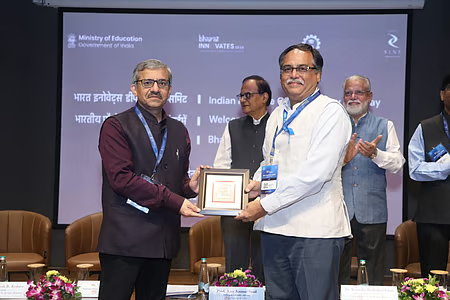
The Bharat Innovates Deep-Tech Pre-Summit at IIT Bombay marks a significant moment in India’s evolving innovation story, not merely as a showcase of startups and emerging technologies, but as a statement of national intent. Inaugurated by Principal Scientific Adviser Ajay Kumar Sood, the two-day event positioned deep-tech as central to India’s future technological leadership, economic competitiveness, and strategic self-confidence. More importantly, it highlighted a growing policy consensus that India’s rise as a global innovation power will depend on how effectively it can connect academic research, government support, startup energy, investor confidence, and national purpose. Hosted at ASPIRE – IIT Bombay Research Park Foundation, the summit reflects a broader effort to ensure that the country’s scientific and technological promise is not left confined to laboratories, but translated into real-world impact at home and visible influence abroad.
Deep-tech emerges as a strategic pillar of India’s innovation ambition
What makes the Bharat Innovates Deep-Tech Pre-Summit especially important is that it places deep-tech innovation at the centre of India’s future development model. Unlike conventional startup ecosystems driven largely by consumer applications and quick-scaling digital platforms, deep-tech is rooted in scientific research, advanced engineering, intellectual property, and long-term capability building. It typically demands more patient investment, stronger institutional collaboration, and greater policy backing. By giving deep-tech a dedicated national platform, the government is signaling that India wants to move beyond being seen only as a service economy or software destination and instead be recognised as a serious producer of frontier technologies.
Ajay Kumar Sood’s remarks captured this shift clearly. By stressing the importance of academic institutions, research ecosystems, and startups in advancing cutting-edge technologies, he underscored that technological leadership is never built by isolated actors. It requires a chain of capability from university labs to translational research, from founders to financiers, and from policy vision to market deployment. That vision is increasingly relevant for India, which has long possessed scientific talent but has often struggled to convert research potential into globally competitive technology platforms. The pre-summit at IIT Bombay is therefore not just another event. It is part of a larger attempt to build the missing bridges between knowledge creation and industrial transformation.
The institutional framing of Bharat Innovates 2026 adds further significance. As described by Department of Higher Education Secretary Vineet Joshi, the initiative is being pursued as a whole-of-government effort involving the Ministry of Education, the Department of Science and Technology, the Department of Biotechnology, the Space Department, and the Ministry of Defence. This is a notable approach because deep-tech development cuts across sectors and cannot be sustained through fragmented schemes. Whether the focus is semiconductors, defence systems, advanced materials, biotech, or next-generation communications, success depends on coordinated planning, patient support, and the ability to align research, regulation, funding, and national priorities.
The fact that this journey is set to culminate in India’s global innovation debut at Nice, France, in June 2026, as part of the India-France Year of Innovation 2026, gives the programme an international dimension. This is not merely about domestic startup encouragement. It is also about projecting India’s innovation maturity to the world. That matters because international credibility in deep-tech is built not only through rhetoric but through demonstrated capacity, institutional seriousness, and the ability to present a pipeline of ventures operating across critical technology sectors. In that sense, the pre-summit serves as both an internal mobilization exercise and an external positioning strategy.
Vineet Joshi’s comments also pointed to a deeper transformation in India’s education landscape. His observation that the National Education Policy 2020 has helped shift the focus from examination scores to meaningful contribution to society reflects an important policy aspiration. For deep-tech innovation to flourish, education systems must reward curiosity, experimentation, interdisciplinary learning, and problem-solving rather than rote performance alone. India cannot build a globally relevant innovation ecosystem if its students are trained only to reproduce answers instead of creating new ones. The link drawn between educational reform and the vision of Viksit Bharat by 2047 was therefore not incidental. It suggested that innovation is being viewed not merely as an economic tool, but as a civilisational project tied to national development.
Startups, investors and institutions shape a broader national technology mission
Another important strength of the summit lies in its effort to widen the geography and social imagination of innovation. Joshi’s call for investors and corporates to identify promising startups beyond the metros was especially relevant. India’s innovation discourse often concentrates on a few urban clusters, creating the impression that high-impact entrepreneurship belongs only to established metropolitan ecosystems. By explicitly stating that innovation is not confined by geography, the summit pushed back against that bias. This matters for both equity and efficiency. Some of India’s most urgent technological challenges and market opportunities lie outside major cities, in sectors such as agriculture, health access, climate resilience, mobility, and disaster management. A truly national deep-tech ecosystem must therefore be capable of discovering talent wherever it exists.
The comments by Abhay Karandikar added another layer to this narrative by placing the event within the wider rise of India’s startup ecosystem. His observation that India is now the third-largest startup ecosystem in the world, with nearly two lakh startups and around 125 unicorns, reflects the dramatic expansion of entrepreneurial activity over the past decade. Yet the real question is whether this scale can now evolve into technological depth. Large startup numbers alone do not guarantee strategic innovation leadership. What matters is whether the ecosystem can produce globally competitive technologies in domains that shape the future of industry, defence, healthcare, communications, and sustainability. The Bharat Innovates platform appears designed to push the ecosystem in that direction.
Shireesh Kedare’s description of Bharat as a deep-tech ecosystem resting on three pillars — the education system, strategic investors, and the corporate sector — offers a useful framework for understanding what is required. Universities and research institutions generate ideas and talent. Investors provide risk capital and strategic confidence. Corporates offer market access, deployment opportunities, and practical grounding that can turn technology into impact. When any one of these pillars is weak, the ecosystem remains incomplete. India’s challenge has often been not the absence of talent, but the lack of sustained alignment across these pillars. That is why a platform like this matters. It helps create visibility, legitimacy, and connection among the actors who must work together if deep-tech is to move from promise to scale.
The selection process itself reinforces the seriousness of the initiative. More than 3,000 startup applications were received from across the country, and 137 were selected through a rigorous multi-stage evaluation spanning 13 thematic areas. That scale suggests both ambition and diversity. The chosen technology domains — including advanced computing, healthcare and medtech, space and defence, energy and sustainability, semiconductors, biotechnology, smart cities and mobility, blue economy, next-generation communications, agri and food technologies, advanced materials, manufacturing and Industry 4.0, and disaster management — reveal the breadth of India’s current innovation priorities. These are not peripheral sectors. They are areas that will shape economic resilience, technological sovereignty, and strategic influence in the coming decades.
The summit also carries a symbolic message. When K. Radhakrishnan urged innovators and founders to work with conviction and national purpose, and described them as ambassadors of India, he was framing entrepreneurship in civic as well as commercial terms. That framing can be powerful when used well. It reminds founders that building technology is not only about valuation, exits, or competitive advantage, but also about contributing to national capability and solving meaningful public problems. In the context of deep-tech, where gestation periods are long and market certainty is often limited, a sense of mission can be as important as financial momentum.
The Bharat Innovates Deep-Tech Pre-Summit at IIT Bombay thus represents more than a curtain-raiser to an international showcase. It reflects a deliberate attempt to redefine how India understands innovation itself. The emphasis is shifting from volume to depth, from isolated success stories to ecosystem-building, and from startup celebration to strategic capability creation. That is a necessary shift if India wants to become not just a large innovation market, but a source of world-class technologies with national relevance and global reach.