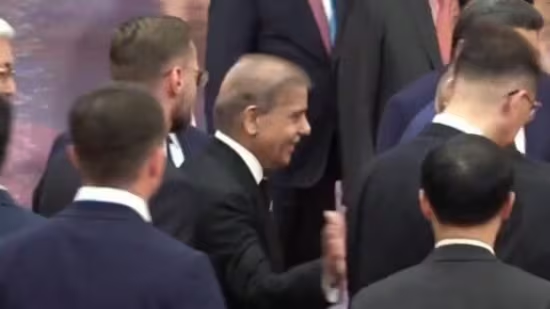
The 25th Shanghai Cooperation Organisation (SCO) Summit in Tianjin brought together leaders from ten member nations, including India’s Prime Minister Narendra Modi, Russian President Vladimir Putin, and Chinese President Xi Jinping. While the summit was intended to focus on regional security, terrorism, and multilateral cooperation, it unexpectedly became a stage for viral online trolling targeting Pakistan’s Prime Minister Shehbaz Sharif. A short video clip from the event showing Shehbaz Sharif appearing to rush towards President Putin for a handshake triggered widespread social media reactions, drawing attention to what many netizens called an awkward and desperate attempt for recognition. The incident overshadowed diplomatic discussions, highlighting how a seemingly minor gesture at a high-profile summit can attract intense scrutiny in the age of digital media.
The Viral Handshake Incident and Online Reactions
In the widely shared video, Vladimir Putin and Xi Jinping are seen walking together following a photo opportunity, while Shehbaz Sharif approaches from behind and hurriedly extends his hand to shake President Putin. The timing and manner of Shehbaz Sharif’s approach drew immediate attention, with many observers interpreting it as an urgent or overly eager attempt to gain acknowledgment from the more influential leaders. Social media users quickly seized upon the clip, mocking the Pakistani leader for what they described as “desperate” behavior.
Netizens highlighted the contrast between Shehbaz Sharif and other leaders, emphasizing the composure displayed by figures such as Modi, Putin, and Xi Jinping. One user on X (formerly Twitter) wrote that while other leaders demonstrated poise, Shehbaz Sharif’s hurried attempt reflected attention-seeking behavior. The clip also revealed that Xi Jinping noticed Shehbaz Sharif’s approach and appeared to turn away, which social media commentators interpreted as a subtle display of diplomatic indifference. Many users framed the moment as symbolic of Pakistan’s perceived lack of influence within the forum, with some using harsh descriptors like “beggar” and “embarrassment” to describe Sharif’s conduct.
The online reactions highlighted the intersection of diplomacy, public perception, and social media culture. In the modern era, even small gestures during high-stakes international events can become subject to intense scrutiny, shaping global perceptions of leaders and their countries. The widespread sharing of the video clip and the accompanying commentary underscored how visual narratives can rapidly overshadow the substantive discussions of a summit. Some users even speculated that the gesture indicated broader geopolitical dynamics, interpreting Xi Jinping’s apparent avoidance as a sign of subtle disapproval or a reminder of Pakistan’s marginalized position in the SCO.
SCO Summit Context and PM Modi’s Address
Amid the viral backlash against Shehbaz Sharif, the 25th SCO Summit continued its core agenda focused on security challenges, regional cooperation, and combating terrorism. Prime Minister Narendra Modi delivered a speech emphasizing the importance of multilateral collaboration in addressing the global threat of terrorism. Prime Minister Narendra Modi highlighted that terrorism remains a challenge not only for individual nations but for humanity as a whole. He criticized the practice of double standards in counter-terrorism efforts, stressing that selective condemnation of terrorism undermines trust among nations and global cooperation.
The summit, established in 2001, brings together Eurasian leaders to promote regional stability and strategic partnerships. While discussions spanned critical issues such as counterterrorism strategies, trade cooperation, and infrastructural development, the media spotlight shifted temporarily to the personal interactions among leaders, largely due to the viral clip of Shehbaz Sharif. Despite the trolling, Shehbaz Sharif’s presence underscored Pakistan’s continued engagement in regional dialogues and its attempt to maintain diplomatic ties with major powers such as Russia and China.
Prime Minister Modi’s remarks provided a contrasting narrative to the social media attention on Shehbaz Sharif. By focusing on principled and structured diplomacy, Prime Minister Narendra Modi projected India as a stable and influential actor within the SCO framework. The emphasis on regional cooperation, connectivity, and security reinforced India’s leadership role while diverting attention from individual missteps by other leaders. The summit’s agenda highlighted that while personal gestures may capture public attention online, substantive policy discussions regarding regional stability, economic collaboration, and counterterrorism efforts remain the primary focus of international diplomacy.
The incident involving Shehbaz Sharif also illustrated broader themes of perception management in global forums. Leaders’ gestures, body language, and interactions are constantly analyzed and interpreted by both diplomatic peers and the global audience. In a world increasingly mediated by social media, minor moments can quickly take on outsized significance, affecting the image of national leadership and diplomatic credibility. The viral clip of Shehbaz Sharif serves as a case study in how digital media amplifies personal behavior and influences public narratives about high-level diplomatic interactions.
The SCO Summit’s blend of formal discussions and informal interactions demonstrates the delicate balance leaders must maintain between protocol, diplomacy, and public perception. While Shehbaz Sharif’s handshake attempt attracted significant online attention, the broader summit continued to address strategic issues central to Eurasian security and cooperation. Observers noted that moments like these, though seemingly trivial, reflect the pressures faced by smaller nations to assert themselves within multilateral forums dominated by more influential powers.
The social media reactions also highlighted cultural and geopolitical biases, with commentators often exaggerating or interpreting minor gestures in ways that align with preexisting narratives. In the case of Shehbaz Sharif, interpretations ranged from amusement to criticism, framing the Pakistani PM as seeking attention and approval from more prominent leaders. This demonstrates how digital platforms shape international discourse, influencing public perceptions of diplomatic efficacy and national stature.
Meanwhile, the formal sessions at the SCO Summit continued, focusing on collaboration across member states. Leaders discussed initiatives aimed at strengthening regional security frameworks, countering terrorism, enhancing economic ties, and promoting infrastructural connectivity. Such measures aim to foster trust, collaboration, and stability among member nations, reinforcing the significance of the SCO as a platform for dialogue and cooperation beyond individual personalities or viral moments.
The handshake incident also highlighted the human aspect of diplomacy, where gestures, timing, and interpersonal interactions carry symbolic weight. While leaders often engage in coordinated protocols, spontaneous actions can generate interpretations ranging from strategic intent to perceived awkwardness. The global audience, mediated through social media, has the power to amplify these interpretations, shaping reputational narratives that can overshadow substantive policy achievements.
In addition to the viral attention, the SCO Summit facilitated bilateral discussions among member nations, emphasizing the importance of maintaining diplomatic channels and strategic partnerships. The presence of leaders like Narendra Modi, Vladimir Putin, Xi Jinping, and Shehbaz Sharif enabled dialogues on issues ranging from security and counterterrorism to economic cooperation and energy security. These discussions underscored the value of multilateral forums in addressing complex regional challenges, demonstrating that while individual gestures may attract temporary attention, the outcomes of policy deliberations have long-term implications for member states.
Through the incident and its widespread coverage, the SCO Summit illustrated the interplay between formal diplomacy and public perception in the digital age. Leaders’ actions, whether intentional or spontaneous, are scrutinized by global audiences, with social media acting as both an amplifier and a lens through which diplomatic narratives are interpreted. The case of Shehbaz Sharif highlights how personal gestures can intersect with broader political and cultural narratives, influencing the perception of leadership, national stature, and diplomatic efficacy.
The SCO Summit continued to advance discussions on security, terrorism, and regional collaboration while the social media discourse surrounding Shehbaz Sharif unfolded in parallel. Analysts noted that while the viral clip captured public attention, it did not detract from the substantive diplomatic work carried out at the summit. The juxtaposition of viral moments and formal negotiations underscores the dual challenges faced by leaders in navigating both media perception and strategic diplomacy.
Ultimately, the incident serves as a reflection of the pressures leaders face to assert visibility and influence in high-profile forums. It also demonstrates the power of social media in shaping narratives, amplifying minor gestures, and influencing perceptions of national leadership. For Pakistan, the viral handshake clip became a symbol of the delicate balancing act required to maintain diplomatic engagement while managing international image.
The SCO Summit, with its focus on multilateral cooperation and regional stability, continued to provide a platform for leaders to discuss critical issues affecting Eurasia. While the social media reactions to Shehbaz Sharif’s handshake dominated online discourse temporarily, the summit’s broader agenda emphasized long-term strategic goals, regional security frameworks, and collaborative initiatives among member states. The incident ultimately reflects the intersection of diplomacy, media, and public perception in contemporary global politics.