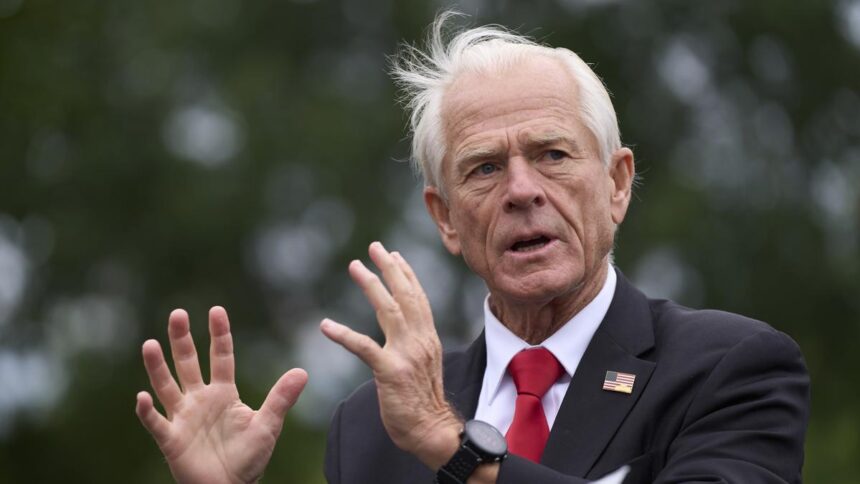
White House trade advisor Peter Navarro has once again targeted India, linking the country’s purchase of Russian oil to what he describes as profiteering at the expense of ordinary Indians. In recent statements, Peter Navarro framed India as a “laundromat for the Kremlin” and a “Maharaja of tariffs,” criticizing New Delhi for benefiting financially from Russian crude while simultaneously imposing high trade barriers on the United States. Speaking to U.S. media outlets, he claimed that India’s engagement with Russian and Chinese leadership contradicts its position as the world’s largest democracy and feeds the ongoing Ukraine conflict. Peter Navarro’s remarks come amid heightened tensions over U.S. tariffs, which have doubled to 50 percent on Indian exports, in an effort to pressure India over its energy trade with Russia.
Peter Navarro’s Critique of India’s Energy Strategy and Trade Policies
Peter Navarro’s latest comments reflect long-standing frustrations in Washington over India’s strategic choices in sourcing energy and conducting trade with Russia and China. According to him, India did not purchase significant volumes of Russian oil before the February 2022 invasion of Ukraine. He argued that after the invasion, Russian refiners formed commercial arrangements with Indian oil companies, providing discounted crude to India, which was then refined and exported at a premium to European, African, and Asian markets. This, Peter Navarro claimed, created substantial profits for Indian firms while indirectly supporting Russia’s military operations in Ukraine.
The trade advisor did not limit his criticism to energy alone. He characterized India as a “Maharaja of tariffs,” highlighting the country’s high import duties and trade barriers that, according to him, harm U.S. exporters and workers. Peter Navarro suggested that American taxpayers and consumers ultimately bear the cost of these policies while India profits from its strategic positioning. In interviews with U.S. media, he repeatedly stressed that India’s trade practices, combined with its oil purchases, fuel the Russian war effort and exacerbate the suffering of Ukrainian civilians. Peter Navarro framed this combination of high tariffs, selective trade policies, and profitable Russian oil imports as ethically and strategically problematic, raising questions about India’s international responsibilities.
Peter Navarro also brought cultural references into his argument, controversially accusing Indian Brahmins of benefiting at the expense of the broader population. He framed the discussion as not only a geopolitical or economic issue but a moral one, urging the Indian public to scrutinize government decisions and question who truly benefits from these arrangements. According to Peter Navarro, while Prime Minister Narendra Modi is a “great leader,” the decision to continue trade and energy engagements with Russia and China undermines India’s democratic and global standing. By calling India a “laundromat for the Kremlin,” Peter Navarro reiterated a phrase he has used in prior criticisms, emphasizing his perception that the country is enabling Russian financial and strategic goals through its commercial choices.
India’s Defense and Strategic Perspective on Russian Oil Purchases
India has consistently defended its energy strategy, framing it as a pragmatic and security-driven response to global market conditions. Indian officials have emphasized that purchases of Russian crude are guided by market offerings, pricing, and national strategic imperatives rather than political alignment with Moscow. The Ministry of External Affairs has highlighted that India’s decisions in the aftermath of the Ukraine crisis were aligned with global energy stability, and Washington itself initially encouraged Indian imports to help stabilize energy markets disrupted by the conflict.
India has further noted that trade engagement with Russia is not an isolated case but part of broader global patterns, including continuing trade relations between Russia, the United States, and the European Union. For instance, European countries continue to import Russian energy and goods, and the United States maintains imports from Russia for its civil nuclear industry. From New Delhi’s perspective, energy sourcing decisions are therefore consistent with global practices and necessary for ensuring national energy security.
Officials have underscored that India’s purchases are structured to meet domestic energy requirements efficiently and cost-effectively, reducing dependency on volatile markets while safeguarding economic growth. The Indian government maintains that these measures do not contravene international norms but instead reflect an independent policy based on strategic necessity. In addition, Indian authorities argue that their approach to sourcing and refining Russian oil involves carefully regulated commercial arrangements that provide benefits to domestic industries, support energy security, and facilitate regional trade networks across Asia, Europe, and Africa.
While Peter Navarro portrays the Indian government’s actions as fueling the Russian war machine, New Delhi contends that energy imports are driven by economic rationale and national interest. Officials point out that the global context includes complex supply chains, international contracts, and longstanding energy dependencies that cannot be easily disentangled from geopolitics. India frames its strategy as balanced, ensuring energy security while maintaining diplomatic flexibility and avoiding alignment that would compromise its independent foreign policy.
The Broader Implications of Peter Navarro’s Remarks
Peter Navarro’s statements come at a sensitive juncture in U.S.-India trade relations, as American tariffs on Indian goods have surged to unprecedented levels. His remarks amplify political and economic pressures on India while framing the country’s energy purchases in moral and geopolitical terms. By highlighting alleged profiteering and linking trade practices to the Ukraine conflict, Navarro seeks to build a narrative justifying U.S. tariffs and broader economic penalties.
These criticisms also raise questions about the intersection of global diplomacy, trade policy, and energy security. Peter Navarro’s approach reflects a perspective that energy procurement cannot be separated from geopolitical consequences, arguing that national policies have wider implications for conflict zones and global security. From this standpoint, he sees India’s energy choices not merely as economic decisions but as actions with significant consequences for international stability and humanitarian outcomes.
Meanwhile, India’s position emphasizes sovereignty, strategic calculation, and pragmatism. New Delhi maintains that decisions on energy sourcing and trade relations must prioritize national security and economic stability over external pressure. The ongoing dialogue with the United States, while contentious, reflects India’s effort to balance these imperatives against diplomatic and economic expectations from a major trade partner.
Peter Navarro’s repeated use of charged terms such as “laundromat,” “Maharaja of tariffs,” and the allegations of profiteering underscore the intensity of U.S. criticism. However, India’s structured defense highlights that these claims often overlook the complexities of global trade, energy markets, and multilateral diplomatic considerations. New Delhi presents a calculated, rules-based approach that seeks to reconcile domestic needs with international obligations, demonstrating a consistent policy trajectory that addresses both energy and trade security concerns.
At the same time, Peter Navarro’s rhetoric illustrates broader tensions in U.S.-India relations, where economic measures intersect with perceptions of moral responsibility and strategic alignment. His statements are part of a wider discourse linking trade, energy policy, and global security frameworks, suggesting that commercial actions are inseparable from geopolitical ramifications.
For India, the challenge lies in navigating these criticisms while maintaining its strategic autonomy. By emphasizing transparency, market-driven decision-making, and alignment with national interest, India aims to counter narratives that frame its actions as politically motivated or detrimental to international peace. This balancing act involves addressing U.S. concerns about tariffs and trade access while reinforcing the rationale for energy policies driven by security imperatives and long-term economic strategy.