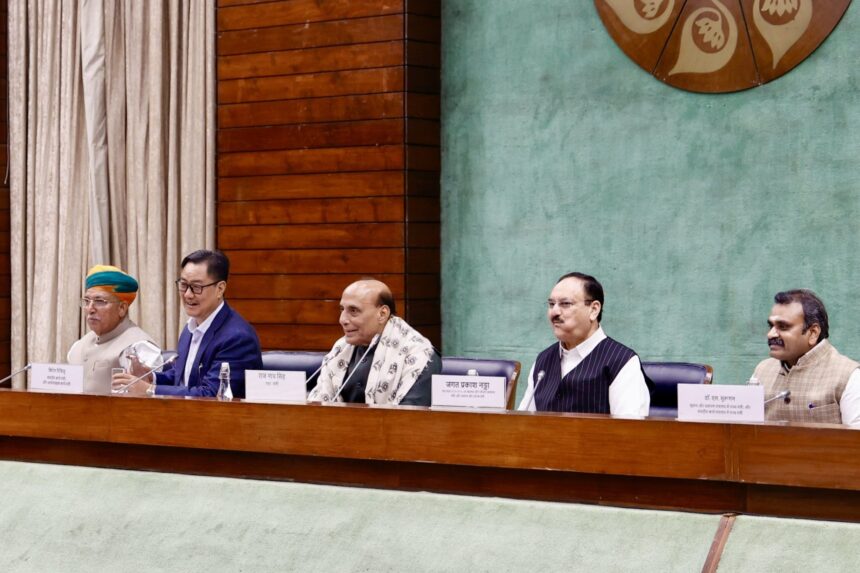
The government convened an all-party meeting at the Parliament House Annexe on the eve of the Winter Session, bringing together leaders from across the political spectrum to discuss the agenda and ensure smooth coordination for the upcoming proceedings. Chaired by Defence Minister Rajnath Singh, the meeting served as a platform for political parties to present their views, outline priorities and extend cooperation in advance of a busy parliamentary session beginning tomorrow.
Government seeks unity and cooperation as 36 parties participate in pre-session dialogue
The all-party meeting, attended by 50 leaders representing 36 political parties, underscored both the diversity of the Indian political landscape and the government’s expectation of a cooperative Winter Session. Defence Minister Rajnath Singh opened the meeting by emphasising the importance of constructive engagement and consensus-building in Parliament. The gathering aimed to address likely legislative challenges, anticipate issues that may galvanise debate and reassure parties that the government is open to discussion on matters of national importance.
Parliamentary Affairs Minister Kiren Rijiju, speaking after the meeting, noted that the discussions took place in a “positive atmosphere,” with leaders from both the ruling coalition and the opposition expressing a willingness to facilitate smooth functioning of both Houses. He added that the government has appealed to floor leaders for cooperation throughout the session, stressing that parliamentary productivity relies heavily on mutual respect despite ideological differences.
Rijiju informed the media that the government has tentatively listed 14 items of legislative and other business for the Winter Session. While he did not detail each item, he clarified that the government is prepared to take up any additional important issues raised by members, provided they align with parliamentary rules and procedures. This assurance was aimed at easing concerns among opposition parties, many of whom intend to raise questions on economic policies, federal issues, social justice, national security and administrative reforms.
Leaders from various political parties took turns expressing their perspectives on the issues they were likely to raise during the Winter Session. Several opposition figures emphasised that even though the government holds a majority in Parliament, it is essential that voices from all parties be heard and accounted for in shaping national policy. Many leaders highlighted matters they believe require immediate attention, including governance concerns, economic pressures, regional development priorities and matters relating to public welfare.
The meeting was attended by senior parliamentary leaders including J. P. Nadda, leader of the House in the Rajya Sabha; Parliamentary Affairs Minister Kiren Rijiju; Ministers of State for Parliamentary Affairs Arjun Ram Meghwal and Dr. L. Murugan. From the opposition side, several prominent leaders took part, including Congress leader Gourav Gogoi, DMK’s Tiruchi Shiva, TMC’s Derek O’Brien, Samajwadi Party leader Ram Gopal Yadav, JD(U) leader Sanjay Jha, TDP’s Lavu Shrikrishna Devarayalu and Shiv Sena’s Naresh Mhaske.
The presence of a broad spectrum of political parties—representing national, regional and ideological diversity—helped ensure that the pre-session dialogue reflected the multifaceted concerns present across India’s political environment. Discussions reportedly revolved around issues that are expected to dominate parliamentary proceedings, including pressing social matters, economic debates and key legislative proposals.
Winter Session to begin with 15 sittings over 19 days as political expectations rise
The Winter Session of Parliament will begin tomorrow and continue until December 19, offering a total of 15 sittings spread across 19 days. As one of the shorter yet significant sessions of the year, it is expected to handle a blend of legislative bills, financial discussions and policy debates. Though concise in duration, such sessions often set the tone for the government’s legislative priorities for the year ahead and provide the opposition with an arena to question, challenge and highlight issues of national importance.
In recent years, Winter Sessions have witnessed intense political exchanges, and this year appears likely to be no different. With several crucial bills expected to be brought forward, floor debates may become arenas for discussing broader themes such as national security, economic growth, social equity and administrative reforms. The government’s assurance that it is ready to debate additional important matters has raised expectations among parties that the session may include unplanned but necessary discussions.
The opposition, despite participating in the all-party meeting in a cooperative spirit, is expected to raise multiple concerns once the session begins. Several leaders have hinted that they will insist on discussions around governance issues, inflationary pressures, unemployment trends, federal challenges faced by state governments and policy decisions impacting welfare schemes. Parliamentary debates in the Winter Session often gain national attention, and parties aim to use the platform to sharpen their public messaging.
Inside Parliament, the government’s primary focus will be on ensuring that legislative business proceeds without disruptions. The tentative list of 14 items may include bills related to administrative updates, sector-specific reforms, financial management and other matters of public policy. The government may also present statements on urgent national issues, depending on developments during the course of the session.
Outside the House, the session is also likely to witness political mobilisation, with various parties planning demonstrations, press briefings and coordinated campaigns to highlight their positions on key matters. Given the growing importance of parliamentary sessions in public discourse, both the ruling coalition and the opposition view the Winter Session as a critical opportunity to consolidate their political messaging.
Security arrangements around Parliament have been strengthened due to the expected influx of leaders, delegations, and public attention. The start of the session often attracts scrutiny from civil society groups, activists, and analysts, all keen to observe how Parliament navigates pressing national challenges.
The productive tone of the all-party meeting has been welcomed by political observers. While cooperation was pledged by many parties, the real test will come once debates begin in the Lok Sabha and Rajya Sabha. The government, armed with a substantial majority, seeks to deliver legislative progress, while the opposition aims to push for accountability and transparent debate.
With the session set to begin, political momentum is building. The interplay between legislative business and political contention will determine how impactful this Winter Session becomes in shaping the country’s direction at the close of the year.