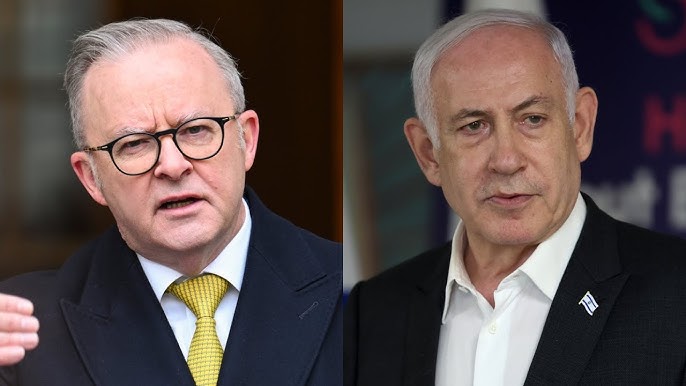
Australia’s recent announcement to recognize a Palestinian state has intensified diplomatic tensions as Prime Minister Anthony Albanese openly criticized Israeli Prime Minister Benjamin Netanyahu’s handling of the humanitarian crisis in Gaza. Albanese accused Benjamin Netanyahu of being “in denial” about the devastating impact of Israel’s military operations on innocent civilians. This development comes alongside growing international calls, including from French President Emmanuel Macron, for a peaceful resolution to the conflict and reflects a shift in Australia’s Middle East policy amid escalating violence.
Anthony Albanese’s Criticism of Benjamin Netanyahu and Australia’s Recognition of Palestine
Prime Minister Anthony Albanese’s candid criticism of Israeli Prime Minister Benjamin Netanyahu marks a significant moment in Australia’s foreign policy discourse. Following a phone conversation with Benjamin Netanyahu, Anthony Albanese publicly stated that the Israeli leader was unwilling to acknowledge the humanitarian consequences of the ongoing military campaign in Gaza. This accusation highlights growing frustration within the Australian government over Israel’s approach in the besieged territory, where intense conflict has resulted in massive civilian suffering.
Anthony Albanese emphasized that Australia’s decision to recognize Palestinian statehood, to be formalized at the upcoming United Nations General Assembly, was grounded in certain preconditions agreed upon with the Palestinian Authority. One of the key requirements is that Hamas—a group designated as a terrorist organization by Australia and several other countries—would have no role in any future Palestinian government. Anthony Albanese asserted that the international community, including Arab states and Palestinian leadership, could prevent Hamas from participating in elections, underscoring the necessity of unified diplomatic pressure to ensure peace and stability.
Despite repeated media inquiries, Anthony Albanese and Foreign Minister Penny Wong refrained from specifying what actions Australia might take if these conditions are unmet, leaving some ambiguity around potential diplomatic consequences. Nonetheless, Wong stressed that Australia would work with global partners to hold the Palestinian Authority accountable to its commitments.
Anthony Albanese further voiced his concerns about the ongoing violence, particularly Israel’s planned military occupation of Gaza City, warning that such hostilities “cannot continue into the future without an end point.” He called for the international community to focus on securing a permanent resolution that ensures lasting security and peace for the region’s people.
International and Domestic Responses to Australia’s Policy Shift
The Australian government’s move has garnered mixed reactions both at home and internationally. French President Emmanuel Macron expressed support, describing Australia’s recognition of Palestine as part of a global momentum toward resolving the Gaza crisis and reaffirming commitment to the two-state solution. Macron emphasized the importance of rebuilding political pathways for peace and security for all parties involved.
However, the decision has sparked strong criticism from Israel and Australia’s political opposition. Israel’s government condemned the recognition, accusing the Labor government of rewarding Hamas amid ongoing hostage situations and violence. Sharren Haskel, Israel’s deputy foreign minister, dismissed the move as politically motivated and disconnected from the realities on the ground, highlighting that dozens of hostages remain in Hamas captivity under dire conditions.
Domestically, the Coalition opposition labeled the decision as misguided, warning it would embolden Hamas rather than contribute to peace. Opposition leader Sussan Ley declared that a future Coalition government would revoke Palestinian recognition, raising questions about how such a reversal would be implemented years after formal recognition. Critics also questioned the government’s silence on how the recognition aligns with broader Middle East peace efforts and Australia’s diplomatic interests.
Former Prime Minister Scott Morrison echoed concerns, suggesting that Jewish Australians might feel betrayed by the policy shift. He cautioned that recognition alone would not alleviate suffering in Gaza or help secure the release of hostages, framing the move as largely symbolic.
Meanwhile, Anthony Albanese’s government defended its position as a step toward balanced diplomacy aimed at advancing peace and security. By setting clear conditions for recognition, the government seeks to support a Palestinian state that rejects terrorism and engages constructively in the peace process.
Australia’s recognition of Palestine amid the ongoing Gaza crisis represents a bold recalibration of its foreign policy, balancing humanitarian concerns with geopolitical complexities. The dialogue between Anthony Albanese and Benjamin Netanyahu, coupled with international reactions and domestic political debate, underscores the challenges of navigating this sensitive issue. As the world watches closely, the effectiveness of Australia’s approach in promoting peace, security, and stability in the Middle East remains to be seen.