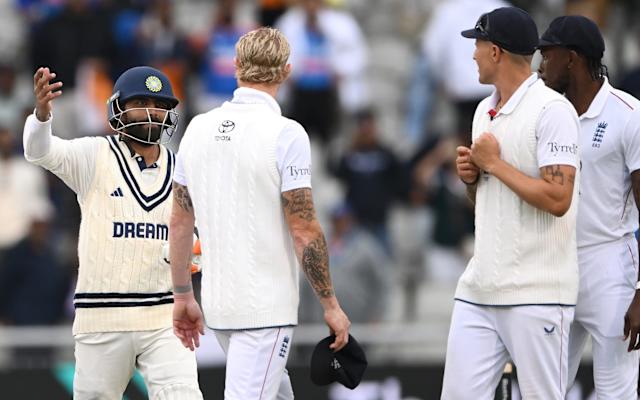
Tensions flared during the closing moments of the fourth Test between India and England in Manchester, as a verbal exchange between England batters and Indian all-rounders Ravindra Jadeja and Washington Sundar sparked fresh controversy. What seemed like a routine draw at the end of a hard-fought Test took an unexpected turn when England’s Zak Crawley and Ben Duckett directed pointed comments at the Indian duo for continuing their innings, despite the match heading toward a stalemate. The incident has now caught the attention of Australian cricket circles, with former wicketkeeper Brad Haddin issuing a warning ahead of the upcoming Ashes series.
Australia’s former vice-captain Brad Haddin did not hold back in criticizing England’s behavior in the dying stages of the match. He condemned the unsporting remarks made by Crawley and Duckett and suggested that Australia would be watching closely when it comes to how these English batters handle pressure. According to Haddin, the sledging came after England realized that they couldn’t win the Test, which triggered their frustration.
Frustration Turns Verbal in Final Moments
The match, which had seen India battling valiantly to save the game, was nearing its final half-hour. At that moment, with Indian batters well into their 90s and 80s respectively, England captain Ben Stokes approached the umpires and suggested calling it a draw. When asked for his opinion, Jadeja, still eyeing a personal milestone, declined to agree immediately. This decision seemed to irritate England’s fielders.
Crawley was the first to approach Jadeja, sarcastically asking, “Is it your decision?” Jadeja replied playfully, “No, no, no!” But the tension rose when Crawley threatened to bowl bouncers if the Indians chose to keep batting. Jadeja, unfazed, laughed it off with a sharp retort: “But you’ve been doing that all day!”
Duckett then joined in, asking Jadeja if he needed “an hour” to complete his hundred. He later pointed to Sundar and insinuated that the two batters were extending the game just to reach their centuries. This subtle but sharp commentary visibly added a layer of animosity in what had otherwise been a competitive but civil Test.
India’s Right to Bat On and Australia’s Take
For Haddin, the whole episode revealed more about England’s mindset than India’s decisions. He praised the Indian team for refusing to bow down to pressure and instead continuing to pursue personal and team goals. Haddin argued that India had every right to be on the field and go for centuries after enduring pressure throughout the Test.
The Australian ex-cricketer went on to accuse England of trying to control the narrative and only promoting sportsmanship when results were in their favor. “Just because it didn’t go their way, England weren’t happy,” Haddin said, asserting that India earned the right to stay on the pitch.
Interestingly, Haddin wasn’t entirely critical of Stokes’ decision to hand the ball to part-timer Harry Brook in the final overs. Given the close scheduling of the next Test at the Oval, Haddin felt Stokes’ choice to save his frontline bowlers was a pragmatic one. However, what bothered him was the reactive behavior from England’s players and the pressure they tried to apply through words, rather than cricketing skill.
Haddin’s remarks carry extra weight as Australia prepares to face England in the upcoming Ashes. He stated that Australian players would certainly take note of how Crawley and Duckett behave under stress and may target them in pressure situations. The Aussies are known for their aggressive and psychological style of cricket, and this sledging incident could set the tone for the high-octane Ashes battles ahead.
This wasn’t just about cricketing decisions or tactics—it was about pride, personal milestones, and handling the heat of high-level competition. The Indian team’s resistance and their batters’ poise were commended, while England’s attempts to rush the conclusion came off as petulant to many observers.
What unfolded in Manchester was a microcosm of modern Test cricket, where sportsmanship, strategy, and ego intersect in unpredictable ways. With the Ashes looming, Australia now has more than just statistical analysis to pore over—they’ve also gotten a glimpse of England’s temperament when the tide turns against them.