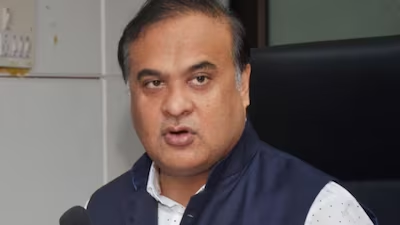
In a landmark move aimed at social and economic reform, the Assam government has approved a series of key policy decisions, including a complete ban on polygamy with certain legal exemptions. Chief Minister Himanta Biswa Sarma announced that the bill, titled The Assam Prohibition of Polygamy Bill, 2025, will be introduced in the state assembly on November 25. Alongside this major legislative decision, the cabinet also cleared projects for a state-of-the-art judicial township in Guwahati and approved the Assam Startup and Innovation Policy 2025–30, positioning the state as a future hub for entrepreneurship and innovation.
Polygamy Ban: A Step Towards Social Reform and Gender Justice
Addressing a press conference following the cabinet meeting, Chief Minister Himanta Biswa Sarma declared that the government had formally resolved to prohibit polygamy in the state. The new legislation, The Assam Prohibition of Polygamy Bill, 2025, seeks to outlaw the practice of having multiple spouses simultaneously, with a few narrowly defined exceptions. Sarma stated that the bill is part of the government’s broader vision to uphold women’s rights, promote gender equality, and ensure legal uniformity in marital practices across the state.
Under the proposed legislation, individuals will not be permitted to marry again if they already have a living spouse, unless they have been legally separated through a divorce decree. Any person found violating this provision would be subject to up to seven years of rigorous imprisonment. The Chief Minister emphasized that this provision is designed not merely as a punitive measure but as a means to deter social practices that have historically caused suffering to women.
Sarma elaborated that the legislation also includes provisions for compensating women affected by polygamous marriages. A dedicated fund will be established by the government to provide financial support to such victims, ensuring that they do not face economic or social hardship after the dissolution of an unlawful marriage. “The Assam Prohibition of Polygamy Bill, 2025, further seeks to provide compensation to the victim women as they have to suffer immense pain and hardship due to polygamous marriage,” Sarma said.
He added that the government aims to protect the moral and social fabric of society through this bill. “To save the society from the scourge of such practices, this Bill has been framed with the avowed objective to streamline the society,” he said. The legislation is expected to bring greater clarity and consistency in the state’s marital laws and ensure protection for women who have long endured emotional and financial trauma in polygamous households.
The Assam government’s decision to ban polygamy is seen as a major step in enforcing the spirit of equality enshrined in the Indian Constitution. While the bill allows limited exemptions under specific customary and legal conditions, it underscores the government’s commitment to eradicating practices that contradict the principles of modern social justice.
This move follows the state’s ongoing efforts to align personal laws with constitutional values, a policy direction that the Chief Minister has consistently championed in recent years. The decision is likely to spark significant debate in the legislative assembly, but it also signals the government’s intent to pursue bold legal reforms with far-reaching social implications.
Infrastructure and Innovation: Assam’s Vision for Judicial and Economic Modernization
In addition to the polygamy bill, the Assam cabinet also granted administrative approval for several major development projects, reflecting the state’s dual focus on governance and growth. Among the most notable is the State-of-the-Art Judicial Township Project at Rangmahal, North Guwahati, which has been approved with an estimated budget of ₹478.78 crore.
Chief Minister Sarma explained that the first phase of the project, titled High Court Complex Development (Phase I), is designed to establish a comprehensive judicial campus that will serve as the apex legal hub for the entire region. The new High Court Complex will consist of interconnected buildings linked through bridges, ensuring ease of access and modern functionality. Key facilities planned include a High Court Building with a ground-plus-four structure, a High Court Bar Building with six floors, and a High Court Office Building with six floors as well.
The Chief Minister highlighted that this project will not only modernize the judicial infrastructure but also improve accessibility and efficiency within the state’s legal system. Once completed, it will mark a significant step toward making Guwahati a major administrative and judicial center in Northeast India.
In another major policy development, the cabinet approved the Assam Startup and Innovation Policy 2025–30, a forward-looking framework designed to transform Assam into one of India’s leading entrepreneurship and innovation hubs over the next five years. With a total financial outlay of ₹397 crore, the policy aims to encourage the growth of startups across sectors such as technology, manufacturing, agribusiness, and sustainability.
The policy outlines a range of funding mechanisms to support budding entrepreneurs and innovators at various stages of development. It includes an Ideation Grant of up to ₹10 lakh to help innovators validate their concepts or develop proof-of-concept models. For prototype development, general and technology-based startups can avail of grants up to ₹20 lakh, while deep-tech ventures — focusing on advanced technological solutions — will be eligible for grants up to ₹40 lakh.
Furthermore, the policy introduces the Assam Startup Seed Fund, an equity-based investment model under which startups can receive up to ₹50 lakh in funding. The government will retain a maximum 4% equity stake in each supported startup. This structure aims to not only provide financial assistance but also create long-term partnerships that enable sustained innovation and growth.
Beyond funding, the policy emphasizes capacity building, mentorship, and collaboration between academia, industry, and government institutions. The objective is to create a thriving entrepreneurial ecosystem where new ideas can grow into scalable enterprises, thereby contributing to employment generation and economic resilience in the state.
Sarma also announced that the state cabinet has approved the implementation date for promotions under the Career Advancement Scheme (CAS) for Assistant Professors and Librarians serving in Autonomous Colleges, Provincialised Colleges, and Government Degree Colleges across Assam. This move is expected to enhance morale and career progression opportunities for educators and academic professionals in the state’s higher education sector.
The combined effect of these initiatives — social reform through the prohibition of polygamy, judicial modernization through infrastructural investment, and economic empowerment through startup policy — reflects the Assam government’s multidimensional approach to governance. Each policy complements the other, together building a framework for a socially progressive, economically dynamic, and administratively efficient state.
By addressing both societal challenges and developmental priorities, the Himanta Biswa Sarma-led government is positioning Assam as a model of balanced progress — one that upholds tradition while embracing modernity, protects individual rights while promoting collective growth, and nurtures innovation as the foundation for a stronger future.