In a major counter-terror breakthrough, Jammu and Kashmir Police, in coordination with Haryana Police, dismantled a sophisticated terror network linked to Jaish-e-Mohammed (JeM) after uncovering a huge cache of explosives and weapons in Faridabad, near Delhi. Authorities seized around 350 kilograms of explosives, two assault rifles, and other bomb-making materials, exposing an organized terror conspiracy stretching from Kashmir to northern India. The joint operation, which lasted nearly fifteen days, revealed the involvement of professionals, including doctors and an imam, in facilitating the group’s expansion through encrypted communication, secret funding networks, and technical assistance. With seven individuals already in custody, this case has raised grave concerns among national security agencies over the infiltration of radical elements into India’s professional and academic spaces.
Massive Seizure of Explosives and Weapons in Faridabad
The Faridabad operation was launched based on information gathered during the interrogation of suspects arrested earlier in Jammu and Kashmir. Acting swiftly on these leads, security forces raided a location in Faridabad and recovered 350 kilograms of explosives, two assault rifles, three magazines, eight live cartridges, timers, and an array of bomb-making components. According to Police Commissioner Satyendra Kumar Gupta, the seized substance was ammonium nitrate rather than RDX, as initially reported. In addition, 20 timers, remote controls, electric circuits, batteries, metal plates, and wires were confiscated, bringing the total recovered material to approximately 2,900 kilograms of explosive and IED-making components.
The investigation led to the arrest of several individuals with professional and religious affiliations. Among them was Dr. Muzammil Ahmad Gani alias Musaib, a resident of Pulwama’s Koil area and a former university teacher. His interrogation revealed extensive details about the JeM-linked network, which had established connections from Jammu and Kashmir to Haryana, using digital and encrypted channels to coordinate activities. Authorities suspect that the network used academic and professional systems to launder funds and recruit sympathizers, making it difficult to trace the origin of the money.
The arrested individuals have been identified as Arif Nisar Dar alias Sahil, Yasir-ul-Ashraf, and Maqsood Ahmad Dar alias Shahid, all residents of Nowgam in Srinagar. The other four suspects include Maulvi Irfan Ahmad, an imam from Shopian; Jameer Ahmad Ahangar alias Mutlasha from Wakura, Ganderbal; Dr. Muzammil Ahmad Gani from Pulwama; and Dr. Adil Ahmad Rather from Kulgam. The discovery of educated professionals in this network has deeply alarmed law enforcement and intelligence agencies, who now believe terrorist organizations are strategically targeting skilled individuals to strengthen their capabilities and evade detection.
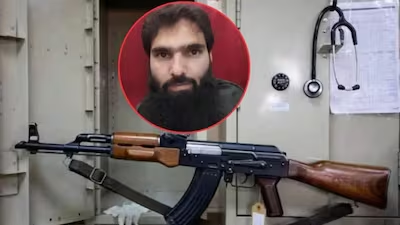
The arrest of Dr. Adil Ahmad Rather, a senior resident doctor at Government Medical College (GMC), Anantnag, proved to be a turning point in the investigation. An AK-47 rifle was discovered in his locker, leading to an expanded probe that extended beyond Jammu and Kashmir into Haryana and Uttar Pradesh. The case first came to light on October 27 when posters supporting the banned Jaish-e-Mohammed group appeared in public spaces in Srinagar. CCTV footage later revealed Dr. Adil pasting the posters himself. On November 6, he was arrested from a hospital in Saharanpur, Uttar Pradesh, where he worked as a medicine specialist. His arrest triggered a series of revelations, uncovering the broader web of radicalized professionals operating across states.
Further interrogations of Dr. Muzammil and other detained suspects led authorities to another key figure, Dr. Mufazil Shakeel, who was residing in a rented flat in Faridabad. When police raided the premises, they recovered another AK-47 rifle and approximately 300 kilograms of explosives. Dr. Shakeel, however, managed to flee and remains absconding. Investigators believe he played a critical role in financing the network and managing the logistics of weapons and materials.
Preliminary reports suggest the group was planning a large-scale terror attack, though investigators are still determining the exact target. The vast quantity of explosives and sophisticated weapons recovered indicates that the network was preparing for a destructive and coordinated strike. Cyber forensics teams are analyzing digital devices seized during the raids to identify communication links, financial transactions, and possible foreign connections.
Expanding Terror Network and Nationwide Investigation
As the investigation progressed, it became clear that the busted cell was part of a much wider network of ideological and logistical supporters spanning multiple Indian states. What startled authorities most was the involvement of educated and professional individuals who allegedly offered technical, medical, and financial support to extremist groups. Intelligence agencies believe these individuals were influenced through online radicalization and ideological indoctrination before being recruited to perform specialized tasks such as fund management, communication security, and medical assistance for operatives.
Police have uncovered several digital trails linked to this network, including encrypted chats, crypto wallet transactions, and suspicious international transfers. The funding, according to early analysis, was being routed through academic institutions and professional circles under the guise of legitimate exchanges. Forensic experts are now verifying whether foreign contributions were involved in sustaining the cell’s operations. Central intelligence agencies have also joined the probe to explore the possibility of cross-border arms smuggling and foreign coordination.
Among the seized weapons are AK-47, AK-56, and AK Krinkov rifles, pointing toward access to sophisticated weapon supply lines. Officials involved in the case said the success of the operation was the result of continuous coordination between Jammu and Kashmir Police, Haryana Police, and national intelligence units. Advanced technical surveillance, mobile tracking, and inter-state information sharing allowed security forces to intercept the terror cell’s communications and dismantle the plot before execution.
Investigators say that terrorist organizations like Jaish-e-Mohammed have evolved their recruitment strategy to infiltrate professional sectors. The inclusion of doctors and academics in such conspiracies reflects a dangerous trend of using educated individuals to strengthen terrorist frameworks under the cover of legitimate professions. Those arrested allegedly provided safe shelters, medical care, and encrypted communication systems to other operatives. The misuse of professional identity made it easier for them to operate unnoticed, even in highly monitored regions.
The ongoing forensic examination of the seized materials is expected to reveal the complete structure of the network. Early evidence suggests the group was planning to target a densely populated urban area outside Jammu and Kashmir, possibly in northern India. The content retrieved from the accused’s digital devices includes propaganda material, encrypted recruitment plans, and ideological communications designed to radicalize young minds and encourage extremist actions.
Security forces are currently pursuing Dr. Mufazil Shakeel, who is believed to have been one of the masterminds of the cell’s operations. His involvement in managing funds, coordinating logistics, and overseeing the assembly of explosives makes him a critical link in the investigation. Intelligence sources suggest that his arrest will help unravel the final layers of the organization’s command structure.
The case has sparked nationwide concern about the growing radicalization within professional communities, a trend that experts warn could pose a long-term threat to national security. Authorities are emphasizing the need for vigilance across educational and healthcare institutions, as well as tighter monitoring of digital communication platforms used for ideological indoctrination. The government has also instructed central agencies to strengthen oversight mechanisms aimed at identifying early signs of radicalization among educated youth.
Officials involved in the operation have stated that several more arrests are likely as investigations continue. Many other individuals suspected of links to the network are under surveillance. This successful joint operation has not only prevented a potential large-scale terror attack but has also exposed how deeply extremist organizations are attempting to penetrate India’s professional and academic ecosystems. The bust serves as a warning that modern terrorism no longer relies solely on traditional combatants but increasingly recruits educated individuals capable of using their expertise to further violent agendas.
By uncovering this extensive network, India’s security agencies have demonstrated both their preparedness and ability to thwart sophisticated terror plots. The operation, which dismantled a major conspiracy and unearthed a disturbing pattern of professional radicalization, underscores the nation’s resilience against emerging threats and its commitment to safeguarding internal security.