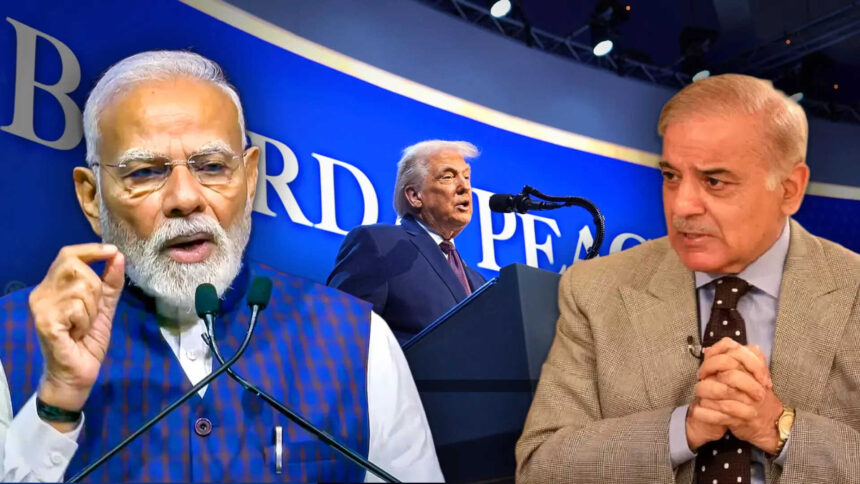
India is currently reviewing an invitation from the United States to participate in the inaugural meeting of US President Donald Trump’s Board of Peace (BoP), a forum widely perceived as an alternative to traditional global conflict management institutions. The invitation comes at a time of heightened regional tensions, as India’s longstanding rival Pakistan has confirmed that its Prime Minister Shehbaz Sharif will attend the Washington meeting scheduled for February 19, accompanied by senior ministers. New Delhi has emphasized that it is considering the proposal carefully, reflecting the strategic and diplomatic calculations involved in engaging with an initiative that, while global in claim, remains largely untested and undefined in scope.
The Board of Peace was initially conceptualized as a mechanism to address the reconstruction of Palestinian territories, particularly Gaza, which has faced repeated Israeli military assaults over recent years. However, President Trump has subsequently repositioned the BoP as a global forum for peace and conflict management, extending invitations to multiple countries without specific reference to Gaza or any particular conflict. Despite the rebranding, major international powers, including members of the G7, have yet to confirm participation, leaving the forum’s legitimacy and influence in question. Against this backdrop, Pakistan’s swift acceptance of the invitation has placed New Delhi in a position of deliberation, weighing the benefits and potential diplomatic risks of engagement.
Pakistan among first to commit, asserting collective Islamic-Arab voice
Pakistan has emerged as one of the earliest countries to publicly commit to attending the inaugural BoP meeting. The decision was announced shortly after the United States released invitations to several nations, signaling Islamabad’s intention to secure visibility and influence within the forum. Pakistani foreign office spokesperson Tahir Andrabi stated that Prime Minister Sharif will participate along with the deputy prime minister or foreign minister, with further details regarding the delegation to be announced in due course. Islamabad emphasized that its participation is not isolated but represents the collective voice of eight Islamic-Arab countries, seeking to advance the rights, peace, and prosperity of the Palestinian people.
Officials in Pakistan highlighted that the BoP, while expanded in scope beyond Gaza, remains a platform to address long-standing Palestinian concerns. Islamabad’s narrative emphasizes adherence to the pre-1967 borders with Al Quds Al Sharif as the capital, positioning Pakistan as a vocal advocate for a just resolution in Palestine. The BoP thus serves multiple objectives for Pakistan: securing international visibility, asserting leadership among fellow Muslim nations, and reinforcing its longstanding policy on the Palestinian issue. The participation also allows Pakistan to frame its engagement within the broader context of global peace, aligning itself with diplomatic narratives promoted by the United States while reinforcing its credentials as a responsible regional actor.
The move has strategic implications beyond Middle Eastern politics. By being among the first to join, Pakistan signals a willingness to collaborate with the United States in multilateral settings while simultaneously highlighting its distinct perspective on regional conflicts. This proactive participation may also be intended to counterbalance India’s influence in Washington and internationally, as the forum gains momentum and public attention. In diplomatic terms, Pakistan’s early commitment underscores its intent to remain visible on the global stage and engage with emerging international mechanisms that could shape regional security discourse in the years ahead.
India’s deliberation amid complex regional and bilateral considerations
In Delhi, the Ministry of External Affairs (MEA) has reiterated India’s consistent stance on promoting peace, stability, and dialogue in West Asia. MEA spokesperson Randhir Jaiswal confirmed that India has received the invitation from Washington and is currently reviewing the proposal. While India has welcomed initiatives aimed at long-term peace, particularly in Gaza, officials emphasized that the government is carefully considering the implications of joining the BoP, including its potential impact on India’s diplomatic positioning and bilateral relations with the United States.
India’s consideration is complicated by a variety of factors. The country recently concluded a trade deal with the United States, following a period of tariff-linked tensions and friction over previous US overtures toward Pakistan. Trump’s administration has reportedly conditioned certain benefits on India ceasing the purchase of Russian oil, a stipulation linked to the conflict in Ukraine, which adds another layer of complexity to Delhi’s decision-making. Indian policymakers must balance the potential diplomatic benefits of engaging in a high-profile global forum with the risks associated with being perceived as aligning with a mechanism that could indirectly amplify Pakistan’s regional narrative.
Historically, India has maintained that the military conflict between India and Pakistan in May of the previous year was resolved through its own measures and has consistently rejected claims of third-party intervention. Despite President Trump’s repeated assertions in media interviews that US pressure and the threat of tariffs were instrumental in securing a ceasefire, India has denied any substantive role played by Washington in mediating the conflict. This backdrop adds caution to India’s deliberations, as participation in the BoP could inadvertently signal an endorsement of US claims or lend credibility to Pakistan’s narrative regarding third-party intervention.
India’s broader foreign policy framework continues to emphasize strategic autonomy and regional stability. Delhi has consistently prioritized bilateral and multilateral engagement that reinforces peace in West Asia, supports sustainable development, and safeguards its national interests without compromising sovereignty or endorsing untested international mechanisms. The invitation to the BoP thus requires a careful assessment of potential diplomatic, economic, and security implications, particularly in the context of evolving India-US relations and the broader South Asian security environment.
From a strategic perspective, New Delhi’s decision will also be informed by the forum’s unclear mandate and scope. While Trump has positioned the BoP as a global peace initiative, the charter lacks specificity regarding its operational objectives, governance mechanisms, and enforcement capabilities. Major countries remain absent from the forum, raising questions about its legitimacy and effectiveness. India must therefore weigh the symbolic and substantive value of participation against potential reputational and diplomatic risks.
Additionally, India must consider the messaging surrounding its attendance. Engagement in the BoP could be interpreted as an alignment with US-led initiatives, potentially impacting India’s relations with regional actors who view the forum with skepticism. Conversely, declining to participate may allow India to maintain strategic discretion, signaling that it will engage selectively in initiatives that align with its interests, values, and long-term diplomatic objectives.
The timing of the BoP meeting, coming shortly after Pakistan’s confirmation, places added pressure on India to articulate a clear position. While Islamabad frames its participation as part of a collective Islamic-Arab voice advocating for Palestine, India’s stance on Gaza has consistently been supportive of peace, stability, and dialogue, without engaging in partisan coalitions. The contrast between Pakistan’s assertive posture and India’s measured deliberation underscores the divergent approaches both countries adopt in navigating multilateral forums and diplomatic opportunities.
At the same time, India-US relations have shown signs of improvement, with renewed cooperation on trade and regional security issues. Delhi must navigate these positive developments carefully, ensuring that any decision regarding BoP participation reinforces, rather than complicates, its strategic partnership with Washington. Balancing this relationship while maintaining regional credibility and autonomy is a central consideration in India’s review process.
The broader geopolitical context also includes unresolved tensions between India and Pakistan, particularly regarding cross-border terrorism and regional security dynamics. Any engagement with the BoP could be perceived as a platform for Pakistan to amplify narratives related to past conflicts or ongoing disputes. Delhi’s approach reflects an awareness of these sensitivities, emphasizing that participation must be considered within the framework of long-term strategic interests and national security imperatives.
Furthermore, the BoP’s evolution from a forum focused on Palestinian reconstruction to a global peace initiative adds additional layers of uncertainty. India must evaluate whether the forum’s mandate, resources, and governance structure are robust enough to deliver tangible outcomes. Participation without clarity could potentially dilute India’s diplomatic influence and divert attention from established channels that have a proven track record in conflict resolution and peacebuilding.
India’s review also takes into account domestic considerations. Public perception, parliamentary oversight, and alignment with broader foreign policy objectives are critical factors in determining whether attendance at the BoP would enhance or complicate India’s international image. Given the politically sensitive nature of India-Pakistan relations, any action perceived as favoring Pakistan’s narrative could provoke domestic criticism or require extensive diplomatic clarification.
India is carefully evaluating multiple dimensions of the invitation to the Board of Peace. While Pakistan has committed to attend, emphasizing a collective voice for Palestine, India’s approach reflects deliberation and caution, ensuring that any engagement aligns with its strategic, diplomatic, and national interest priorities. Officials have emphasized that a decision will be made only after thorough assessment of the potential benefits, risks, and implications of participation in a forum that is still defining its role on the global stage.