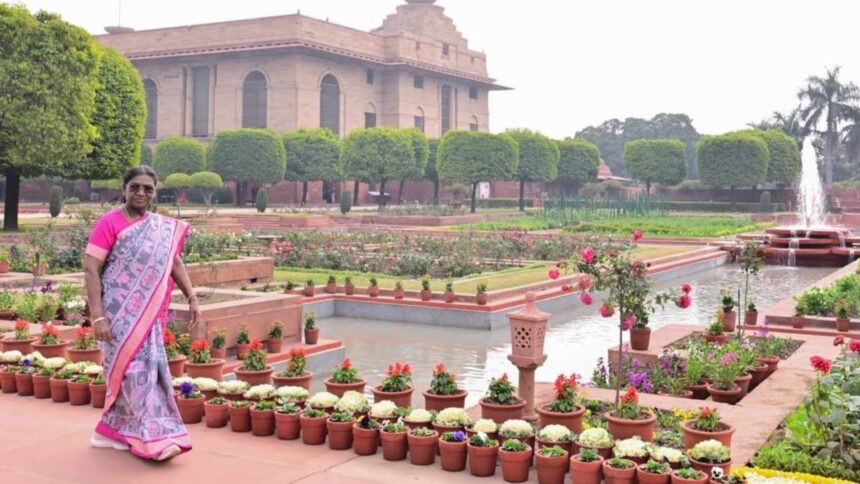
Amrit Udyan at Rashtrapati Bhavan has opened its gates to the public, marking the beginning of one of New Delhi’s most anticipated seasonal attractions, where carefully curated winter blooms and landscaped heritage gardens come together for visitors from across the country.
The opening of Amrit Udyan for the 2026 season has once again transformed the presidential estate into a vibrant public space, offering citizens a rare opportunity to experience the grandeur of the gardens that form an integral part of India’s institutional and cultural legacy. Formerly known as the Mughal Gardens, Amrit Udyan has over the years evolved into a symbol of openness and public engagement, allowing people to witness horticultural excellence set against the backdrop of one of the nation’s most iconic buildings. With the winter annuals in full bloom, the gardens present a blend of colour, symmetry and serenity that reflects both tradition and contemporary landscaping practices.
Seasonal blooms and evolving garden design
The 2026 edition of Amrit Udyan places special emphasis on winter flowering plants that thrive in Delhi’s cooler months. Visitors are greeted by expansive flowerbeds displaying tulips, roses, petunias, pansies, daisies, and other seasonal varieties arranged in intricate geometric patterns. These displays are designed not only to please the eye but also to highlight the meticulous planning and sustained effort of horticultural teams who work year-round to prepare the gardens for public viewing.
One of the defining features of Amrit Udyan is its balance between classical garden layouts and modern additions. The traditional symmetry inspired by Mughal-era landscaping remains intact, with long pathways, water channels, and central lawns providing structure and rhythm to the space. At the same time, newer sections such as themed gardens, bonsai collections, and curated plant zones add diversity to the visitor experience. These additions reflect changing public interests, including a growing awareness of environmental sustainability, native plant species, and wellness-oriented landscaping.
The garden also includes areas designed for quiet reflection, where shaded pathways and open lawns allow visitors to pause and absorb the surroundings. For many, the visit is not just about viewing flowers but about experiencing a sense of calm in the midst of a bustling capital city. Educational signage placed across different sections offers insights into plant varieties, flowering cycles, and maintenance techniques, making the visit informative as well as visually engaging.
Children and families find particular appeal in the dedicated sections created to encourage interaction with nature. These areas are designed to spark curiosity and foster an early appreciation for plants and biodiversity. The presence of such spaces underscores the broader objective of Amrit Udyan as more than a seasonal attraction, positioning it as a living classroom that connects people with the natural world.
Public access, significance and cultural context
The opening of Amrit Udyan to the public each year carries significance beyond horticulture. It represents an effort to make national spaces more accessible and inclusive, reinforcing the idea that heritage sites belong to the people. The 2026 opening was inaugurated by President Droupadi Murmu, continuing the tradition of formally welcoming citizens into the gardens during the winter season.
Public access to Rashtrapati Bhavan’s gardens has gradually expanded over time, reflecting a shift towards greater transparency and engagement between institutions and the public. Visitors from different regions, age groups, and backgrounds walk the same paths, creating a shared experience rooted in appreciation for nature and national heritage. For many first-time visitors, the gardens offer a tangible connection to the seat of the presidency, blending civic pride with leisure.
The seasonal opening also has a cultural dimension, as it coincides with a period when Delhi’s climate is most conducive to outdoor activities. The gardens become a social space where families, students, photographers, and tourists gather, contributing to the city’s cultural rhythm. The visual appeal of Amrit Udyan during this period often finds expression in photography, art, and social conversations, extending its influence beyond physical boundaries.
In recent years, the rebranding of the Mughal Gardens as Amrit Udyan has added a new layer of identity to the space. While retaining its historical design elements, the new name aligns the gardens with contemporary narratives of renewal and inclusivity. The 2026 edition continues this trajectory, presenting the gardens as a symbol of continuity that respects the past while adapting to present sensibilities.
The opening of Amrit Udyan also highlights the role of public gardens in urban environments. As cities expand and green spaces become increasingly valuable, such initiatives underscore the importance of preserving and celebrating landscaped areas. The gardens serve as a reminder of the ecological and emotional benefits of accessible green spaces, particularly in densely populated urban centres.
Through its carefully maintained lawns, vibrant flowerbeds, and thoughtfully designed pathways, Amrit Udyan 2026 stands as an invitation to citizens to slow down, observe, and reconnect with nature within a setting of national importance. The season’s opening reinforces the idea that heritage, environment, and public participation can coexist, offering an experience that is both aesthetically enriching and culturally meaningful.