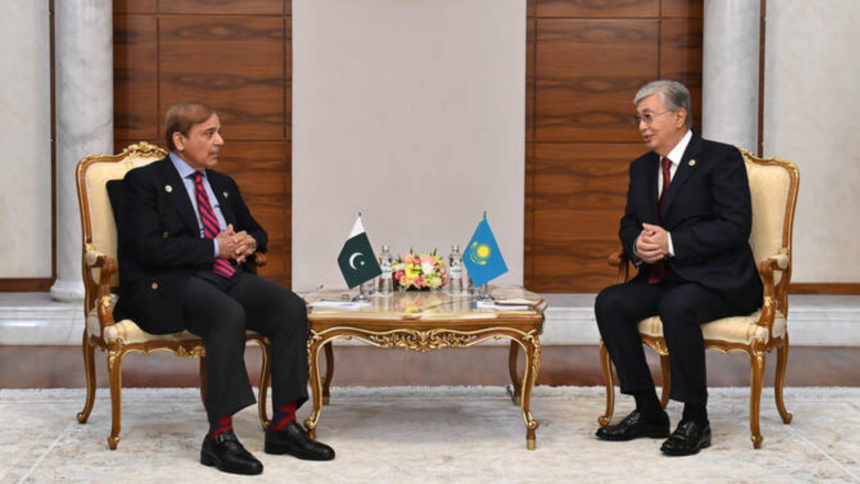
President Kassym-Jomart Tokayev’s upcoming state visit to Pakistan on February 3–4 is being widely viewed as a pivotal moment in Kazakhstan-Pakistan relations, with experts emphasizing trade expansion, transit connectivity and regional cooperation as the core themes likely to dominate high-level discussions.
President Kassym-Jomart Tokayev is scheduled to hold talks with Pakistan’s Prime Minister Shehbaz Sharif and President Asif Ali Zardari, alongside participating in the Kazakhstan-Pakistan business forum. The visit comes at a time when both countries are seeking to diversify economic partnerships and strengthen regional connectivity amid shifting geopolitical and economic realities. Analysts note that the agenda reflects a maturing bilateral relationship that is gradually moving from diplomatic goodwill to tangible economic and strategic cooperation.
Kazakhstan and Pakistan have shared friendly relations since Kazakhstan gained independence in 1991, with Pakistan among the first countries to recognize the new state and formal diplomatic ties established in 1992. Over the decades, political dialogue has remained steady, but recent years have seen a renewed push to deepen cooperation in trade, transport, education and energy. Observers believe the upcoming visit could give fresh momentum to these efforts by aligning political intent with concrete initiatives.
Geography, transit and regional connectivity as strategic drivers
Experts underline that geography, once seen as a limitation due to the absence of a shared border, is increasingly being reframed as an opportunity. Kazakhstan’s position as a major Central Asian economy rich in agricultural output and energy resources complements Pakistan’s location at the crossroads of South Asia, Central Asia and the Middle East, with access to the Arabian Sea.
Pakistani international relations expert Khalid Taimur Akram argues that this geographic logic underpins the growing emphasis on transit and transport cooperation. For landlocked Kazakhstan, access to seaports is a strategic priority, and Pakistan’s ports of Karachi, Port Qasim and Gwadar offer viable gateways to global markets. Islamabad has expressed readiness to facilitate such access, a move experts see as mutually beneficial for regional trade flows.
Central to these efforts is the proposed Pakistan-Kazakhstan Transit Trade Agreement, which aims to connect Central Asia and South Asia through integrated road, rail and maritime routes. The agreement is expected to streamline customs procedures, reduce transit costs and improve logistical efficiency. Analysts suggest that if implemented effectively, it could significantly enhance Kazakhstan’s export options while positioning Pakistan as a key transit hub.
Institutional mechanisms have supported this gradual deepening of ties. Parliamentary exchanges, regular bilateral consultations and the Joint Intergovernmental Commission have provided continuity in dialogue and policy coordination. The commission has convened 13 sessions so far, with the most recent held in 2025, reflecting sustained engagement at the governmental level. These platforms have helped both sides align positions on regional and international issues while keeping economic cooperation high on the agenda.
Connectivity discussions also extend to broader regional corridors. The China-Pakistan Economic Corridor is frequently cited as a potential link between Central Asia and South Asia, offering Kazakhstan an alternative and cost-effective route to reach South Asian and overseas markets. Railways, highways and port infrastructure developed under CPEC are seen as assets that could be leveraged for regional trade integration.
In parallel, Kazakhstan and Pakistan are exploring the Trans-Afghan Corridor as another route to enhance connectivity, despite ongoing security and logistical challenges. Air connectivity has also improved, with direct flights between cities such as Almaty and Lahore strengthening people-to-people contacts and facilitating business travel. Simplified customs and visa procedures are expected to further support tourism and commercial exchanges.
Expanding trade, energy cooperation and human capital links
Trade and economic cooperation have emerged as the centerpiece of the bilateral agenda, with both countries setting an ambitious target of increasing trade turnover to $1 billion. While experts acknowledge that global economic uncertainty and geopolitical complexities make this a challenging goal, they also see it as a clear signal of political commitment and confidence in economic complementarities.
Kazakhstan’s exports to Pakistan include grain, fertilizers, chemical products and sunflower oil, while Pakistan supplies textiles, pharmaceuticals, sports goods and surgical instruments. These trade flows highlight sectoral complementarities that can be expanded through better market access, reduced non-tariff barriers and enhanced business-to-business engagement.
At a meeting in Islamabad in September 2025, Pakistan’s Commerce Minister Jam Kamal Khan and Kazakhstan’s Minister of Trade and Integration Arman Shakkaliyev reviewed outcomes of the Intergovernmental Commission session and the bilateral business forum. Both sides agreed to intensify trade missions, exhibitions and sector-specific cooperation, particularly in information technology, small and medium-sized enterprises and e-commerce. Analysts see this as evidence of a shift from symbolic cooperation toward practical, results-oriented engagement.
Digital cooperation is emerging as a new and promising dimension of the partnership. Kazakhstan and Pakistan are exploring collaboration in artificial intelligence, cybersecurity, fintech and e-government. Memorandums of understanding between Pakistan’s Ignite program and Kazakhstan’s Astana Hub aim to foster joint innovation projects and startup exchanges, reflecting a shared interest in technology-driven growth.
Energy cooperation also holds significant potential. Kazakhstan’s substantial oil and gas reserves position it as a possible supplier for Pakistan’s growing energy needs, opening avenues for investment, technology transfer and long-term supply arrangements. While concrete projects are still at an exploratory stage, experts believe political backing from the highest level could accelerate progress.
Human capital and education form another important pillar of bilateral relations. More than 1,000 Pakistani students currently study in Kazakhstan, and this number is expected to rise as Kazakhstan advances its strategy of becoming an international education hub. Academic exchanges, joint research initiatives and institutional partnerships have gained momentum, supported by frameworks under the Organization of Islamic Cooperation.
The Standing Committee on Scientific and Technological Cooperation, known as COMSTECH, has played a key role in advancing collaboration in science, technology and innovation. Cooperation with the Islamic Organization for Food Security, headquartered in Kazakhstan, has further strengthened links in agricultural research and food security.
According to Prof. Dr. Muhammad Iqbal Choudhary, Coordinator General of OIC-COMSTECH, Kazakhstan’s efforts to attract foreign universities have opened new avenues for academic cooperation. Dozens of branches of leading universities from the United States, the United Kingdom, South Korea, China and France are already operating in Kazakhstan, with more planned in the coming year.
At the Kazakhstan-Pakistan University Forum held in 2025, participants proposed establishing a Kazakhstan-Pakistan University Consortium to institutionalize academic cooperation and ensure the sustainability of partnerships. Plans are also underway to launch academic centers in Islamabad during President Tokayev’s visit, including science and technology, humanities and cultural studies hubs supported by leading Kazakh universities.
Experts believe that these initiatives underscore a broader vision of partnership that goes beyond trade and transit to encompass education, innovation and cultural exchange. As President Tokayev’s visit approaches, expectations are high that discussions in Islamabad will translate political goodwill into concrete agreements, reinforcing Kazakhstan and Pakistan’s shared aspiration to serve as a bridge between Central and South Asia.