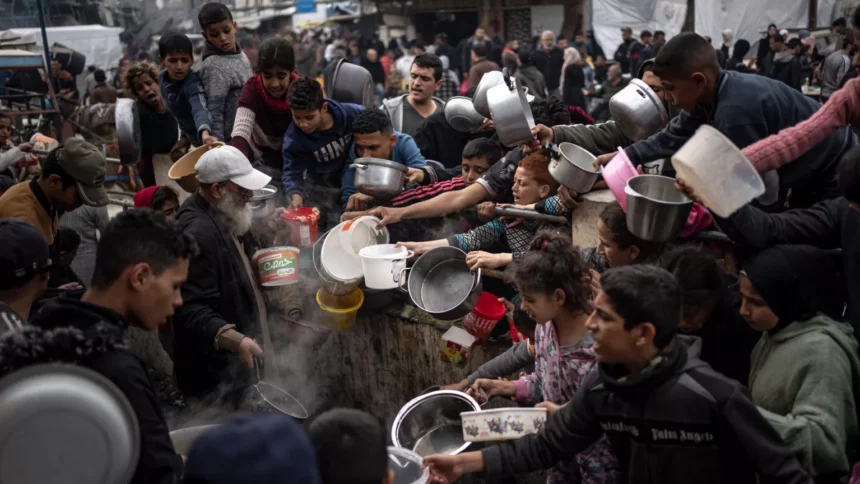
In a visit that has sparked international attention, President Donald Trump’s Middle East envoy Steve Witkoff toured a contentious U.S.-backed humanitarian aid operation in Gaza this Friday, amid deepening global concern over famine and deadly violence in the war-ravaged enclave. With Gaza facing one of the most dire humanitarian crises in decades, Witkoff’s stop at a site operated by the Gaza Humanitarian Foundation (GHF) comes at a moment when questions about aid access, political agendas, and the safety of distribution sites are dominating global discussions.
Witkoff, clad in military-style clothing and a Donald Trump-branded cap, visited the city of Rafah in southern Gaza, where the GHF is operating under the joint support of the United States and Israel. The visit follows sharp criticism from the United Nations and several humanitarian organizations who accuse GHF of distributing aid in ways that are unsafe and politically compromised. While the GHF claims to have delivered 100 million meals, the UN reports that more than 1,000 people have been killed while trying to access aid, mostly due to shootings by Israeli forces near distribution sites.
Escalating Violence and Contested Narratives
Just hours after Witkoff’s visit, Palestinian medics reported that Israeli troops shot and killed three Palestinians near a GHF distribution point on Gaza’s southern edge. While the Israeli military acknowledged firing warning shots at what it called a “gathering of suspects,” it did not confirm whether the incident occurred at the same site visited by Witkoff.
These fatalities are the latest in a string of violent incidents tied to aid distribution. The Israeli military admits to having killed Palestinians near aid zones, but claims to have implemented new orders to improve troop behavior. In contrast, the GHF insists that no deaths have occurred at its distribution sites, emphasizing that it provides better security than the UN.
Despite such claims, the UN has refused to cooperate with the GHF, arguing that its operations compromise humanitarian neutrality and pose unacceptable risks to civilians. The situation on the ground reflects this tension, as food insecurity continues to intensify. A leading global hunger monitor warned this week that famine is now unfolding in Gaza, further complicating the humanitarian mission.
High-Stakes Diplomacy and Media Messaging
Joining Witkoff was U.S. Ambassador to Israel Mike Huckabee, who shared an image online showing desperate Gazans behind barbed wire alongside a large American flag with the slogan: “100,000,000 meals delivered.” This public relations push is part of an effort to showcase the Donald Trump administration’s alternative to traditional aid channels, which they argue have failed to prevent Hamas from intercepting supplies.
Witkoff stated that his mission was to offer President Donald Trump a firsthand understanding of conditions in Gaza, in order to craft a targeted humanitarian strategy. He met with other aid organizations during the trip and emphasized the urgency of delivering food and medical supplies without empowering militant groups.
Israel maintains that the GHF model was necessary after previous aid systems, including those supported by the UN, allegedly enabled Hamas to seize and divert supplies. Hamas denies these accusations. Meanwhile, indirect talks over a proposed 60-day ceasefire and hostage release collapsed last week without progress.
Adding to the emotional weight of the crisis, Hamas and its allies have released new hostage videos, showing skeletal captives pleading for their release. One such video featured Israeli hostage Evyatar David in a tunnel, appearing frail and distressed. These images have renewed calls for international intervention, though tangible solutions remain elusive.
Humanitarian Crisis and Diplomatic Fallout
The situation in Gaza continues to deteriorate at an alarming rate. Local medics report that dozens of Palestinians have died from malnutrition in recent days. This follows a near-total blockade by Israel from March to May, during which food, water, and medical supplies were severely restricted. Although Israel has recently taken steps to reopen some aid channels—including temporary pauses in fighting and the designation of secure routes—relief groups argue that the measures fall short of meeting the escalating needs.
UN agencies claim thousands of aid trucks are waiting at the border, unable to enter due to strict Israeli security checks. Although Israel initiated air drops of food this week, UN officials stress that these deliveries are no substitute for the large-scale land-based aid that Gaza requires. On Friday alone, six countries including France, Germany, and Spain participated in air drops totaling 126 food packages.
Amid this worsening landscape, the broader political ramifications are becoming more pronounced. France, Britain, and Canada have all hinted at possible recognition of a Palestinian state—a significant policy shift for Western powers that had previously aligned more closely with Israel. These developments reflect growing discomfort among global leaders over the scale of destruction and the perceived failure of diplomacy to contain the crisis.
Israel launched its military campaign in Gaza after Hamas militants killed over 1,200 Israelis and took 251 hostages during an unprecedented attack on October 7, 2023. Since then, Gaza health authorities report that more than 60,000 Palestinians have been killed in the Israeli offensive. The scale and duration of the violence have drawn mounting criticism, not just from traditional adversaries but also from longtime allies.
As the humanitarian emergency deepens and political tensions rise, the stakes in Gaza remain extraordinarily high. Witkoff’s visit, while symbolically powerful, underscores the urgent need for a coordinated international effort to address both the human suffering and the underlying political impasse.