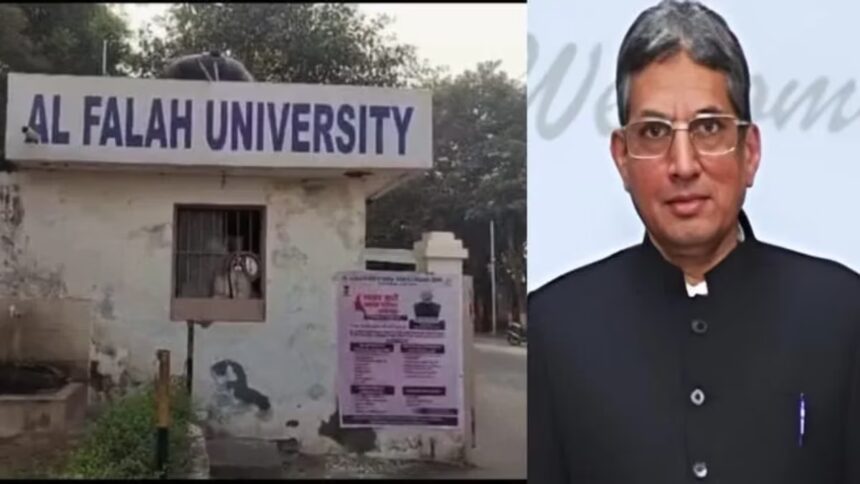
The Enforcement Directorate’s investigation into the Al Falah Group and its associated trust has widened significantly, revealing a complex network of alleged financial irregularities, forged property documents, and questionable land acquisitions linked to its arrested chairman, Jawad Ahmed Siddiqui. As the probe deepens, investigators are examining suspicious transactions, forged general power of attorney papers, and the rapid rise of the group’s educational empire. The case has attracted further attention due to its connection with the November 10 Red Fort area blast, which claimed fifteen lives and brought the Al Falah University under intense scrutiny.
ED expands inquiry into forged land transactions, money laundering, and questionable growth of the Al Falah Group
The Enforcement Directorate has intensified its investigation into the Al Falah Group following the arrest of chairman Jawad Ahmed Siddiqui on November 18. His arrest came after a series of coordinated raids on properties linked to the Al Falah Group, its educational institutions, and entities associated with the trust. According to investigators, Siddiqui is suspected of using forged documents to acquire land parcels in Delhi, raising serious concerns about the scale and method of expansion pursued by the organization over the years.
The case has become even more sensitive due to its connection with the Red Fort area blast of November 10. In that incident, a doctor employed at the Al Falah University’s medical college allegedly detonated a car containing chemical explosives, killing himself and fourteen others in a massive explosion that devastated the area. Although the motive behind the blast is still under investigation, the association of the accused with the university has intensified the scrutiny on the entire Al Falah ecosystem.
ED officials, citing internal findings, believe that at least five property transactions involving general power of attorney documents may have been processed using forged signatures and records. Investigators are verifying whether some of these GPAs were issued in the names of individuals who were already deceased at the time of documentation. If verified, these findings could indicate a larger pattern of systematic tampering, enabling the acquisition of valuable land at artificially low rates or through illegal means.
These forged documents, officials suggest, may have been used to secure multiple land parcels across Delhi, which later became part of expansion projects linked to the Al Falah Trust. The ED is currently examining the financial trails linked to these acquisitions, including payments made to intermediaries, shell entities, and bank accounts flagged during searches. Preliminary documents suggest routing of funds through layers of accounts in order to obscure the origins of payments and the beneficiaries behind them.
In addition to land acquisition records, the agency is also analyzing the financial structure of the Al Falah Group. Investigators have expressed concern about widespread discrepancies in fee collection, student admissions, and accreditation claims made by the university and affiliated institutions. Early findings indicate that the group may have generated over ₹415 crore through practices that the ED describes as dishonest and deceptive. These include allegations of enrolling students into courses that lacked valid accreditation or using misleading language to imply official recognition. Many students reportedly paid large sums only to discover later that certain programmes were not properly approved or lacked the requisite regulatory validation.
The ED’s remand notes claim that Siddiqui wielded complete control over the group’s administrative machinery, including those handling admission registers, financial ledgers, fee accounts, and digital systems. This level of command, enforcement officers argue, gave him the power to alter or destroy records, a risk that prompted investigators to seek custodial interrogation to prevent evidence tampering. According to the agency, the chairman is the central figure through whom all major decisions, finances, and expansion plans were executed.
Investigators are also examining the “meteoric rise” of the Al Falah Group since the 1990s. What began as a small institution reportedly grew into a large educational conglomerate over three decades, establishing multiple colleges, training centres, and a university. Officials are trying to understand how this expansion was funded, particularly in light of the newly discovered transactions that appear inconsistent with officially recorded revenue streams. The ED suspects that unaccounted funds, as well as money obtained through dishonest student admissions, may have been diverted into real estate purchases, overseas transfers, and high-value investments.
Another aspect attracting the agency’s attention is Siddiqui’s alleged motivation to flee India. The ED claims that many of his close family members reside in Gulf countries, providing him with potential safe havens. Based on this, the agency argued in court that Siddiqui could abscond, especially given the severity of allegations and the scale of financial irregularities uncovered so far.
The investigation also includes a nationwide exercise to identify, catalogue, and evaluate the movable and immovable assets linked to Siddiqui and the Al Falah Group. Properties located in multiple states are currently being surveyed and valued. If these assets are found to be connected to proceeds of crime, the ED may attach them under provisions of the Prevention of Money Laundering Act. Officials are also working to trace funds that may have been diverted abroad through hawala channels, shell companies, or international bank transfers disguised as legitimate payments.
The explosive nature of the case has drawn attention not only because of the alleged fraud but also because of its educational implications. Many students enrolled in institutions under the Al Falah Trust reportedly paid substantial fees, expecting recognized degrees and legitimate academic programs. The lack of proper accreditation in several courses raises concerns about the academic futures of these students, who may find themselves with degrees that hold little professional or legal value. The ED suspects that the group financially exploited hundreds, if not thousands, of students with misleading promises about academic infrastructure, faculty strength, and career opportunities.
During searches, investigators also collected digital records, financial statements, meeting minutes, and admission data that may shed light on internal decision-making within the organization. The agency believes these materials could provide evidence of systematic concealment, intentional misrepresentation, and collusion between certain staff members and the trust leadership. The ED has also recorded statements from employees, some of whom have claimed that instructions regarding documentation and admissions were often issued directly by Siddiqui or his close associates.
Sources indicate that the ED is probing whether any public officials were influenced or bribed to expedite land-related paperwork or licensing procedures in the past. Given the scale of expansion and number of approvals obtained over the years, investigators are verifying whether any irregularities occurred during these processes. Such links, if established, could broaden the investigation and lead to additional arrests.
The ED’s focus on land-deal documents remains central to the case. The alleged use of forged general power of attorney papers suggests premeditated efforts to manipulate the property market. Officials believe these forgeries enabled the trust to gain control over land without undergoing conventional verification processes, thereby creating opportunities for rapid expansion. By using documents forged in the names of deceased individuals, the group could also bypass potential legal challenges or seller disputes, acquiring land that might otherwise have remained unavailable.
Financial forensics experts working with the ED are reconstructing the money trail to determine how the ₹415 crore was spent, saved, or diverted. A significant portion of the suspected criminal proceeds has yet to be identified, indicating that the financial network is far more complex than initially expected. Some funds may be hidden in investments under proxy names, layered into multiple bank accounts, or shifted into businesses that function as fronts for laundering illicit earnings.
With each new discovery, the investigation expands in scope. What began as a financial inquiry now includes elements of document forgery, unexplained wealth, abuse of institutional trust, and potential overseas laundering. As investigators scrutinize the organization’s activities, they are also exploring whether the group’s sudden rise in the education sector coincided with any suspicious financial inflows.
The Red Fort area blast incident has further heightened scrutiny of the group. The involvement of a doctor employed at the university’s medical college has raised troubling questions about internal oversight, security vetting, and background verification processes. While the nature of the doctor’s motives remains under investigation, the proximity of the accused to the institution has cast an additional shadow over the group’s operations.
ED officials say it could take months before the full extent of the financial irregularities is understood. For now, investigators maintain that Siddiqui stands at the centre of a well-organized system that enabled fraud, document manipulation, and exploitation of students. As the investigation deepens, it continues to unravel the mechanisms that facilitated the organization’s rapid rise and the alleged wrongdoing that accompanied it.