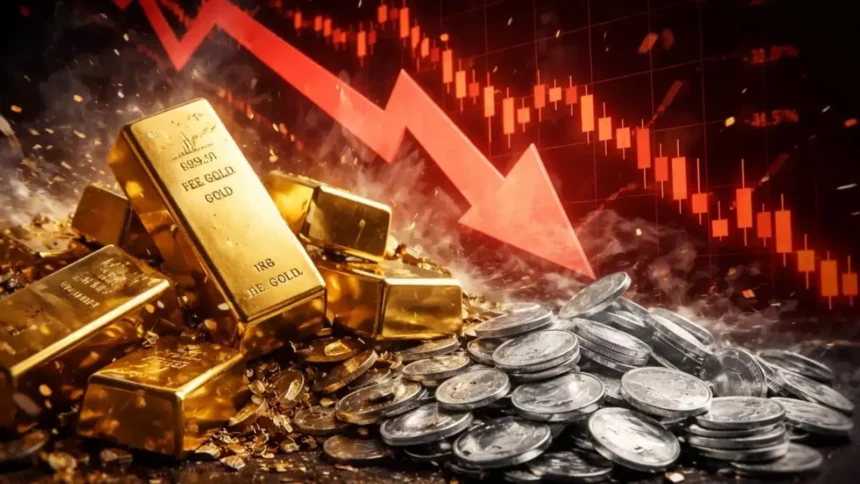
Gold and silver prices have corrected sharply over the past week, giving buyers temporary relief but exposing how volatile the bullion market has become in 2026. The numbers now available for March 22 show 24-carat gold in India around ₹1.46 lakh per 10 grams, while silver is near ₹2.45 lakh per kilogram, both well below the extreme highs seen earlier this year. Recent market trackers also show that silver has fallen steeply from its late-January peak, while gold has retreated materially from its own high. This pullback reflects a mix of profit booking, liquidity demand, and broader global uncertainty rather than any stable easing in risk. In other words, bullion has become cheaper for now, but not calmer.
Bullion prices cool after a period of extraordinary highs
The claim in your text that gold became cheaper by about ₹11,000 in a week broadly matches the recent downtrend, though current publicly listed prices on March 22 are a bit lower than the ₹1.47 lakh figure mentioned. Goodreturns shows India’s 24-carat gold price at ₹1,45,970 per 10 grams on March 22, with Delhi and Noida close to ₹1,46,120 per 10 grams.
Silver also remains under pressure. On March 22, Goodreturns listed silver at ₹2,45,000 per kilogram in India, including Delhi and Noida. That means the ₹2.32 lakh figure in your text appears lower than the rates I could verify today, though the broad point about a large fall from prior highs is correct. Goodreturns’ historical city data shows silver at ₹4,10,000 per kilogram in Delhi on January 29 and ₹2,45,000 on March 22, a drop of ₹1,65,000 from that peak.
The broader trend is clear: bullion has moved from a panic-driven spike earlier in 2026 into a phase of sharp correction. Market reports from March 20 had already shown gold near ₹1.48 lakh and silver above ₹2.38 lakh, suggesting that volatility remains intense even across a span of just a few days.
One reason city-wise prices differ is local pricing structure. Retail rates vary by transport and security costs, city-specific demand, inventory cycles, and jeweller association benchmarks. Current Delhi and Noida prices are slightly above the all-India benchmark, which reflects exactly that local pricing variation. IBJA also notes that benchmark bullion rates are quoted without 3% GST and making charges, which is another reason retail purchase prices differ from quoted benchmark levels.
What buyers should understand before treating the fall as a bargain
The main mistake buyers make in a fast-falling bullion market is assuming that lower prices automatically mean stability. They do not. Current prices are lower than the January peaks, but they remain historically elevated. Goodreturns data shows gold still around ₹1.46 lakh per 10 grams on March 22, far above the levels seen at the end of 2025, while silver at ₹2.45 lakh per kilogram is also still above many late-2025 levels despite the recent slide.
That means anyone buying now should focus less on “cheap” and more on authenticity and price discipline. For gold, BIS hallmarking remains essential, and benchmark comparison matters because 24K, 22K, and 18K prices differ substantially. On March 22, Goodreturns lists 24K gold at ₹14,597 per gram, 22K at ₹13,380, and 18K at ₹10,948 at the India level.
For silver, retail verification is equally important. Your text mentions magnet, smell, cloth, and ice tests. Those are common consumer checks, but they are not substitutes for buying from a credible seller with proper billing and purity disclosure. In a market this volatile, documentation matters more than informal tests.
So the real story is not simply that gold and silver have become cheaper. It is that bullion is swinging violently after touching extraordinary highs, and buyers should read the fall as a correction inside a highly unstable market, not as proof that prices have settled into a predictable range.