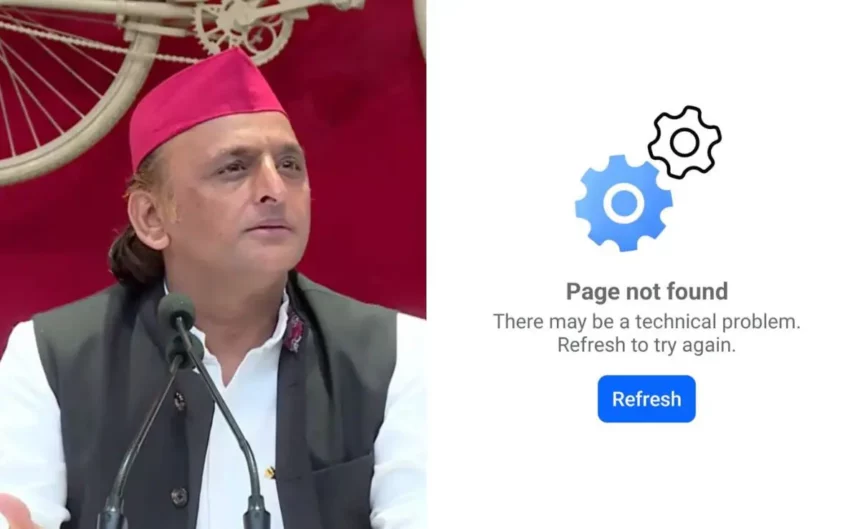
The sudden suspension of the official Facebook account of Samajwadi Party (SP) president Akhilesh Yadav has triggered a storm of political reactions, raising questions about digital governance, freedom of expression, and the role of social media platforms in India’s democratic discourse. Sources clarified that Meta, the parent company of Facebook, was responsible for the action and that the government had no involvement. However, the timing of the suspension and the prominence of the individual involved have led the SP to allege political interference, accusing the Bharatiya Janata Party (BJP)-led government of attempting to suppress dissenting voices. With over eight million followers, Akhilesh Yadav’s Facebook page has long been a vital tool for the former Uttar Pradesh Chief Minister to communicate with supporters, voice opinions on governance, and highlight the perceived shortcomings of the ruling establishment. The suspension, reportedly over a “violent sexual post,” has brought into focus the broader issues surrounding content moderation, political influence, and social media accountability in India.
SP Leaders Condemn Action, Accuse Government of Undermining Democracy
Reacting immediately to the suspension, senior leaders of the Samajwadi Party expressed strong condemnation, framing the incident as a direct attack on democracy and the freedom of political expression. SP spokesperson Fakhrul Hasan Chaand, through a post on X, described the suspension as an “attack on democracy” and warned that the move was part of an undeclared emergency being imposed by the BJP government, wherein every voice opposing the ruling party is allegedly being suppressed. Chaand emphasized that despite such challenges, the SP remains committed to continuing its opposition against policies it views as anti-people. The rhetoric underscores the political narrative being advanced by the party that positions the suspension not merely as a social media policy enforcement issue but as a symbol of larger political intimidation and erosion of democratic norms in India.
Rajeev Rai, the national secretary of the SP, also weighed in on the controversy, condemning the suspension as a blow to India’s democratic system. In his X post, Rai stressed that silencing the leader of the country’s third-largest parliamentary party and a former Chief Minister of Uttar Pradesh is unacceptable and indicative of a troubling trend in the suppression of political dissent. He further asserted that if the action was influenced or directed by the BJP, it would signify a display of cowardice, aiming to suppress socialist voices through institutional power. Rai’s statements reflect the party’s broader strategy of highlighting what it perceives as an attack on democratic institutions and freedom of expression, turning a social media moderation decision into a central political issue.
The reaction from party legislators reinforced the SP’s unified stance against the suspension. SP MLA Pooja Shukla criticized Facebook for allegedly exceeding its boundaries by suspending Akhilesh Yadav’s account without any prior warning or notification. Shukla stressed that the account represents not just an individual but the voice of millions of followers, and silencing it constitutes an affront to democratic discourse. Her statement called for the platform to “bring Facebook to its senses,” framing the suspension as an overreach and asserting that such arrogance would not be tolerated by the party or its supporters. Collectively, these reactions paint a picture of heightened political tension, where social media governance intersects with issues of political freedom, public accountability, and the rights of citizens to access information and express opinions freely.
Meta’s Role and Content Moderation Challenges in India
While SP leaders focused on political implications, industry experts and legal analysts have highlighted the role of Meta as a global platform and its content moderation policies that apply across geographies. The suspension reportedly stems from a post deemed a “violent sexual post,” which falls under Facebook’s content guidelines. However, critics argue that the implementation of these rules often lacks transparency and can inadvertently impact high-profile public figures, especially political leaders whose communication channels are closely followed by millions. The challenges of balancing platform integrity, adherence to community standards, and respect for political discourse are particularly complex in a country like India, where social media serves as a primary conduit for political engagement, grassroots mobilization, and public debate.
Social media experts note that the absence of clear communication regarding suspensions can exacerbate political tensions, especially when high-profile accounts are involved. In Akhilesh Yadav’s case, the lack of immediate explanation or procedural transparency has fueled speculation about government interference, despite official denials from sources that the Indian administration had no role in the action. The situation illustrates the delicate interplay between platform governance, public perception, and political narrative management in India’s digital ecosystem. Furthermore, the incident raises broader questions about how social media companies navigate the unique political and cultural contexts of the countries in which they operate, particularly when content moderation intersects with democratic freedoms and political rivalries.
The controversy also highlights the broader debate on social media accountability in India. Critics argue that platforms like Facebook wield immense power in shaping public discourse, influencing political narratives, and controlling access to information. When high-profile political accounts are suspended, it not only impacts the individual leader but also has wider repercussions on followers, party supporters, and the general public who rely on these channels for news, updates, and political communication. The incident has ignited conversations about the need for transparent procedures, clear redressal mechanisms, and better communication between platforms and their users, particularly in politically sensitive cases.
Political analysts observe that the SP has leveraged the suspension to reinforce its narrative of an alleged clampdown on dissent. By framing the issue as an attack on democracy, the party is strategically positioning itself as a defender of free speech, mobilizing its supporters, and generating national attention on what it perceives as a politically motivated silencing of opposition voices. The reactions from multiple party leaders, social media statements, and public communications collectively underscore the high stakes of digital political engagement in India, where social media is intertwined with electoral politics, party strategy, and public perception.
Additionally, the timing of the suspension, coming during a period of heightened political activity in Uttar Pradesh and the country at large, adds a layer of complexity to the narrative. Political parties increasingly recognize the significance of social media as a campaign tool, a forum for public debate, and a platform to bypass traditional media channels. For leaders like Akhilesh Yadav, who has cultivated a significant following online, sudden disruptions to these communication channels can have political, organizational, and reputational consequences.
The incident also underscores the evolving dynamics between social media platforms, political leadership, and governance structures in India. While Meta’s global policies guide actions like account suspension, the local political context can amplify the impact of these decisions, resulting in domestic controversies, media scrutiny, and public debate. In this instance, the suspension of Akhilesh Yadav’s account has gone beyond the technical or administrative realm to become a flashpoint in India’s ongoing discussion about digital democracy, political accountability, and freedom of expression in the age of social media.
Experts suggest that moving forward, social media platforms need to implement clearer, more transparent mechanisms for addressing politically sensitive content violations. This includes timely notifications, detailed explanations of violations, and accessible appeal processes, especially for high-profile users whose accounts serve as critical communication channels for millions. Simultaneously, political leaders and parties must recognize the role of these platforms as independent entities enforcing global standards, while also advocating for fair and consistent treatment within national legal frameworks.
The Akhilesh Yadav suspension incident is likely to set a precedent in Indian political and digital discourse, illustrating the growing intersection of technology, politics, and law. It highlights the complex challenges of ensuring democratic engagement and expression in a digital landscape dominated by private platforms with the power to enforce rules that have wide-reaching consequences. As parties debate, leaders respond, and the public observes, the event underscores the importance of digital literacy, political awareness, and institutional checks in navigating the rapidly evolving online political environment.
Overall, the suspension has become a focal point for discussion on the rights of political leaders, the responsibilities of social media companies, and the broader implications for democracy in India. By converting a content moderation action into a political flashpoint, the Samajwadi Party has brought national attention to the delicate balance between platform governance, political expression, and public accountability, making this incident a key case study in the ongoing negotiation between digital freedom and responsible communication in India’s political landscape.