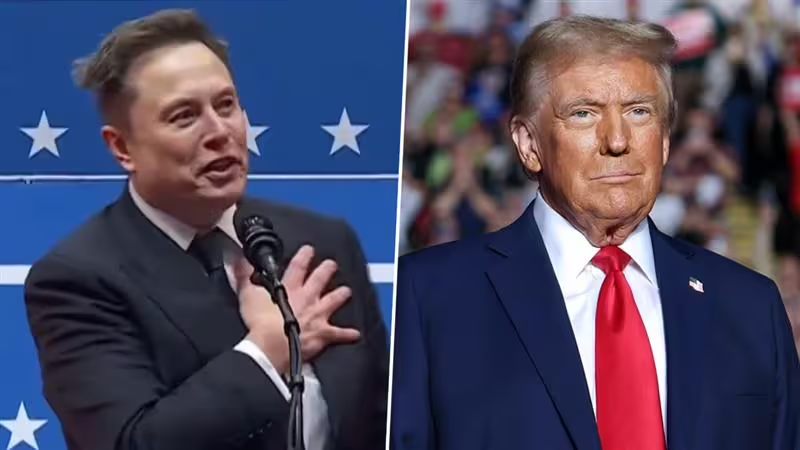
The Anti-Defamation League (ADL), a prominent watchdog against anti-Semitism, is facing significant backlash after defending Elon Musk’s raised-arm gesture during an event following President Donald Trump’s inauguration. The gesture, widely interpreted as a Nazi salute, has sparked controversy and calls for accountability. Elon Musk’s action, performed at the Capital One Arena in Washington, D.C., appeared to resemble the infamous “Sieg Heil” salute, historically associated with Nazi Germany.
Elon Musk, speaking at the rally, raised his arm while thanking the crowd for electing Trump, a move that raised eyebrows for its striking similarity to the Nazi gesture. The billionaire entrepreneur then repeated the gesture moments later. Many critics, including historians and public figures, have expressed their concerns, calling it a Nazi salute, citing its resemblance to the “Sieg Heil” greeting, a gesture linked to Adolf Hitler and the Nazi regime.
However, the ADL, an organization dedicated to combating anti-Semitism and hate crimes, rushed to Elon Musk’s defense. In a social media post, the group dismissed the raised-arm gesture as an “awkward gesture in a moment of enthusiasm,” downplaying its controversial nature. This statement drew sharp criticism, particularly from those who see the ADL as prioritizing its support for Israel over addressing broader issues of hate and anti-Semitism. The ADL’s defense of Elon Musk has been seen as inconsistent with its past actions, especially considering its strong stance on opposing anti-Semitism and its frequent condemnations of hate speech.
The controversy surrounding the ADL’s stance has raised questions about the organization’s priorities. For years, the ADL has been a leading authority on anti-Semitism, working closely with government agencies, law enforcement, and the corporate sector. Its annual audit of anti-Semitic incidents is widely cited, and the organization has enjoyed a reputation as a reliable source of information on hate crimes. However, its recent defense of Elon Musk, combined with its historical tendency to focus on silencing voices critical of Israel, has led some to accuse the ADL of ignoring its mission to fight anti-Semitism in favor of political interests.
One of the most vocal critics of the ADL’s response is Beth Miller, the political director of Jewish Voice for Peace (JVP). Miller criticized the organization for failing to prioritize the protection of Jewish communities, stating that the ADL has “made it as clear as possible that they are not a reputable source of information when it comes to anti-Semitism.” She suggested that the ADL’s actions reflect a larger agenda of silencing critics of Israel rather than combating anti-Semitism in all its forms.
The ADL’s defense of Elon Musk has also drawn the ire of progressive political figures, including Congresswoman Alexandria Ocasio-Cortez, who took to social media to condemn the ADL’s response. Ocasio-Cortez directly challenged the organization, saying that by defending Elon Musk’s apparent Nazi salute, the ADL had lost its credibility as a reputable source on issues related to hate and bigotry.
The backlash is further complicated by the ADL’s history of defending figures with controversial ties to far-right ideologies, especially when those figures express support for Israel. Critics argue that the ADL’s defense of Elon Musk is part of a broader pattern in which the organization overlooks the problematic behavior of pro-Israel figures while focusing its energies on silencing those critical of Israel’s policies.
The controversy also brings into question the ADL’s broader stance on Palestinian rights and its approach to anti-Semitism in the context of the Israeli-Palestinian conflict. In the past, the ADL has been accused of equating criticism of Israel with anti-Semitism, a stance that has drawn ire from Palestinian rights advocates and Muslim groups in the U.S. These groups argue that the ADL is more concerned with protecting Israel’s image than with fighting genuine hate crimes.
Elon Musk’s apparent Nazi salute follows a series of incidents that have raised concerns about his political affiliations and his support for far-right ideologies. Elon Musk has previously expressed admiration for controversial figures, including those with ties to white supremacy and nationalism. His recent comments about the far-right party in Germany, AfD, and his support for Tommy Robinson, a British anti-Muslim activist, have further fueled criticism of his political views.
Despite the controversy, Elon Musk has dismissed the accusations surrounding his raised-arm gesture. He shrugged off the incident, mocking the critics on social media and claiming that the “everyone is Hitler” accusation is a tired trope. Elon Musk’s reaction to the backlash highlights his long-standing defiance of public scrutiny, especially when it comes to his political stances and affiliations.
The ADL’s involvement in this controversy is particularly notable given its previous conflict with Elon Musk. In 2022, Elon Musk threatened to sue the ADL, accusing the group of pressuring advertisers to abandon his platform, X (formerly known as Twitter), after he acquired it. The feud between Elon Musk and the ADL escalated with accusations of anti-Semitism, which were met with sharp criticism from the organization. Despite this, the ADL has since made efforts to mend its relationship with Elon Musk, even praising him in 2023 for his business acumen and comparing him favorably to industrialist Henry Ford, a figure associated with anti-Semitism.
The situation has sparked a broader debate about the ADL’s role in modern American politics, especially in its dealings with figures like Elon Musk, whose controversial behavior has frequently collided with issues of hate and extremism. Critics argue that the ADL’s support for figures like Elon Musk undermines its credibility and distracts from its core mission of combating anti-Semitism in all its forms.
As the controversy surrounding Musk’s gesture and the ADL’s response continues to unfold, many are calling for a reevaluation of the organization’s role in combating hate and bigotry. Progressive groups, including Bend the Arc, a Jewish advocacy organization, have launched petitions demanding that the ADL retract its defense of Musk. The petition highlights the apparent double standard in the ADL’s approach to anti-Semitism and its treatment of Palestinian rights activists, urging the organization to reconsider its stance on the Elon Musk incident.
In the wake of the controversy, questions remain about the ADL’s future direction. As more people become aware of the organization’s ties to political interests and its shifting priorities, there is growing concern about its ability to maintain its reputation as a credible voice on anti-Semitism and hate crimes. With growing divisions within the Jewish community itself over the ADL’s stance, it is unclear how the organization will navigate the fallout from its defense of Elon Musk.
As the debate continues, the ADL faces mounting pressure to address concerns about its credibility and its approach to combating hate in a more consistent and transparent manner. The outcome of this controversy may have lasting implications for the organization’s future and its role in shaping discussions about anti-Semitism and hate in the U.S. and beyond.