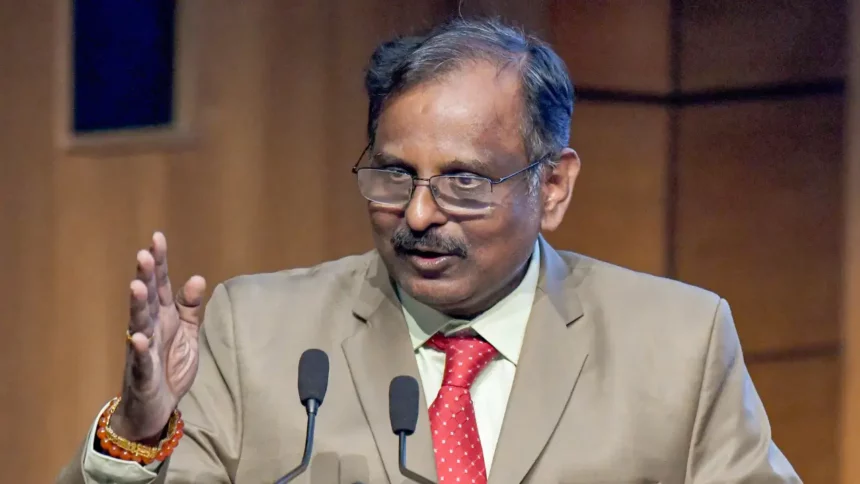
ISRO chairman V Narayanan recently revealed that 10 satellites are continuously operational to ensure the safety and security of India’s citizens, especially amid rising tensions with Pakistan. Speaking at the 5th convocation ceremony of Central Agricultural University (CAU) in Agartala, Narayanan emphasized that satellite and drone technologies play a crucial role in safeguarding the country. He further added, “To ensure the safety of our country, we must rely on our satellites to monitor critical areas such as the 7,000 km-long coastline.”
Narayanan’s remarks coincide with the upcoming launch of EOS-09 (RISAT-1B), a radar imaging satellite set for a sun-synchronous orbit on May 18. This satellite is expected to significantly boost India’s surveillance capabilities along its sensitive borders.
India’s Satellite Revolution and Future Plans
Narayanan also highlighted the growing importance of advanced satellite technology in propelling India’s development, particularly in regions like the northeastern states. He pointed out that ISRO’s satellite network has contributed to numerous regional development projects. The ISRO chairman expressed optimism for the future, predicting that by the time India celebrates its centenary of independence, the country would emerge as a global leader in various fields, with space technology playing a pivotal role.
ISRO has already launched 127 satellites, including those from private operators and academic institutions. Out of these, 22 satellites are in low Earth orbit, and 29 are in geosynchronous orbit. Among these, a dozen satellites, including Cartosat, RISAT, EMISAT, and MicroSat, are dedicated to strategic monitoring and reconnaissance.
A New Era of Space Surveillance
India is also looking to expand its space surveillance capabilities. The Indian National Space Promotion and Authorization Centre (IN-SPACe) has announced plans to launch a constellation of 52 satellites over the next five years. This ambitious project, revealed by IN-SPACe chairman Pawan Kumar Goenka at the Global Space Exploration Conference 2025, aims to significantly enhance space-based surveillance. Goenka emphasized that while India already has strong capabilities, constant enhancement is necessary. The plan also includes involving the private sector in future satellite operations, alongside ISRO.
The new satellites will be instrumental for India’s defense forces, including the Army, Navy, and Air Force. They will aid in tracking enemy movements, monitoring borders, and improving coordination during military operations. This expanded satellite network marks a new era in India’s strategic space capabilities.