The ambitious cloud seeding experiment conducted over Delhi on Tuesday, aimed at bringing artificial rain to curb pollution, ended without any measurable rainfall. Despite the ₹1.2 crore exercise failing to produce showers, Delhi’s environment minister called the trial “scientifically successful,” citing minor reductions in particulate matter levels. The initiative, however, quickly turned into a political flashpoint, reigniting the rivalry between the Aam Aadmi Party (AAP) and the Bharatiya Janata Party (BJP), with AAP accusing the government of wasting taxpayers’ money and the BJP defending it as a step forward in scientific experimentation.
The Science Behind Delhi’s Cloud Seeding Attempt
Delhi’s latest attempt to induce artificial rain was carried out with the help of IIT Kanpur, marking one of the city’s most ambitious environmental projects to combat hazardous air pollution. The Delhi Cabinet had approved the cloud seeding project on May 7, allocating ₹3.21 crore for five experimental trials — roughly ₹64 lakh per attempt. Of these, two trials were conducted on Tuesday, costing approximately ₹1.28 crore in total.
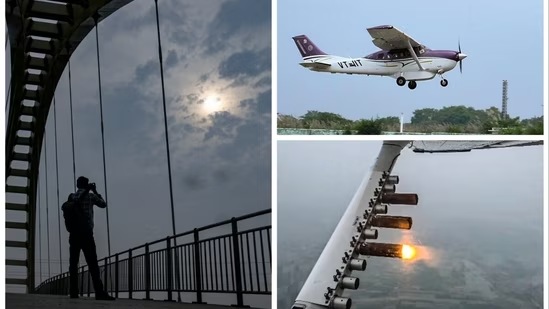
A single-engine Cessna aircraft operated by IIT Kanpur carried out the operation over northwest Delhi, Burari, and parts of Noida and Mayur Vihar. The aircraft released 16 flares — eight in each trial — containing a mixture of silver iodide and sodium chloride compounds into the clouds. These substances are commonly used in cloud seeding experiments worldwide to encourage condensation and rainfall.
The first trial was completed by 2 pm, while the second flight took off from Meerut at 4 pm and concluded within an hour, covering areas including Badli and outer Delhi. The environment ministry hoped that rainfall would occur within 15 minutes to four hours after the operation. However, data from the India Meteorological Department (IMD) showed no rainfall in Delhi until late evening.
According to the Delhi government’s official report, the IMD had predicted very low humidity levels of about 10–15 percent — far from ideal for cloud seeding to succeed. Under such conditions, the chances of generating rainfall through artificial means were minimal. Despite this, Environment Minister Manjinder Singh Sirsa described the experiment as an “important step forward” in using science to fight pollution.
Sirsa stated that the primary goal was not merely to produce rainfall but to assess how effective cloud seeding could be in Delhi’s atmospheric conditions. He noted that the trials provided valuable data on the interaction between humidity, aerosol particles, and cloud formation over the region. He added that several more trials were planned for the coming days, depending on weather conditions.
He emphasized that Delhi had taken an unprecedented “science-first” approach by adopting cloud seeding as a pollution control tool. “With every trial, science guides our actions—for the winter and all year round,” he said. Sirsa explained that IIT Kanpur’s data would be analyzed to understand the reduction in particulate matter levels recorded in the targeted areas after the trial. The report indicated minor improvements in air quality metrics even though rainfall did not occur.
This initiative came amid a severe pollution crisis, with the Air Quality Index (AQI) in Delhi remaining in the “very poor” category. The cloud seeding plan was part of a broader strategy to explore emergency interventions during peak smog periods. The government hoped that even a slight drizzle would help settle dust and pollutants suspended in the air.
The project faced multiple delays before it could take off. Initially, it was scheduled for late May or early June but was postponed due to the onset of the southwest monsoon. Later, continued rains in August and September forced another delay. Finally, with weather conditions clearing but pollution levels soaring, the government decided to proceed in late October.
However, scientists cautioned that artificial rain is never guaranteed. Cloud seeding requires specific meteorological conditions — including adequate moisture and cloud density — to trigger precipitation. Without sufficient humidity, the seeding particles cannot effectively attract water droplets, making rainfall unlikely.
Experts also pointed out that even when successful, cloud seeding produces only light rain and should not be seen as a permanent solution to Delhi’s chronic air pollution. Instead, it can provide temporary relief while long-term structural measures are implemented. Despite this scientific context, the absence of rain on Tuesday became a lightning rod for political attacks.
Political Tussle Over Artificial Rain and Accountability
The failure of Delhi’s cloud seeding trial quickly escalated into a political controversy, reflecting the intense rivalry between the AAP and BJP in the capital. The Aam Aadmi Party, which governed Delhi before the BJP-led administration took charge, criticized the experiment as a “publicity stunt” and questioned the timing and scientific basis of the trials.
At a press conference on Tuesday, senior AAP leader Saurabh Bharadwaj mocked the government’s efforts, asking sarcastically whether “Lord Indra” would descend to confirm whether the rain was artificial or natural. The event even featured the Bollywood song “Jhooth Bole Kauwa Kaate” playing in the background as Saurabh Bharadwaj displayed placards accusing the BJP of misleading citizens and conducting “fraudulent experiments.”
Saurabh Bharadwaj also questioned why the trials were conducted on a day when the IMD had already predicted natural rainfall, suggesting that the government was attempting to take undue credit for any showers that might occur. “If IMD had already forecast rain, what was the point of spending over ₹1 crore on artificial rain experiments?” he asked.
He further alleged that the government was using taxpayer money for optics rather than science and transparency. AAP leaders accused the administration of ignoring expert advice and failing to disclose complete data about the meteorological conditions under which the trials were carried out.
In response, Environment Minister Manjinder Singh Sirsa defended the project, emphasizing that the purpose was to collect scientific data, not to ensure immediate rainfall. He pointed out that AAP had originally introduced the concept of cloud seeding in 2023 but failed to execute it, citing “unfavorable meteorological conditions.”
Sirsa accused AAP of hypocrisy, saying that while they had only talked about the project, the current government had actually implemented it. “They merely made announcements. We acted,” he said. He further added that cloud seeding is a proven technique used in several countries, including the United States, China, and the United Arab Emirates, to supplement rainfall and reduce pollution.
The BJP-led government maintained that the experiment was part of a larger scientific collaboration with IIT Kanpur and that more trials would follow. Sirsa clarified that the IMD’s data on humidity levels was taken into account before proceeding, and despite unfavorable conditions, the trials yielded valuable learnings. He stated that scientific experimentation often requires multiple attempts and long-term analysis before measurable success is achieved.
The Delhi government’s report mentioned that although rainfall was not observed, particulate matter levels showed a slight decline in the regions directly under the seeded clouds, suggesting partial atmospheric benefits. This finding, according to officials, justified the continuation of further trials.
Meanwhile, AAP continued to criticize the BJP’s handling of environmental issues, accusing it of diverting attention from more practical measures such as regulating construction dust, vehicular emissions, and industrial pollutants. The party claimed that the money spent on the failed experiment could have been used to fund anti-smog guns, street vacuum machines, or air purifiers in schools and hospitals.
Political observers see the episode as a reflection of the larger governance battle in Delhi, where both parties are locked in a continuous struggle to claim credit for environmental initiatives. With pollution levels rising each winter, every administration faces intense public pressure to act swiftly, even as scientific limitations make quick fixes difficult.
The cloud seeding episode also revived memories of last year’s stalled plan. The AAP government in 2023 had proposed a similar project but claimed it did not receive timely approval from the central government for necessary flight and environmental permissions. BJP leaders, however, argued that AAP failed to fulfill procedural requirements.
This year’s trials, though conducted under BJP’s watch, have highlighted the same challenges: unpredictable weather, low humidity, and unclear communication between multiple agencies. For now, Delhi’s hopes for artificial rain remain unfulfilled, but the controversy ensures that the debate over scientific solutions versus political posturing will continue.
In the coming days, more cloud seeding attempts are expected, depending on the weather forecasts and atmospheric moisture levels. Authorities remain optimistic that with more favorable humidity, future trials might yield better results. Yet, the failure of this initial attempt underscores the difficulty of controlling nature through science — and the ease with which such efforts become political ammunition in the capital’s charged atmosphere.