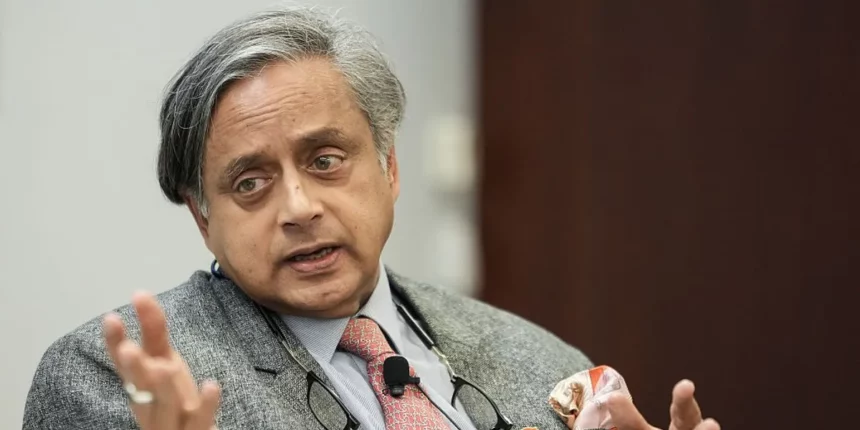
Amazon’s latest decision to slash nearly 30,000 corporate jobs has triggered widespread debate about the future of global employment in the age of artificial intelligence. The move, which marks the largest layoff in the company’s history, comes months after CEO Andy Jassy cautioned that rapid advances in AI would inevitably shrink workforces across industries. Reacting to the development, Congress MP Shashi Tharoor described the situation as “deeply worrying,” expressing concern over how automation and AI are redefining the world of work.
Amazon’s Largest Layoff Marks a Turning Point in Global Employment
On Tuesday, Amazon.com Inc. confirmed plans to eliminate about 14,000 corporate positions in an initial phase, with reports suggesting that the total number of layoffs could reach as high as 30,000. The decision represents a massive downsizing effort aimed at streamlining operations, reducing costs, and reversing the over-hiring that took place during the pandemic-era surge in online demand.
According to Reuters, the layoffs are expected to impact nearly 10 percent of Amazon’s 350,000-strong corporate workforce. Unlike previous rounds of job cuts that primarily affected warehouse or seasonal staff, this phase targets white-collar professionals — engineers, managers, cloud architects, and human resource executives. These roles were once considered relatively secure, leading experts to view this downsizing as a critical inflection point in the global employment landscape.
Congress MP Shashi Tharoor, a long-time observer of global economic and technological shifts, shared his concern on X (formerly Twitter). Quoting a post by global workforce analyst Shanaka Anslem Perera, Tharoor remarked, “We are seeing the future, and it’s deeply worrying.” Perera had earlier described Amazon’s move as a “turning point” in how technology giants are reconfiguring their organizational structures under the influence of AI-driven efficiency.
Perera emphasized that the scale of this downsizing surpasses the 27,000 layoffs Amazon carried out between 2022 and 2023, underscoring that the current wave reflects not just cost-cutting, but a deeper strategic realignment. The affected departments include Amazon Web Services (AWS), operations, devices, services, and the People Experience and Technology (PXT) division — the internal name for the company’s human resources arm.
The layoffs are part of Amazon’s broader restructuring initiative under CEO Andy Jassy, who has openly criticized the company’s internal “bureaucracy” and inefficiencies. Insiders reveal that Jassy’s reforms include introducing an anonymous feedback system for employees to flag redundant processes, a move that has already led to over 450 workflow changes within the company.
The Role of AI and Cost Efficiency in Amazon’s Strategy
Amazon’s restructuring drive cannot be viewed in isolation. Over the past few years, the company has faced mounting pressure to enhance profitability following the explosive expansion during the pandemic. As global e-commerce growth stabilizes and AI becomes increasingly central to corporate strategy, companies like Amazon are realigning their human capital to favor automation, machine learning, and algorithmic optimization over manual oversight.
In June 2025, Andy Jassy had hinted at potential workforce reductions tied to the company’s increasing reliance on AI tools. The CEO emphasized that the company’s investments in artificial intelligence were leading to a more streamlined and data-driven operating model. Insiders suggest that automation has already replaced several managerial and support functions once handled by humans, leading to a natural contraction in corporate headcount.
According to internal sources, managers overseeing teams affected by the layoffs were required to attend a training session on Monday — a day before the layoffs were announced — to learn how to communicate with employees who would soon receive termination notices. The goal, sources said, was to ensure sensitivity and transparency during the process. By Tuesday morning, several employees reportedly began receiving official communication about their job status, confirming the scale of the layoffs.
Industry observers believe the layoffs are a byproduct of two converging trends: cost-cutting measures in response to slowing growth, and a strategic pivot toward AI-powered automation. During the pandemic years, Amazon’s workforce ballooned as demand for online shopping, logistics, and content services surged. However, as global markets normalize, the company now finds itself grappling with excess capacity in both manpower and management structures.
Moreover, the integration of AI into business operations has made certain roles redundant. Functions like human resources, data analysis, and project management — once considered insulated from automation — are now increasingly being handled by AI-driven systems that can process information faster and at a lower cost. This shift has sparked fears of widespread job displacement, not only within Amazon but across the entire tech sector.
Tharoor’s reaction reflects a growing global anxiety about the impact of artificial intelligence on employment. He noted that while technological progress is inevitable, it is “deeply worrying” that human roles are being erased faster than societies can adapt. His statement aligns with a broader political and philosophical debate about how governments and corporations should address the social consequences of automation and AI.
Several labor economists have pointed out that the latest round of layoffs represents more than just a cost-management exercise. It symbolizes a paradigm shift in corporate priorities, where human capital is increasingly being replaced with algorithmic efficiency. The trend, they warn, could exacerbate inequality and lead to long-term instability in labor markets if not countered with robust policy interventions.
Amazon’s restructuring comes at a time when other tech giants — including Google, Meta, and Microsoft — are also implementing significant workforce reductions while investing heavily in AI capabilities. The simultaneous occurrence of layoffs and AI expansion has led many analysts to conclude that the technology sector is entering a new phase of “creative destruction,” where old roles are rapidly being replaced by new ones that require entirely different skill sets.
At the same time, Amazon’s leadership insists that these changes are necessary to maintain competitiveness and innovation. In internal communications, Andy Jassy has emphasized the need to “focus resources on high-impact projects” while eliminating redundant layers of management. He has described the restructuring as essential to sustaining Amazon’s long-term growth in an era defined by automation and digital transformation.
However, critics argue that the company’s relentless pursuit of efficiency may come at the expense of its workforce’s morale and stability. Employees affected by the layoffs have expressed disillusionment with what they describe as a “cold and calculated” process, noting that Amazon’s once-celebrated corporate culture now feels increasingly transactional.
Analysts further note that the impact of such large-scale layoffs is not limited to the individuals directly affected. The ripple effects extend to the broader economy, especially in sectors that rely on corporate spending, such as housing, healthcare, and education. In cities like Seattle, where Amazon’s presence is a major economic driver, local businesses are bracing for potential downturns in consumer spending.
Despite these concerns, Amazon remains optimistic about its long-term vision. The company’s focus on artificial intelligence, automation, and cloud innovation is expected to shape its next decade of growth. Yet, the immediate human cost of these strategic shifts — thousands of skilled professionals losing their jobs — underscores the growing tension between technological progress and social responsibility.
Shashi Tharoor’s comment, therefore, captures not just the sentiment surrounding Amazon’s layoffs but also a larger philosophical dilemma confronting modern economies. As AI systems grow more capable, the definition of “safe” jobs continues to erode, forcing policymakers, corporations, and workers alike to confront difficult questions about the future of employment.
In the end, Amazon’s layoffs serve as a stark reminder of both the promise and peril of technological advancement. While the company’s restructuring may position it for greater efficiency and innovation, it also lays bare the unsettling reality of an economy increasingly driven by machines — one that may leave millions of workers behind unless proactive measures are taken to ensure a just and inclusive transition into the AI era.