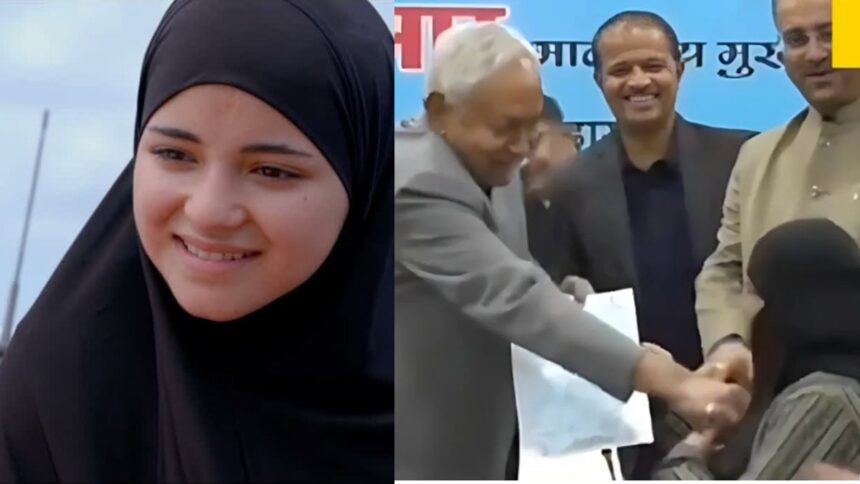
Former actor Zaira Wasim’s sharp criticism of Bihar Chief Minister Nitish Kumar over a controversial hijab-related incident has reignited a nationwide conversation on women’s dignity, religious freedom, and the responsibilities of those holding public office. Her demand for an unconditional apology has resonated far beyond the immediate episode, drawing attention to deeper questions about power, consent, and the boundaries that must govern public conduct in a diverse democracy like India.
The incident and the public outcry that followed
The controversy began after a video from a public programme in Bihar circulated widely on social media, showing Chief Minister Nitish Kumar interacting with a young female doctor during an official appointment ceremony. In the footage, the chief minister is seen reaching toward the woman’s hijab in a gesture that many viewers perceived as intrusive and inappropriate. The moment, brief but highly visible, quickly became the centre of intense public scrutiny, triggering debates across political, social, and cultural platforms.
As the video gained traction, reactions poured in from across the country. Many social media users expressed discomfort and anger, arguing that the act violated personal boundaries and disregarded a woman’s right to bodily autonomy and religious expression. Others sought to contextualise or downplay the incident, suggesting it was misunderstood or unintended. However, the dominant response reflected a sense of unease about the optics of a senior political leader touching a woman’s religious attire in a public setting.
Zaira Wasim, who stepped away from the film industry several years ago and has since spoken frequently on issues of faith, identity, and dignity, emerged as one of the most prominent voices condemning the incident. In a strongly worded message shared online, she described the act as infuriating and unacceptable, asserting that no position of authority grants the right to cross personal or religious boundaries. She emphasised that a woman’s hijab is not a prop to be adjusted or questioned in public, but an intimate expression of personal and religious choice.
Wasim’s reaction struck a chord with many, particularly women who saw the incident as emblematic of a broader pattern in which powerful figures feel entitled to intrude into women’s personal space. Her insistence on an unconditional apology underscored the belief that accountability must be clear and unequivocal, especially when the actions of public leaders send signals about acceptable behaviour in society.
The issue quickly moved beyond individual reactions and entered the political arena. Opposition leaders criticised the chief minister’s conduct, framing it as a violation of personal dignity and religious freedom. Some parties demanded a formal apology, while others raised questions about the broader culture of impunity enjoyed by those in power. At the same time, a few voices within the ruling establishment attempted to defend Nitish Kumar, describing the gesture as paternal or misunderstood, a defence that itself attracted criticism for reinforcing patronising attitudes toward women.
The woman at the centre of the incident, a newly appointed doctor, became an unwilling focal point of national attention. Many commentators stressed that regardless of intent, the incident highlighted how easily women can be placed in uncomfortable situations on public stages, particularly when interacting with senior male authority figures. The episode thus became less about individual intent and more about systemic attitudes toward consent, respect, and power.
Zaira Wasim’s stance and the wider debate on dignity and power
Zaira Wasim’s intervention added a distinct moral and social dimension to the unfolding controversy. Speaking as a Muslim woman, she articulated the emotional impact of seeing another woman’s religious attire handled casually in public. Her comments framed the incident not merely as a political misstep but as a violation of dignity that resonates deeply with those for whom the hijab is tied to identity, faith, and personal autonomy.
In her statements, Wasim stressed that the issue was not about political allegiance but about basic human respect. She argued that public officials must be held to higher standards because their actions shape societal norms. When those in authority cross boundaries without consequence, it risks normalising behaviour that undermines women’s safety and confidence in public spaces. Her demand for an unconditional apology reflected a broader call for acknowledgement of harm rather than justifications or explanations.
The controversy also reignited long-standing debates in India around religious symbols, women’s agency, and the intersection of politics and personal faith. For many, the incident served as a reminder that discussions about hijab and religious attire are often conducted without centring the voices of the women who wear them. Instead, decisions and judgments are frequently imposed from positions of power, reinforcing hierarchies that marginalise individual choice.
Supporters of Wasim’s stance pointed out that the conversation should not be diverted into arguments about intent or political rivalry. They argued that the core issue was consent and respect, principles that apply regardless of religion, gender, or political ideology. The act of touching someone’s clothing or body without consent, they said, is inappropriate in any context, more so when it involves a woman and a powerful male leader on a public platform.
At the same time, the incident exposed how quickly such matters become polarised in India’s charged political environment. While many demanded accountability, others framed the backlash as excessive or politically motivated. This division highlighted the challenge of addressing issues of gender and dignity without them being subsumed into partisan conflict.
The broader debate also touched on the expectations placed on public leaders in a democratic society. Critics argued that leaders must be acutely aware of how their actions are perceived, particularly in a country marked by religious diversity and historical sensitivities. Symbolic gestures, even if unintended, can carry significant meaning and consequences. In this context, the call for an unconditional apology was seen not as an act of humiliation but as a reaffirmation of democratic values and respect for citizens.
Zaira Wasim’s criticism thus became part of a larger conversation about reclaiming space for women’s voices in discussions that directly affect them. Her intervention highlighted how public discourse often shifts focus away from those who experience harm toward debates about political intent or image management. By insisting on accountability and dignity, she redirected attention to the lived realities of women navigating public life under the gaze of power.
As the debate continued, it underscored unresolved tensions in Indian society regarding authority, tradition, and change. The incident and its aftermath revealed how deeply questions of consent and respect are intertwined with cultural norms and political structures. It also demonstrated the influence that public figures like Wasim can wield in shaping conversations that challenge entrenched attitudes.
The controversy remains a touchstone for discussions about how India negotiates issues of gender, religion, and power in public life. Whether it leads to lasting reflection or fades into the cycle of news will depend on how institutions and leaders respond to the demands for accountability and change voiced by citizens and public figures alike.