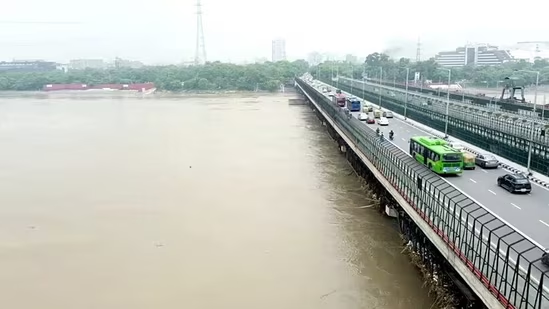
The Yamuna river in Delhi has once again breached the danger mark, raising alarm across the capital and bringing renewed focus on the city’s preparedness to deal with recurring flooding in low-lying areas. Despite Delhi chief minister Rekha Gupta’s assurances earlier this week that there was no flood-like situation and that water levels would soon recede, the river crossed critical limits on Wednesday morning, prompting officials to intensify monitoring and relief measures. The situation has once again highlighted the vulnerability of Delhi’s floodplain settlements and the challenges of managing excessive water releases from upstream barrages.
Water Levels Cross Critical Limits in the Capital
The Yamuna’s warning mark in Delhi is set at 204.50 metres, while the danger mark stands at 205.33 metres. Evacuation protocols are triggered when the river crosses the 206-metre mark. On Monday, the river first crossed the danger threshold following the opening of all eighteen gates of the Hathinikund Barrage in Haryana — the first such release this monsoon season. The surge in water flow not only impacted Delhi but also created ripple effects downstream in Faridabad, where rising water levels from the Okhla Barrage led to waterlogging in low-lying neighborhoods.
By Tuesday morning, the water level at the Old Railway Bridge in Delhi had climbed to 205.79 metres, dangerously close to the 206-metre evacuation threshold. This development came just a day after chief minister Rekha Gupta had expressed confidence that the peak levels had already been reached and that the situation was under control. Gupta, while visiting Yamuna Bazar on Tuesday, waded through knee-deep water in some areas, interacting directly with residents whose homes were inundated. She assured citizens that arrangements were being made to ensure safety, including shelter in schools converted into relief camps, the provision of food and medical facilities, and the installation of solar-powered floodlights in the absence of electricity.
In her remarks shared on social media platform X, Gupta stressed that the government’s control room was keeping a constant watch on the river’s water levels and that rescue teams were stationed in vulnerable zones. “This area is a low-lying part of the Yamuna floodplain, so water has entered, but it has not advanced further. There is no flood-like situation in Delhi. The peak water level has been reached, and the water is receding,” she wrote. However, the fact that the river rose again the very next day has raised questions about the unpredictability of monsoon flows and the accuracy of official forecasts.
The consistent rise and fall of the Yamuna’s water level this week is also a reminder of how fragile the balance remains between natural monsoon inflows, barrage management, and urban flood preparedness. Delhi’s low-lying areas, particularly those close to the Yamuna’s banks, face disproportionate risks during this season, with hundreds of families forced to move to temporary shelters whenever the river breaches its danger mark. While some are relocated, many others continue to live with floodwaters inside their homes, citing livelihood concerns and attachment to their localities.
Government Response and Administrative Preparations
Chief minister Rekha Gupta’s inspection of Yamuna Bazar highlighted both the immediate difficulties faced by residents and the government’s efforts to mitigate the crisis. Officials accompanying her reported that relief camps had been set up in several schools across flood-prone areas, where basic amenities such as food, drinking water, and medical relief are being provided. Special attention has been given to vulnerable groups, including children, elderly people, and patients with chronic illnesses, who are often most affected by displacements.
A particular challenge in the flooded areas has been the disruption of electricity. In response, the Delhi government has arranged solar-powered floodlights to ensure safety and visibility at night, minimizing the risks posed by darkness in waterlogged neighborhoods. The chief minister assured residents that no household would be left without support, and that all administrative agencies — including disaster management units, police, and health departments — had been directed to maintain round-the-clock vigilance.
Officials said that monitoring of the river’s levels was being carried out in real time, with continuous coordination between Delhi and Haryana authorities. The release of water from upstream barrages, especially Hathinikund in Yamunanagar district, remains the single most critical factor influencing the capital’s flood situation. Whenever the barrage gates are fully opened, massive volumes of water flow downstream within hours, creating pressure on the city’s floodplains. In past years, this phenomenon has repeatedly led to displacement of thousands of residents, disruption of transport routes, and large-scale damage to property and crops.
The Faridabad administration has also reported increased waterlogging after releases from Delhi’s Okhla Barrage, underlining the cascading impact of barrage operations along the Yamuna. With heavy rainfall continuing in parts of Haryana, Uttarakhand, and Himachal Pradesh, officials are concerned that the river could experience further surges in the coming days. The India Meteorological Department has forecast scattered rainfall across the region, though not at levels that could trigger extreme flooding.
Despite these measures, criticism has emerged regarding the timing and communication of flood alerts. Opposition leaders and civic groups have argued that vulnerable communities should have been warned earlier and relocated before water entered their homes. Many families in Yamuna Bazar and nearby areas complained about inadequate arrangements for sanitation and drinking water at relief camps, pointing to recurring gaps in flood preparedness year after year.
The issue has also acquired a political dimension, as Rekha Gupta’s government faces scrutiny for its handling of the crisis. Gupta has maintained that the situation is under control and that the administration has acted swiftly, but critics claim the assurances have not matched the realities faced by residents on the ground.
Beyond the immediate crisis, experts argue that Delhi’s flood management system requires a long-term overhaul. Urban planners have consistently warned against unchecked construction on floodplains, which reduces the natural capacity of the Yamuna to absorb excess flows. Encroachments, coupled with inadequate drainage infrastructure, compound the risks of waterlogging and displacement whenever the river breaches its limits. Environmentalists also point to the degradation of the Yamuna’s ecosystem, arguing that restoring wetlands and creating buffer zones would significantly reduce the impact of monsoon flooding.
The Yamuna continues to flow above the danger mark, the Delhi government has reiterated its commitment to protect lives and property. Relief teams remain on alert, and further evacuations could be ordered if the water level crosses 206 metres. While the immediate situation is tense but under watch, the broader challenge for Delhi lies in developing resilient flood management strategies that can withstand the increasingly erratic monsoon patterns of recent years.