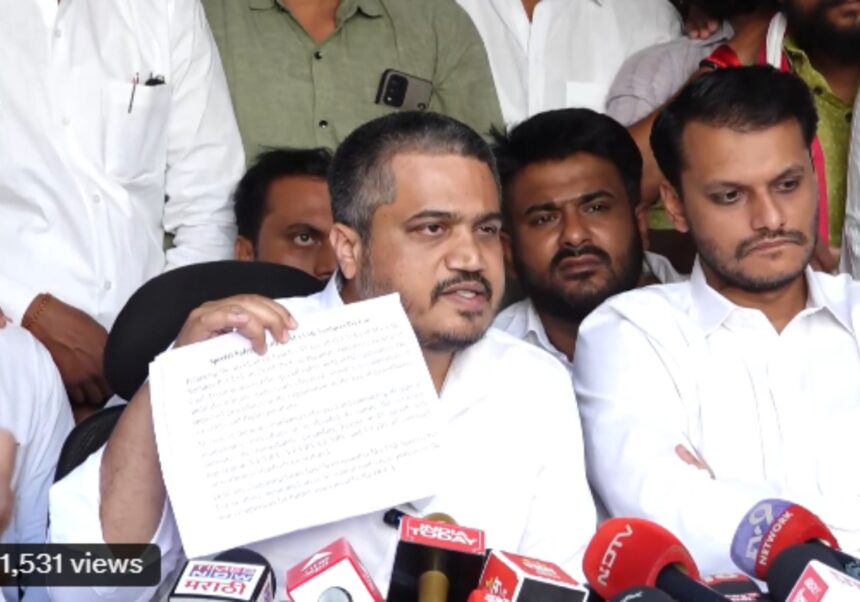
The investigation into the tragic plane crash that claimed the life of senior Maharashtra leader Ajit Pawar has entered a critical phase, with the Aircraft Accident Investigation Bureau set to release its preliminary findings and Rohit Pawar announcing that he will reveal what he describes as shocking details about the incident. The development has intensified political debate, public scrutiny, and demands for transparency as multiple agencies examine the circumstances surrounding the crash.
The accident, which occurred near Baramati, sent shockwaves across Maharashtra and the country. Ajit Pawar, a prominent political figure with decades of influence in state politics, was travelling in a private aircraft when it went down under circumstances that remain under investigation. In the immediate aftermath, authorities launched a multi-layered probe to determine whether technical malfunction, human error, weather conditions, or regulatory lapses played a role in the fatal incident.
The Aircraft Accident Investigation Bureau, the central agency responsible for probing civil aviation accidents, began its inquiry by securing the crash site, collecting debris, and retrieving the aircraft’s flight data recorder and cockpit voice recorder. Investigators have since analysed flight parameters, engine performance data, and communication logs between the cockpit and air traffic control. The preliminary report, expected to be presented soon, will outline initial findings without assigning final responsibility, in accordance with established aviation investigation protocols.
Amid this ongoing technical investigation, Rohit Pawar, a political leader and relative of the late Ajit Pawar, has publicly stated that he intends to disclose information that could raise serious questions about the circumstances leading to the crash. His announcement has heightened anticipation ahead of the official report, adding a political dimension to what is fundamentally an aviation safety inquiry.
Political Allegations and Demands for Transparency Intensify
Rohit Pawar’s statements have brought renewed attention to the case, as he has suggested that the public deserves complete transparency and accountability. He has indicated that the material he plans to reveal could challenge prevailing narratives or expose potential irregularities linked to the aircraft’s operations, maintenance, or regulatory oversight. While he has not publicly detailed the nature of his claims, the suggestion of “shocking findings” has sparked speculation and debate across political circles.
In recent weeks, Rohit Pawar has written to national authorities urging a thorough and impartial investigation. He has called for scrutiny of the aircraft’s ownership structure, operational clearances, and compliance with aviation safety norms. According to him, any possible conflict of interest or regulatory lapse must be examined in depth to ensure that the investigation commands public trust.
The crash has also prompted broader political reactions in Maharashtra. Leaders across party lines have expressed condolences and demanded a transparent probe. However, the issue has increasingly become part of the political discourse, with questions raised about regulatory oversight and whether existing safety mechanisms were adequately enforced.
Public sentiment in the region where the crash occurred has been marked by grief as well as agitation. Residents have sought clarity regarding the sequence of events that led to the accident. In some areas, local groups have organised demonstrations and symbolic shutdowns to underline their demand for a comprehensive investigation. For many, the tragedy represents not only a personal loss but also a test of institutional accountability.
The Maharashtra government has acknowledged the seriousness of public concerns and has supported the continuation of a detailed probe. Alongside the Aircraft Accident Investigation Bureau’s inquiry, discussions have emerged regarding the possibility of additional investigative oversight to reinforce credibility. The objective, officials have said, is to ensure that no aspect of the incident remains unexplored.
Aviation experts have noted that preliminary investigation reports typically focus on factual data collected in the early stages. These reports often detail flight conditions, aircraft configuration, weather information, and initial observations from wreckage analysis. They do not usually determine final causation, which can take months or even years to establish after exhaustive technical evaluation. Nevertheless, preliminary findings often shape public understanding of the event’s direction and may highlight areas requiring deeper scrutiny.
Against this backdrop, Rohit Pawar’s proposed revelations have added urgency to the political climate. Supporters argue that independent scrutiny strengthens democratic accountability, while others caution against drawing conclusions before official findings are fully examined. The intersection of technical investigation and political commentary has made the case one of the most closely watched aviation incidents in recent memory within the state.
Technical Investigation, Aviation Safety and Wider Implications
The crash near Baramati involved a private aircraft operating under civil aviation regulations that require strict adherence to maintenance schedules, crew certification standards, and operational guidelines. Investigators have been examining whether the aircraft met all airworthiness criteria before departure. Maintenance records, pilot training documentation, and pre-flight inspection procedures are central to determining whether procedural lapses contributed to the tragedy.
The recovery and analysis of flight data recorders represent a crucial step in reconstructing the aircraft’s final moments. These devices capture detailed information about altitude, speed, engine performance, control inputs, and other technical parameters. When correlated with cockpit voice recordings and air traffic control communications, investigators can develop a minute-by-minute timeline of events leading up to the crash.
Weather conditions at the time of the incident have also come under review. Low visibility, wind patterns, and atmospheric disturbances can significantly affect flight safety, particularly during takeoff or landing phases. Meteorological data from the relevant period is being assessed to determine whether environmental factors played a contributing role.
Beyond technical specifics, the case has reopened discussions about aviation oversight in India’s rapidly expanding civil aviation sector. With increasing numbers of private aircraft operations and growing passenger traffic nationwide, ensuring robust regulatory enforcement remains essential. The Aircraft Accident Investigation Bureau operates independently of commercial aviation operators, and its mandate focuses on identifying causes and preventing recurrence rather than assigning criminal liability.
Safety specialists stress that aviation investigations are designed to improve systemic safeguards. By identifying procedural weaknesses or mechanical vulnerabilities, authorities can recommend corrective measures that enhance future safety standards. In this context, the preliminary report will likely outline initial observations and may suggest interim safety recommendations if immediate risks are identified.
Meanwhile, the broader political narrative continues to evolve. Rohit Pawar has maintained that transparency is essential not only for justice but also for restoring public faith in regulatory institutions. His call for accountability reflects a wider expectation that high-profile incidents must be investigated without ambiguity. He has emphasised that the matter transcends party lines and concerns public safety at large.
Observers note that aviation tragedies involving public figures often attract heightened scrutiny due to their national impact. The loss of a senior leader amplifies emotional responses and intensifies demands for clarity. In such situations, balancing technical investigation protocols with public communication becomes particularly important. Authorities must ensure that factual information is shared responsibly while avoiding premature conclusions.
As the preliminary report’s release approaches, anticipation remains high. The findings will provide an initial framework for understanding the incident, though comprehensive conclusions may take considerable time. The interplay between official investigation results and Rohit Pawar’s promised disclosures is likely to shape public discourse in the coming weeks.
The tragedy has underscored the importance of rigorous aviation standards, transparent governance, and measured political dialogue. It has also highlighted the need for institutions to communicate clearly during crises, ensuring that facts guide public understanding rather than speculation. In the absence of final conclusions, the focus remains on evidence-based analysis and the pursuit of accountability through established legal and regulatory channels.
The coming days are expected to clarify key aspects of the incident while potentially raising new questions that warrant further examination. As investigators continue their work and political leaders voice their positions, the case stands at the intersection of aviation safety, public trust, and democratic scrutiny.