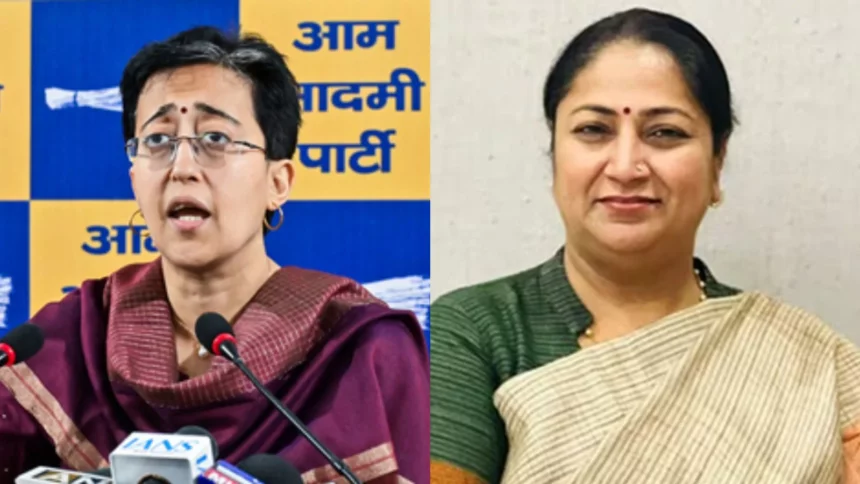
In a disturbing turn of events that has triggered strong political reactions across party lines, Delhi Chief Minister Rekha Gupta was allegedly attacked during a public hearing programme at her official residence in Civil Lines on Wednesday. The incident, which reportedly involved a man approaching the chief minister aggressively and physically assaulting her, has not only led to widespread condemnation but also reignited discussions on the state of women’s safety in the capital. Aam Aadmi Party (AAP) leader and former Delhi Chief Minister Atishi swiftly condemned the incident, asserting that violence has no place in a democracy and expressing concern for Rekha Gupta’s well-being. Leaders from other parties, including the Delhi Congress chief Devender Yadav, have also weighed in, framing the episode as reflective of broader concerns over law and order in the city.
Atishi Condemns Violence, Calls Incident an Assault on Democracy
Soon after reports of the alleged attack on Rekha Gupta surfaced, AAP leader Atishi reacted strongly to the incident. Taking to X (formerly Twitter), she expressed her shock and disappointment over the turn of events, emphasizing that while dissent and protest are intrinsic to the functioning of a democratic system, violence can never be condoned. “The attack on Delhi’s Chief Minister Rekha Gupta is highly condemnable. In a democracy, there is a place for disagreement and protest, but there is no place for violence,” Atishi wrote. Her statement, which quickly gained traction online, highlighted not only her solidarity with her successor but also the broader principle of maintaining civility in political and civic engagement.
Atishi, who herself has navigated intense political challenges as chief minister before Rekha Gupta, underscored the need for protecting democratic values against any form of aggression. The timing of the alleged assault is particularly sensitive, coming at a period when the capital city has been facing increasing public scrutiny over governance, transparency, and security. For AAP, which has positioned itself as a party focused on democratic participation and people-centric governance, the attack on Rekha Gupta struck at the core of its narrative of ensuring accountability and accessibility.
The BJP, which has long been AAP’s principal rival in Delhi politics, also reacted strongly to the news, but framed the incident differently. Party leaders argued that the alleged assault pointed to administrative lapses in security arrangements around the chief minister, given that the attack reportedly occurred inside Rekha Gupta’s official residence during a structured public event. The contrast between the statements of Atishi and BJP leaders revealed an ongoing tug-of-war in the political sphere, with both sides attempting to control the narrative emerging from the episode.
According to accounts provided by people in the chief minister’s office, the incident unfolded rapidly during the “Jan Sunwai” programme—a public grievance hearing session where citizens directly bring their concerns to the CM. A man in his thirties, as initially described, reportedly approached Rekha Gupta under the pretext of handing her a piece of paper. Instead of making a simple request, however, he began raising his voice at her, using offensive language and eventually escalating to physical aggression. Witnesses claim that he allegedly slapped the chief minister before being overpowered by her security detail and detained on the spot.
This sequence of events has been further complicated by contradictory details regarding the attacker’s identity. While early reports described him as being in his thirties, subsequent questioning revealed that the man himself claimed to be 41 years old. Authorities are still in the process of verifying his personal details and motivations, leaving several questions unanswered about how he gained access to the CM and whether the act was premeditated.
Women’s Safety Concerns Resurface Amid Political Outcry
Beyond the immediate condemnation of the incident as an attack on democratic principles, the episode has also brought the conversation around women’s safety to the forefront once again. Delhi Congress chief Devender Yadav, while describing the assault as “unfortunate,” placed it in the larger context of gender security in the national capital. He argued that the assault, if proven true, underscored a disturbing reality: if the chief minister of Delhi herself can be subjected to such violence within the supposedly secure confines of her official residence, then the safety of ordinary women in the city stands on even shakier ground.
“CM leads the entire Delhi, and I think that the more such incidents are condemned, the less it is. But this incident also exposes women’s safety. If the CM of Delhi is not safe, how can a common man or common woman be safe?” Yadav remarked. His comments resonated with a long-standing narrative that Delhi, often dubbed one of India’s most unsafe cities for women, continues to struggle with systemic issues related to gender-based violence, harassment, and insufficient law enforcement.
The political undertones of his statement were clear as well. By framing the incident as emblematic of women’s vulnerability in the capital, Yadav not only expressed solidarity with the victim but also implicitly questioned the effectiveness of the ruling party’s governance. It was a strategic move that shifted the narrative from being solely about an individual act of aggression to a larger reflection of institutional failures.
For citizens, however, the incident struck a chord for different reasons. Public hearings like “Jan Sunwai” are meant to symbolize direct democracy—platforms where leaders remain accessible to people and listen to their grievances without barriers. Such forums are especially significant in Delhi, where the complexity of urban issues often leaves residents feeling disconnected from governance. The alleged attack, therefore, risks undermining the trust and openness that these events are supposed to foster. If security concerns now begin to overshadow public hearings, the very concept of participatory governance could face setbacks.
Civil society groups have already started voicing concerns about the implications. Women’s rights activists, for instance, have pointed out that the episode reflects the double burden women leaders often face: navigating the challenges of political opposition while simultaneously confronting societal tendencies of aggression and disrespect toward women in positions of authority. Some have called for stronger protocols to protect female politicians, not only from physical harm but also from verbal abuse and harassment, which they argue are often dismissed as routine political hazards.
Meanwhile, law enforcement officials remain under pressure to provide clear answers about how the alleged assailant managed to breach the controlled environment of the CM’s residence during an official event. Security protocols at such high-level residences are typically stringent, raising questions about whether lapses occurred on the part of the Delhi Police or the chief minister’s personal security team. The fact that conflicting details about the attacker’s age and identity have emerged only deepens concerns about the adequacy of the investigation and the credibility of early reporting.
The political fallout is expected to intensify in the coming days, with opposition parties likely to continue criticizing the ruling dispensation while AAP leaders focus on portraying the incident as an attack not just on Rekha Gupta but on the very values of democracy. For Rekha Gupta herself, the incident represents a significant test of resilience and leadership. Her response to this challenge will likely influence public perception of her tenure, particularly as she seeks to establish herself in the shadow of her predecessor Atishi.
As Delhi processes the shock of this episode, one theme remains clear: violence, whether symbolic or physical, continues to threaten the democratic fabric of India’s capital. The assault on a sitting chief minister, if proven as described, represents not only a personal violation but also a larger indictment of the fragile balance between openness and security in public life. It has reawakened debates about how to preserve the spirit of participatory governance while ensuring that leaders—especially women leaders—are not left vulnerable to aggression.