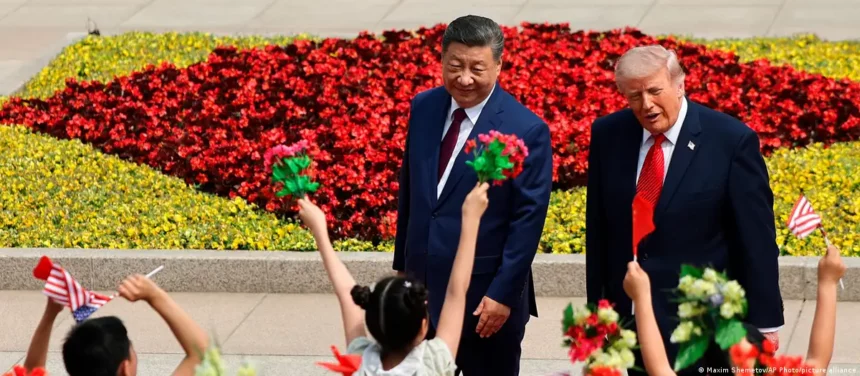
Xi Jinping and Donald Trump Hold Crucial Beijing Summit Amid Taiwan and Iran Tensions
Chinese President Xi Jinping and U.S. President Donald Trump held a historic summit in Beijing that could redefine the future of relations between the world’s two largest powers, as both leaders attempted to balance cooperation, rivalry, and escalating global tensions.
The high-profile meeting at the Great Hall of the People unfolded against the backdrop of rising geopolitical uncertainty, growing concerns over Taiwan, economic competition, and the ongoing crisis in West Asia. While both leaders projected optimism about stabilizing bilateral ties, sharp differences remained visible on several sensitive issues — especially Taiwan, which Xi described as the “most important issue” in China-US relations.
The summit marked one of the most closely watched diplomatic engagements of the year, with global markets, international allies, and strategic observers tracking every statement emerging from Beijing.
Xi Signals Stable Ties But Draws Red Line on Taiwan
During the talks, Xi Jinping emphasized the need for a “new era” in relations between China and the United States, calling for stable engagement and managed competition instead of confrontation.
Chinese state media portrayed the meeting as an effort to build a more predictable framework for bilateral ties after years of economic disputes, strategic mistrust, and military tensions in the Indo-Pacific region.
However, Xi also delivered a strong warning regarding Taiwan, making it clear that Beijing considers the self-ruled island a core national interest that cannot be compromised.
According to Chinese officials, Xi told Trump that Taiwan had the potential to become “very dangerous” if mishandled. He stressed that the issue remained the most sensitive and critical point in the relationship between the two powers.
The Taiwan question has increasingly become one of the biggest flashpoints between Beijing and Washington. China views Taiwan as part of its sovereign territory, while the United States maintains unofficial ties with Taipei and continues providing military and strategic support to the island.
Over the past several years, military activity around the Taiwan Strait has intensified significantly, raising fears of a future confrontation that could destabilize the broader Indo-Pacific region.
Diplomatic analysts believe Xi’s remarks were intended to firmly remind Washington that any major shift in U.S. policy on Taiwan would cross Beijing’s strategic red line.
Trump Seeks Cooperation Amid Global Instability
Despite disagreements over Taiwan and trade, Donald Trump struck a relatively optimistic tone during the summit.
Speaking briefly to reporters, Trump described the discussions with Xi as “great” and highlighted the importance of maintaining communication between the two global powers.
The U.S. president also focused heavily on economic engagement and business cooperation during the visit. Trump traveled to China accompanied by several prominent American business leaders, including Elon Musk and Tim Cook.
According to reports from Chinese state media, Trump told Xi that American corporate leaders had come to China to “pay respects” and strengthen commercial ties.
The inclusion of major U.S. business executives signaled Washington’s attempt to stabilize economic relations even as strategic rivalry continues in technology, trade, and defense sectors.
Economic relations between China and the United States have experienced repeated strain over tariffs, export controls, semiconductor restrictions, supply-chain disputes, and concerns regarding industrial policy.
However, business communities in both countries continue pushing for stable engagement due to the massive economic interdependence between the two economies.
Iran Crisis and Strait of Hormuz Concerns Dominate Discussions
While Taiwan dominated geopolitical attention, the ongoing conflict involving Iran and instability in West Asia also cast a major shadow over the summit.
The leaders reportedly discussed the growing global energy crisis linked to tensions around the Strait of Hormuz — one of the world’s most critical oil shipping routes.
Washington is believed to be urging Beijing to use its influence with Iran to help reduce regional tensions and support efforts aimed at stabilizing maritime trade routes.
China maintains close economic and strategic ties with Iran and remains one of Tehran’s most important global partners.
Trump was reportedly expected to encourage Xi to pressure Iran into ensuring uninterrupted maritime access through the Strait of Hormuz, where fears of escalation have rattled global energy markets.
The ongoing uncertainty in the Gulf region has already contributed to volatility in crude oil prices, shipping costs, and international energy supply chains.
For both China and the United States, stability in West Asia remains economically important because of the region’s role in global oil and gas exports.
Energy analysts say any prolonged disruption around Hormuz could severely affect global inflation, fuel prices, and industrial supply chains.
US-China Economic Relations Enter Sensitive Phase
The Beijing summit also highlighted the increasingly complicated nature of economic relations between the two countries.
China and the United States remain deeply interconnected economically despite strategic rivalry and growing technological competition.
American companies continue viewing China as one of the world’s largest consumer markets, while China remains heavily integrated into global manufacturing and trade systems.
However, political tensions have complicated commercial engagement over recent years.
Washington has imposed restrictions on advanced semiconductor exports, technology transfers, and investment flows involving strategic sectors. China, meanwhile, has accelerated efforts to reduce dependence on Western technology and strengthen domestic industrial capabilities.
The summit appeared designed partly to prevent further deterioration in business confidence and investor sentiment.
Meetings between Xi and American business executives suggested that Beijing wants to reassure international investors amid slowing economic growth and rising geopolitical risks.
At the same time, U.S. officials continue expressing concern over trade imbalances, market access issues, intellectual property disputes, and national security implications linked to advanced technology competition.
Global Attention Focuses on Future of Superpower Relations
The Xi-Trump summit has attracted extraordinary global attention because of its broader implications for international stability and geopolitical balance.
Relations between Washington and Beijing influence nearly every major global issue, including trade, technology, climate policy, military security, supply chains, and international diplomacy.
Allies across Asia, Europe, and the Middle East are closely monitoring the outcome of the talks to assess whether tensions between the two powers may stabilize or intensify further.
Strategic experts note that while both sides appear interested in avoiding direct confrontation, deep structural competition remains unresolved.
Issues involving Taiwan, military activity in the Indo-Pacific, economic rivalry, cybersecurity, and technological dominance continue shaping the long-term trajectory of US-China relations.
The summit’s symbolism was also significant because it reflected efforts by both governments to maintain direct dialogue despite increasing mistrust and geopolitical friction.
State Banquet and Further Talks Ahead
Following the formal summit discussions, Xi Jinping and Donald Trump were scheduled to attend a state banquet in Beijing before continuing another round of talks.
Officials from both countries are expected to continue negotiations on trade, security cooperation, energy stability, and diplomatic communication channels.
Observers believe the summit may help reduce immediate tensions and reopen broader strategic engagement, but few expect the fundamental rivalry between the two countries to disappear.
Instead, analysts say the emerging relationship may increasingly revolve around “managed competition” — a framework where both nations attempt to prevent conflict while continuing to compete aggressively for global influence.
As the world watches developments from Beijing, the future of the US-China relationship remains one of the defining factors shaping global politics, economic stability, and international security in the years ahead