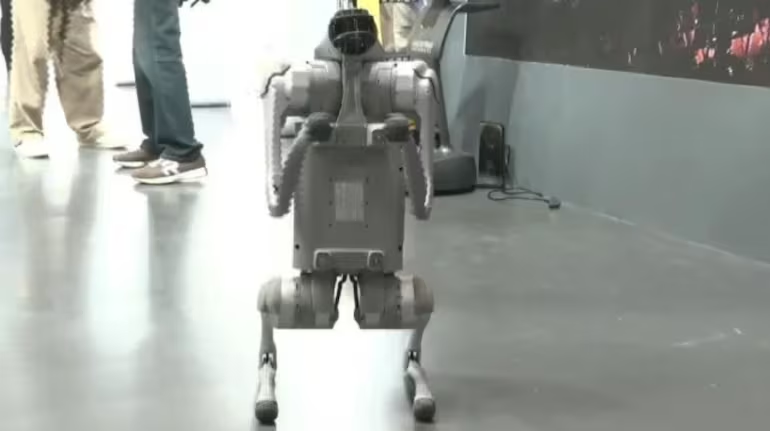
Technology services major Wipro showcased the Unitree Go2 quadruped robot at the Delhi AI Summit 2026, presenting it as a symbol of applied artificial intelligence and next-generation automation. The demonstration comes in the backdrop of a recent controversy involving Galgotias University, where questions were raised regarding the demonstration and attribution of similar robotic technology at a campus event. The timing of Wipro’s showcase has intensified public discourse on transparency, innovation ownership, and India’s evolving AI ecosystem.
The Unitree Go2 robot dog, developed by Chinese robotics firm Unitree Robotics, is an advanced quadruped robotic system designed for research, surveillance, industrial inspection, and smart infrastructure applications. At the summit, Wipro representatives demonstrated the robot’s agility, obstacle avoidance, environmental mapping, and AI-integrated operational capabilities, underlining its potential across enterprise and public-sector domains.
Enterprise Robotics and India’s AI Ambition
The Delhi AI Summit has emerged as a key platform for India’s artificial intelligence ambitions, bringing together technology firms, policymakers, researchers, and startups. Wipro’s participation underscored the increasing convergence of software-driven AI solutions with robotics hardware systems.
During the live demonstration, the Unitree Go2 performed coordinated movements including stair climbing, dynamic balancing, autonomous navigation, and real-time response to commands. Equipped with high-resolution sensors, LiDAR systems, and edge computing modules, the robot showcased its ability to process environmental data and adapt to complex terrains. Officials explained that such robotic systems can support operations in hazardous industrial zones, energy plants, disaster-response missions, and remote inspection assignments where human risk is significant.
Wipro positioned the robot as part of a broader AI-enabled ecosystem rather than a standalone gadget. Company executives emphasised integration with cloud platforms, analytics dashboards, and predictive maintenance frameworks. The goal, according to the presentation, is to enable enterprises to harness robotics for data-driven operational efficiency.
Industry experts at the summit noted that quadruped robots represent a fast-growing segment in global automation markets. Unlike traditional wheeled robots, quadrupeds can traverse uneven terrain, narrow pathways, and vertical structures more effectively. This flexibility expands their deployment potential across smart cities, logistics hubs, mining operations, and defence-related infrastructure monitoring.
The demonstration also highlighted India’s growing appetite for advanced robotics solutions. Although domestic robotics manufacturing remains in a developmental stage, Indian firms are increasingly collaborating with global hardware innovators while focusing on AI software capabilities. Analysts believe such partnerships can accelerate India’s transition toward Industry 4.0 adoption.
Galgotias Controversy and Transparency Debate
The backdrop to Wipro’s showcase includes controversy linked to Galgotias University, where a similar robotic platform was presented during an academic event. Reports suggested confusion over whether the technology was indigenously developed or sourced externally, triggering public scrutiny over innovation claims and academic transparency.
While the university clarified aspects of the demonstration, the incident sparked a broader conversation about representation of imported technology as domestic innovation. In an era where artificial intelligence and robotics are closely tied to national capability narratives, accurate attribution has become increasingly significant.
Wipro did not directly address the controversy during the summit but framed its presentation within the context of enterprise deployment and global collaboration. Observers noted that clear disclosure of technology origins and partnerships is becoming central to maintaining credibility in India’s rapidly expanding AI ecosystem.
The controversy has also drawn attention to the distinction between hardware innovation and software integration. Experts argue that while hardware platforms like the Unitree Go2 may be developed internationally, the value addition often lies in customised AI applications, data analytics frameworks, and enterprise deployment models designed by Indian firms.
At the Delhi AI Summit, policymakers reiterated the importance of building indigenous AI capabilities while maintaining openness to international cooperation. India’s policy roadmap aims to strengthen domestic research, encourage startup innovation, and create regulatory clarity for emerging technologies such as robotics and autonomous systems.
The visibility of the Unitree Go2 robot dog at the summit reflects broader technological aspirations. Demonstrations of agile robotic systems not only capture public imagination but also signal readiness for automation-driven transformation. As AI adoption expands across industries, robotics platforms integrated with intelligent software are expected to play a critical role in shaping productivity gains and infrastructure resilience.
The episode underscores how technological showcases can intersect with public perception, political narratives, and institutional credibility. With India positioning itself as a global AI hub, transparency, collaboration, and innovation accountability remain central to sustaining momentum.