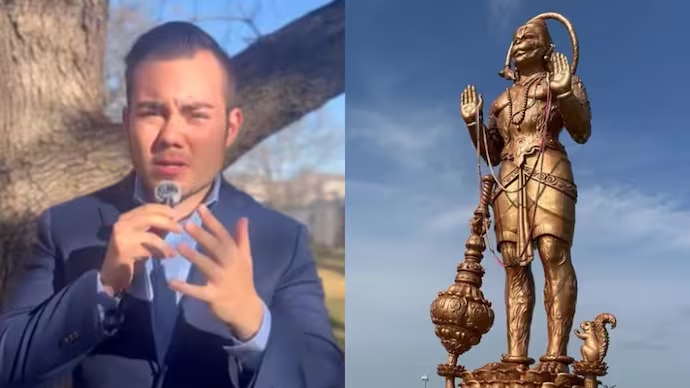
A political activist aligned with United States President Donald Trump has drawn criticism after targeting a 90-foot-tall statue of Lord Hanuman in Texas, describing it as symbolic of immigrants from “poorer nations taking control” of America. The remarks, posted on social media platform X by Carlos Turcios, have reignited conversations around religious freedom, immigration politics, and rising hate incidents against South Asian communities in the United States.
Turcios questioned why such a large statue exists in Sugar Land, Texas, writing that the city is “not Islamabad or New Delhi.” He further claimed that immigrants were gradually asserting dominance in the state and asked why the structure is the third-largest statue in the country. His post included the phrase “stop the invasion,” prompting backlash from civil rights advocates and members of the Indian-American community.
Statue of Union and Political Backlash
The statue at the centre of the controversy stands at the Sri Ashta Lakshmi Temple in Sugar Land, Texas. Known as the “Statue of Union,” the 90-foot bronze idol depicts Lord Hanuman with one hand raised in Abhaya Mudra and holding a mace in the other. Weighing approximately 90 tonnes and crafted from a blend of five metals, it is recognised as the tallest Hanuman statue outside India.
In the United States, it is considered the third-tallest statue after the Statue of Liberty, which stands at 151 feet, and the Pegasus and Dragon statue in Florida at 110 feet. The idol rests on a lotus-shaped pedestal adorned with elephant sculptures. A three-day Prana Pratishtha ceremony was conducted from August 15 to 18, 2024, drawing thousands of devotees and visitors.
The concept for the statue originated with spiritual leader Shri Chinmaya Jeyar Swamiji, and it was constructed with support from the local Hindu community. Temple authorities have described it as a symbol of unity and cultural heritage.
Turcios’s remarks were widely criticised online. Social media users accused him of spreading racist ideology and undermining the constitutional principle of religious freedom. One user pointed out that Spanish is spoken in approximately 41 million American homes, while Indian languages do not rank among the top ten, arguing that Indian-Americans have largely integrated into mainstream society.
Another commentator noted that the statue has been in place for over a year and that Hindus have every right to practise their religion in the United States. Critics stressed that the First Amendment protects freedom of religion, allowing communities to build places of worship and cultural monuments without discrimination.
This is not the first controversy surrounding the statue. Last year, Republican leader Alexander Duncan referred to it as a “false idol,” claiming the United States is a Christian nation. His remarks were condemned by several organisations, which demanded an apology and called the statement an attack on religious beliefs.
Rising Hate Incidents and Immigration Debate
The controversy unfolds against the backdrop of rising hate incidents targeting people of Indian origin and the broader South Asian community. Reports indicate that online trolling and threats increased significantly following Trump’s return to office. By October 2024, approximately 46,000 trolling incidents and 884 threats had been recorded. By October 2025, trolling cases reportedly rose to 88,000, marking a sharp escalation.
Tensions intensified during debates over visa and migration policies, including discussions involving Trump, Elon Musk, and Vivek Ramaswamy on H-1B visa reforms. According to reports, 76% of threats in December were linked to claims that migrants were “taking away jobs.” The administration’s decision to raise H-1B visa fees and deport over 100 Indian nationals further fuelled anxiety within immigrant communities.
Between November 2024 and October 2025, several violent incidents involving Indian-origin individuals were reported across American cities. In February 2025, an Indian-American businessman was shot dead in Virginia. In March, a father and daughter died in a grocery store attack. September witnessed the killing of two students and workers in Dallas, while another incident involving Chandramouli Nagamalliah drew international attention. In October, a shooting at a motel in Pittsburgh targeted Indian-origin owners and employees.
Experts suggest that resentment toward immigration has become a prominent feature of right-wing political narratives in multiple Western nations. Anger surrounding the H-1B visa programme, which allows skilled foreign professionals to work in the United States, has been cited as a factor behind anti-Indian rhetoric. Some groups argue that foreign workers displace American citizens, despite data showing immigrants contribute significantly to the economy.
Analysts also link the surge in hostility to broader patterns of discrimination against Asian communities and the resurgence of white supremacist rhetoric during election cycles. Trade tensions between India and the United States have occasionally amplified negative sentiment, with isolated incidents exaggerated online to provoke outrage.
The debate over the Hanuman statue has therefore evolved beyond a single monument, reflecting deeper divisions over immigration, cultural pluralism, and the identity of American society. While critics frame the structure as symbolic of demographic change, supporters view it as an expression of constitutional freedoms and multicultural coexistence.