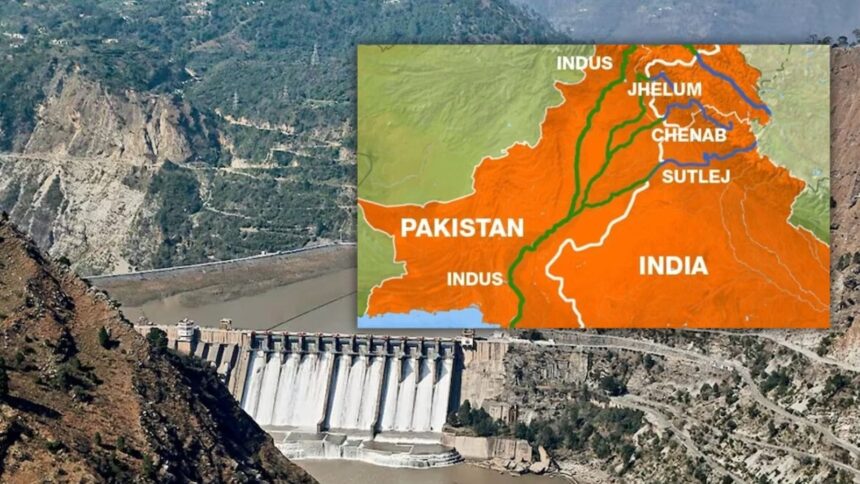
Tensions between India and Pakistan have escalated following the deadly Pahalgam terror attack on April 22, which claimed the lives of 26 people. In response to the attack, India made a significant move by suspending the Indus Waters Treaty (IWT), an agreement signed between the two countries in 1960. India stated that the suspension would remain in effect until Pakistan “credibly and irrevocably abjures its support for cross-border terrorism.” This decision has caused an uproar in Pakistan, with Islamabad labeling it as an “act of war.” Pakistan’s Prime Minister Shehbaz Sharif vowed to respond with full force if any attempt is made to stop or divert the flow of water from the Indus, which is vital to Pakistan’s agriculture and economy.
Following this, Pakistan has indicated its intention to pursue legal action against India’s suspension of the treaty, and it is preparing to challenge the move in international forums. In this article, we examine why Pakistan’s plan to reverse India’s suspension of the Indus Waters Treaty is unlikely to succeed.
India Suspends the Indus Waters Treaty
The Indus Waters Treaty, signed between India and Pakistan in 1960, divides the waters of six rivers between the two nations. India controls the waters of the three eastern rivers—the Ravi, Sutlej, and Beas—while Pakistan controls the western rivers—the Indus, Chenab, and Jhelum. The treaty has remained largely intact despite three wars between the two countries (in 1965, 1971, and 1999). However, in the wake of the Pahalgam terror attack, India decided to suspend the treaty, citing Pakistan’s continued support of terrorism. This suspension has raised significant concerns in Pakistan, which relies heavily on the Indus River for its agricultural needs.
Pakistan’s agriculture sector is a key contributor to its economy, making up 24% of the country’s GDP and employing over 37% of the population. For many Pakistanis, particularly farmers, the suspension of the treaty raises the fear that India could halt water supplies, potentially causing flash floods or water shortages that could devastate crops. Ali Haider Dogar, a Pakistani farmer, expressed his concerns, saying, “We fear India can cause flash floods or stop water destined for our crops.”
Pakistan’s Legal Options to Challenge the Suspension
In response to India’s decision, Pakistan has signaled that it will pursue legal avenues to challenge the suspension of the treaty. Pakistan’s Minister of State for Law and Justice, Aqeel Malik, stated that the country has at least three options to seek redress. These include approaching the World Bank, the Permanent Court of Arbitration (PCA), or the International Court of Justice (ICJ) in The Hague. Malik argues that the suspension of the treaty is a violation of international law, and Pakistan intends to pursue all appropriate legal channels to restore the treaty.
The World Bank, which played a key role in facilitating the treaty, has limited authority in enforcing it. While it can appoint neutral experts or arbitrators, the World Bank cannot directly intervene in disputes or enforce compliance with the treaty. Similarly, the PCA and ICJ could be approached by Pakistan, but India has taken specific reservations regarding the ICJ’s jurisdiction, particularly on issues related to national security and armed conflicts. India has declared that the ICJ does not have jurisdiction over disputes involving countries that are members of the Commonwealth, which includes Pakistan. Moreover, India has made reservations regarding cases connected to actions taken in self-defense or in response to aggression, making it difficult for Pakistan to pursue a case in the ICJ.
Why Pakistan’s Plan May Fail
India’s position on the suspension of the Indus Waters Treaty is legally robust. The Indian government has cited national security concerns and Pakistan’s continued support for cross-border terrorism as reasons for suspending the treaty. India maintains that the treaty’s suspension is within its rights, given the circumstances. According to India’s water resources officials, the country has solid grounds to defend its action if challenged by Pakistan in any international forum.
Moreover, the provisions of the IWT do not explicitly address the suspension of the treaty. There is no clause in the treaty that allows either country to unilaterally suspend it. Therefore, if India chooses to revoke or hold the treaty in abeyance, Pakistan’s legal recourse would be limited. Legal experts note that the dispute resolution mechanisms provided under the treaty are intended for specific disputes, not for cases of suspension or abrogation.
Pakistan’s pursuit of legal action against India’s suspension of the Indus Waters Treaty will likely face significant hurdles. The limitations of the World Bank, the ICJ’s jurisdictional issues, and the absence of provisions within the treaty itself to address suspension all make Pakistan’s challenge difficult. Additionally, India’s strong legal and political stance on national security and terrorism-related concerns will likely bolster its position in any international proceedings.
While Pakistan may continue to raise the issue on diplomatic and legal fronts, the practical impact of such actions remains uncertain. The Indus Waters Treaty has been a long-standing agreement that has survived multiple crises, but in the current geopolitical environment, India’s decision to suspend the treaty sends a clear message about the link between water resources, national security, and the fight against terrorism.
Pakistan’s legal options to challenge India’s suspension of the treaty are limited, and the chances of reversing India’s decision seem slim. As tensions between the two countries continue to rise, the fate of the Indus Waters Treaty remains uncertain, and the international community will closely watch how this dispute unfolds.