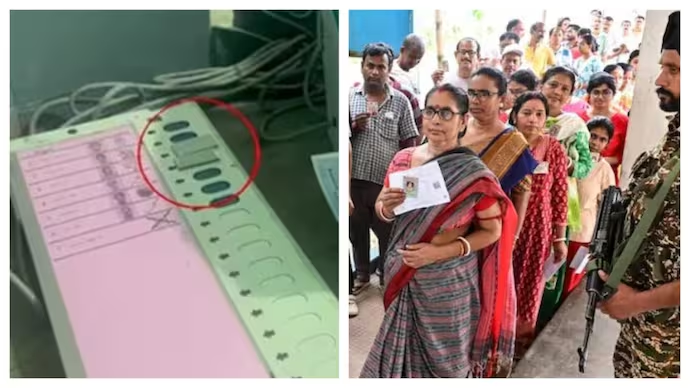
Repolling has begun across 15 polling booths in West Bengal following multiple complaints of Electronic Voting Machine tampering, raising concerns about electoral transparency and integrity.
Repolling commenced on May 2, 2026, in 15 polling stations across two Assembly segments in the South 24 Parganas district of West Bengal after serious allegations of tampering with Electronic Voting Machines prompted swift action by the Election Commission of India. The decision reflects the poll body’s commitment to ensuring free and fair elections amid rising political tensions and public scrutiny.
The affected booths are located in the Diamond Harbour and Magrahat Paschim constituencies, where fresh voting is being conducted from 7 am to 6 pm. Specifically, 11 booths fall under Magrahat Paschim, while four are situated in Diamond Harbour. Authorities have indicated that a final decision regarding repolling in the Falta constituency is still pending, as further investigation continues.
The repoll was necessitated after the Commission received as many as 77 complaints related to alleged tampering of EVMs during the second phase of polling held on April 29. These complaints pointed to various forms of interference, including the placement of black tape, adhesive materials, ink marks, and even perfume on EVM buttons. Such modifications, if proven, could obstruct voters from clearly identifying candidates and symbols, thereby undermining the integrity of the electoral process.
Allegations and Political Reactions Intensify
The issue quickly escalated into a major political controversy, with parties trading accusations over the alleged irregularities. The Bharatiya Janata Party claimed that the tampering attempts were deliberate efforts to prevent voters from selecting certain candidates, raising serious concerns about the fairness of the election.
Reports suggested that in several booths, foreign substances were placed near or directly over the names and symbols of candidates belonging to opposition parties, potentially confusing voters. Visual evidence circulated widely on social media platforms, further intensifying the political debate and drawing national attention to the situation.
The controversy was particularly pronounced in the Falta constituency, which recorded the highest number of complaints at 32. Diamond Harbour followed with 29 complaints, while Magrahat reported 13 and Budge Budge three. The scale of complaints prompted the Election Commission to take immediate cognisance and initiate corrective measures.
Political stakeholders, including candidates and party representatives, formally approached election authorities with detailed reports of irregularities. Allegations extended beyond EVM tampering to include claims of booth capturing and attempts at rigging, although these claims are still under investigation.
Legal Framework and Election Commission Response
Invoking Section 58 subsection 2 of the Representation of the People Act 1951, the Election Commission declared the earlier polling in the affected booths invalid. This provision empowers the Commission to cancel voting and order a repoll if it is satisfied that the integrity of the election process has been compromised due to malpractices, technical failures, or procedural violations.
The Chief Electoral Officer of West Bengal, Manoj Agarwal, reiterated the Commission’s strict zero tolerance policy toward any form of electoral malpractice. He emphasised that decisions regarding repolling are based on comprehensive assessments conducted by district officials and independent observers.
Preliminary investigations indicated that there was no evidence of tampering during the pre polling stages, such as the preparation and mock poll processes. However, authorities suspect that any alleged interference may have occurred during the actual voting hours, which is now the focus of ongoing inquiries.
Election guidelines clearly define any unauthorised modification of EVMs, including the placement of foreign objects, as a serious offence. Such actions can mislead voters, disrupt the voting process, and ultimately affect the credibility of election outcomes.
Broader Implications and Voter Participation
Despite the controversy, voter turnout in the West Bengal Assembly elections has remained exceptionally high. The state recorded an overall turnout of 92.93 percent across both phases, marking one of the highest participation rates since Independence. The first phase on April 23 witnessed a turnout of 93.19 percent, while the second phase on April 29 saw 92.67 percent participation.
The high voter engagement underscores the strong democratic spirit among the electorate, even in the face of allegations and political unrest. However, incidents like these highlight the critical importance of maintaining trust in electoral institutions and ensuring that every vote is cast and counted without interference.
The possibility of extending repolling to additional booths in the Falta constituency remains under consideration. Sources suggest that around 30 more polling stations are currently under review, and a final decision will depend on the findings of ongoing investigations.
The situation has also sparked a broader debate on the security and reliability of EVMs in India’s electoral system. While authorities maintain that EVMs are robust and tamper proof, incidents involving external interference, such as the application of substances on buttons, raise new challenges that require attention and preventive measures.
In response, election officials are likely to strengthen monitoring mechanisms, enhance security protocols, and increase awareness among polling staff to prevent similar occurrences in the future. Training programs and stricter supervision during voting hours may also be implemented to safeguard the integrity of the process.
Ultimately, the decision to conduct repolling reflects the Election Commission’s proactive approach in addressing grievances and upholding democratic values. By ensuring that affected voters are given another opportunity to cast their ballots freely and fairly, the Commission aims to reinforce public confidence in the electoral system.
As the repolling process unfolds, all eyes remain on the Commission’s next steps, particularly regarding the Falta constituency and the broader implications for election management in India. The outcome of these actions will play a crucial role in shaping public perception and trust in the country’s democratic institutions.