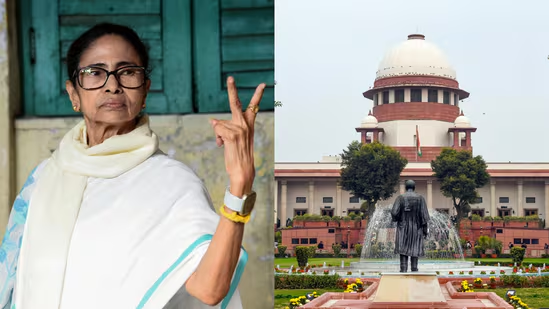
The Supreme Court will hear TMC’s urgent plea challenging the Election Commission’s decision to appoint central staff for vote counting in West Bengal elections.
India’s top judicial authority, the Supreme Court of India, is set to convene a special sitting on May 2, 2026, to hear a crucial plea filed by the All India Trinamool Congress. The petition challenges a directive issued by the Election Commission of India regarding the deployment of central government and public sector undertaking employees for vote counting in the ongoing West Bengal Assembly elections.
The development comes after the Calcutta High Court dismissed the party’s earlier petition, ruling that there was no illegality in the Election Commission’s decision. The High Court emphasized that the poll panel has the authority to appoint counting personnel from either central or state government services, and such administrative decisions cannot be easily questioned in court.
Legal Challenge and Grounds of Appeal
Following the High Court’s dismissal, the Trinamool Congress moved swiftly to file an urgent appeal before the Supreme Court. The plea was mentioned before Chief Justice of India Surya Kant, seeking the constitution of a bench ahead of the scheduled counting of votes on May 4, 2026. Recognizing the urgency of the matter, the apex court agreed to hold a special hearing.
A bench comprising Justices P S Narasimha and Joymalya Bagchi will hear the matter. The petition has been filed through advocate Sanchit Garga, with senior advocate Kapil Sibal expected to represent the party during proceedings.
The core of the dispute lies in the Election Commission’s directive issued on April 13, which mandates that at least one official at each counting table must be from the central government or a central public sector undertaking. The Trinamool Congress has argued that this directive alters the balance of personnel at counting centers and raises concerns about neutrality and fairness.
Concerns Over Neutrality and Electoral Integrity
The petition highlights apprehensions that the increased presence of central government employees could create a perception of bias, especially given that the Bharatiya Janata Party, the principal political opponent of the Trinamool Congress in the state, is the ruling party at the Centre. According to the party, such a structure may undermine the level playing field required for free and fair elections.
The Trinamool Congress has further argued that the directive lacks transparency, as it does not clearly outline the criteria or reasoning behind the decision. The party believes that this could significantly impact the composition of counting personnel and potentially influence the outcome of the electoral process.
Additionally, the petition points out that existing guidelines already ensure the presence of central government personnel in the form of micro observers at each counting table. Introducing additional central staff as supervisors or assistants, the party contends, creates an unnecessary overlap and raises questions about jurisdiction and procedural fairness.
The party has also challenged the authority of the state’s additional Chief Electoral Officer in issuing such a directive, claiming that it exceeds the scope of their jurisdiction. As part of its appeal, the Trinamool Congress has sought an interim stay on the Election Commission’s order until the matter is resolved.
High Court Observations and Election Commission Stand
In its order dated April 30, the Calcutta High Court rejected the concerns raised by the Trinamool Congress, describing the apprehension of bias as unfounded and “impossible to believe.” The court advised that any grievances regarding the electoral process should be addressed through an election petition after the declaration of results.
The High Court also reaffirmed the broad powers of the Election Commission in conducting elections, including the appointment of counting personnel. It held that such decisions fall within the administrative domain of the Commission and do not warrant judicial interference unless clear evidence of illegality is presented.
The Election Commission, on its part, has maintained that the directive is aimed at ensuring transparency, efficiency, and impartiality in the counting process. By involving central government and PSU employees, the Commission seeks to reinforce public confidence in the electoral system.
Broader Electoral Context and Implications
The West Bengal Assembly elections, held in two phases on April 23 and April 29, have witnessed intense political competition and high voter turnout. With counting scheduled for May 4, the outcome is expected to have significant political implications both at the state and national levels.
The Supreme Court’s decision on this matter could set an important precedent regarding the extent of the Election Commission’s powers and the safeguards required to maintain electoral neutrality. It may also influence future guidelines on the deployment of personnel in election-related processes.
As the hearing unfolds, all eyes will be on the apex court’s interpretation of constitutional principles and electoral laws. The verdict will not only determine the immediate course of action for vote counting in West Bengal but also shape the broader discourse on fairness and transparency in India’s democratic framework.