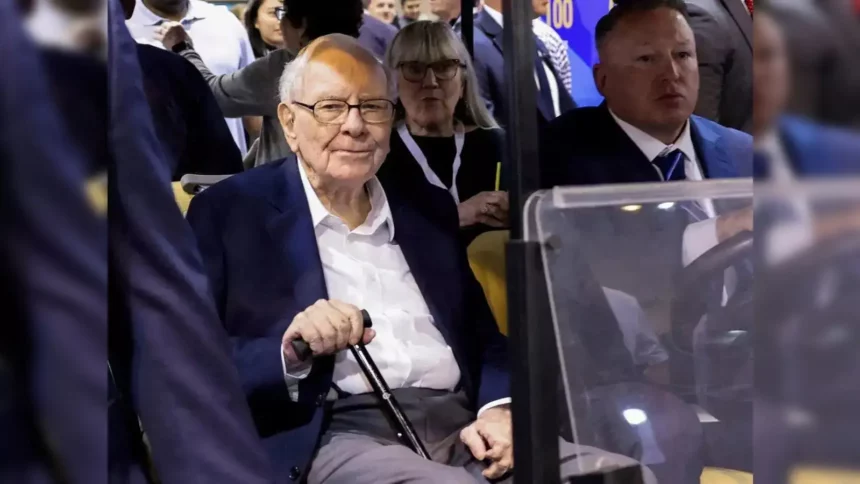
At the age of ninety five, Warren Buffett is stepping away from the role that defined him for more than six decades, closing an era that transformed not only a struggling textile company but also the very philosophy of long-term investing around the world.
the quiet genius who made patience profitable
When Warren Buffett officially retires as chief executive of Berkshire Hathaway, he leaves behind a corporate empire valued at more than one trillion dollars and an investing record that many believe will never be replicated. From modest beginnings in Omaha, Buffett built his reputation not through flashy innovation or technological disruption, but through an almost stubborn commitment to patience, discipline, and rational decision-making. His approach made investing appear deceptively simple, even boring, yet the results were extraordinary.
Buffett took control of Berkshire Hathaway in the 1960s, initially viewing it as a struggling textile manufacturer that could be salvaged. What followed instead was a gradual transformation into one of the most powerful conglomerates in the world. Under his leadership, Berkshire became a holding company for a vast collection of businesses spanning insurance, energy, railroads, consumer goods, and technology. The common thread across these investments was not excitement, but predictability and durability.
What truly set Buffett apart was his ability to let time do the heavy lifting. Between 1964 and 2024, Berkshire Hathaway’s shares compounded at nearly twenty percent annually, a figure that vastly outperformed the broader market. Over the same period, the s&p 500 produced strong but comparatively modest returns. This gap may seem small on an annual basis, but over decades it created a difference so large that it reshaped the concept of wealth itself. A modest investment placed under Buffett’s stewardship grew into a fortune that dwarfed most corporate empires.
Buffett’s personal wealth reflected this compounding power. Even after giving away tens of billions of dollars to charity, his stake in Berkshire grew to more than one hundred twenty five billion dollars. What makes this remarkable is not just the size of the fortune, but how it was built. Buffett did not inherit wealth on this scale, nor did he found a technology company during a digital boom. He accumulated his fortune by repeatedly making sensible decisions and then refusing to interfere with them.
Central to this success was Buffett’s philosophy of buying wonderful businesses at fair prices rather than fair businesses at wonderful prices. He focused on companies with strong brands, consistent cash flows, and management teams that understood capital allocation. This philosophy led him to long-term holdings such as Apple, which became one of Berkshire’s most valuable investments despite Buffett’s earlier reluctance toward technology stocks. His eventual embrace of Apple demonstrated not a change in philosophy, but its adaptability when the fundamentals aligned.
insurance float, capital discipline, and lessons for investors
One of the most misunderstood yet powerful elements of Buffett’s legacy lies in Berkshire Hathaway’s insurance operations. Through subsidiaries like geico and other insurers, Berkshire gained access to what is known as insurance float. This float represents premiums collected upfront that may not be paid out as claims for many years. Buffett treated this float as low-cost, and often negative-cost, capital that could be invested elsewhere. Over time, this became a massive and reliable funding source that fueled Berkshire’s expansion.
Unlike many executives, Buffett resisted the temptation to chase growth for its own sake. He often allowed Berkshire’s cash pile to swell when he could not find investments that met his strict criteria. In his later years, this led to unusually high cash reserves, which he openly described as both a safety net and a warning sign. Buffett repeatedly reminded investors that holding cash was sometimes the most rational choice when markets became overheated and valuations detached from reality.
Another defining aspect of Buffett’s career was transparency. Through his annual letters to shareholders, he explained not only his successes but also his mistakes. He openly acknowledged poor decisions, misjudged acquisitions, and missed opportunities. This honesty built immense trust and turned those letters into essential reading for investors across generations. More than performance reports, they became lessons in psychology, ethics, and long-term thinking.
Buffett’s relationship with risk also distinguished him from many market participants. He did not view risk as volatility, but as the possibility of permanent capital loss. This perspective allowed him to remain calm during market crashes, financial crises, and periods of extreme pessimism. While others panicked, Buffett often saw opportunity, provided the underlying businesses remained strong. His famous advice to be fearful when others are greedy and greedy when others are fearful became more than a slogan; it was a consistent guide to action.
As Buffett hands leadership to Gregory Abel, the future of Berkshire Hathaway enters a new chapter. Abel inherits not just a massive conglomerate, but a culture shaped by decades of rationality, decentralisation, and trust in capable managers. Buffett’s influence is deeply embedded in the company’s structure, from its conservative balance sheet to its hands-off approach with subsidiaries. While markets will inevitably scrutinise Berkshire’s performance in a post-Buffett era, the framework he built is designed to endure.
Beyond Berkshire, Buffett’s broader legacy lies in how he changed the way people think about investing. He proved that extraordinary results do not require extraordinary complexity. His emphasis on patience, discipline, and ethical behaviour challenged the notion that markets must be beaten through constant activity or superior information. Instead, he demonstrated that temperament often matters more than intellect.
As Warren Buffett retires for what is expected to be the final time, he leaves behind more than wealth. He leaves a philosophy that elevated long-term thinking in a short-term world, a corporate structure built to survive beyond its founder, and a set of lessons that continue to guide investors long after his final day in the office. His career stands as evidence that quiet consistency, when paired with time, can reshape industries, fortunes, and financial history itself.