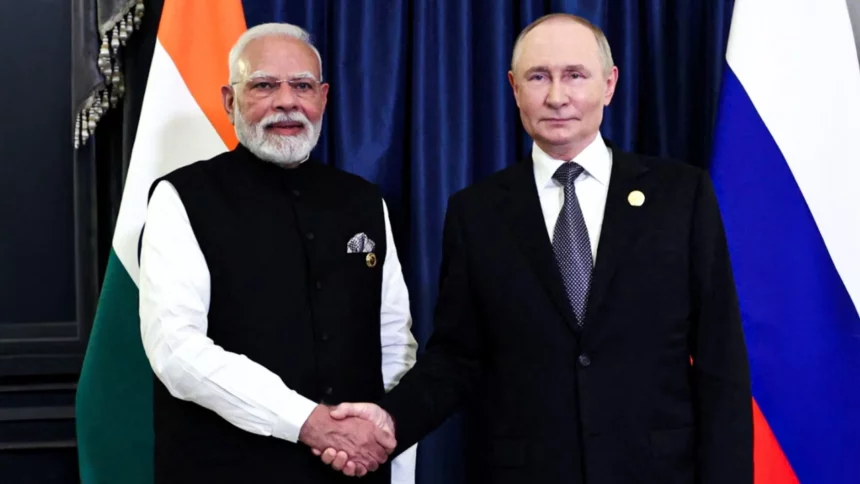
Russian President Vladimir Putin’s arrival in New Delhi for the 23rd India–Russia Annual Summit marks a significant moment in bilateral relations, coming four years after his last visit and at a time when global geopolitical tensions, sanctions, and shifting economic landscapes have created an urgent need for strategic recalibration between the two long-standing partners. The visit is expected to strengthen defence cooperation, deepen trade mechanisms resilient to external pressure, and outline new avenues such as small modular reactors, technology exchange, and advanced energy collaboration. Alongside these formal engagements, the visit has also ignited political debate at home and triggered a massive security operation across the national capital.
Diplomatic Momentum Rises as Putin and Modi Prepare for Crucial Talks on Trade, Energy and Strategic Balancing
Russian President Vladimir Putin is expected to arrive in India at approximately 4:30 p.m. on Thursday, December 4, marking the start of a tightly structured two-day visit. His India trip corresponds with the 23rd India–Russia Annual Summit, hosted at the invitation of Prime Minister Narendra Modi, and commemorates the 25th anniversary of the Strategic Partnership established between the two countries in 2000. The partnership was elevated to a Special and Privileged Strategic Partnership during Putin’s 2010 visit to India, a designation that reflected deep trust and long-term strategic alignment across defence, energy, space, and geopolitical coordination.
The evening of his arrival will feature an intimate private dinner hosted by Prime Minister Modi, mirroring the warmth extended to the Indian leader during his July 2024 visit to Moscow. Such gestures are widely interpreted as signals of sustained personal rapport and diplomatic goodwill between the two leaders—an element often considered pivotal in India–Russia relations.
On Friday morning, Putin will receive a ceremonial welcome, followed by intensive summit discussions. These talks are expected to focus on stabilising bilateral trade and shielding it from Western sanctions that have disrupted traditional payment and shipping mechanisms. Former diplomat Mahesh Sachdev noted that the two leaders are likely to explore “alternative ways to maintain the crucial oil equation,” especially given Russia’s emergence as a leading supplier of discounted crude to India in recent years. Their shared objective appears to be raising bilateral trade to an ambitious target of $100 billion by 2030.
Sachdev also highlighted the broader geopolitical context shaping the summit. Putin held a five-hour meeting in Moscow recently with former U.S. President Donald Trump’s envoy and son-in-law, underscoring how discussions in New Delhi may intersect with evolving Russia–U.S. dynamics. The summit thus serves not only as a bilateral forum but as a platform for India to navigate its multi-alignment strategy amid shifting international power equations.
Following the summit, Putin is scheduled to launch the new India channel of the Russian state broadcaster RT, reflecting Moscow’s broader push to expand media influence. President Droupadi Murmu will then host a state banquet in his honour, rounding off the day’s formal engagements.
In the run-up to the visit, New Delhi witnessed several symbolic events emphasizing the depth of the relationship. The Russian House in Delhi organised a major photo exhibition showcasing 25 years of military-technical cooperation, featuring images of Putin with various Indian prime ministers and displays of defence platforms such as BrahMos missiles, S-400 systems, and Su-57E fighter jet models.
Political reactions within India also intensified. Congress leader Jairam Ramesh underscored the long historical arc of India–Russia ties, tracing them back to the visits of Soviet leaders Bulganin and Khrushchev in 1955. He emphasised that contemporary cooperation is a continuation of that enduring Indo-Soviet partnership.
Rahul Gandhi, meanwhile, voiced criticism of the government’s alleged practice of advising foreign dignitaries not to meet the Leader of the Opposition. He argued that such meetings were traditionally standard diplomatic protocol and that the government’s reluctance stemmed from “insecurity.” His remarks, though not directed at Putin specifically, framed the visit within a broader domestic political debate.
Amid these discussions, Union Minister Satish Chandra Dubey described Putin as “a well-wisher of India” and highlighted the deep trading relationship that continues to grow despite global disruptions and sanctions.
Cultural expressions of welcome also accompanied the preparations. Odisha sand artist Manas Kumar Sahoo created a detailed animation depicting Putin’s portrait alongside iconic Russian landmarks, emphasising hopes for continued peace and prosperity between the two nations.
The convergence of diplomatic, political, cultural, and economic narratives around Putin’s visit underscores the visit’s multifaceted importance. It arrives at a time when India is juggling complex global partnerships, managing domestic expectations, and strengthening strategic autonomy. For Russia, the visit is equally significant as it seeks stable partnerships in Asia amid prolonged tensions with Western powers.
Delhi Turns into Fortified Zone as Multi-Layered Security Network Activated Ahead of Putin’s High-Profile Arrival
Delhi has been placed under one of its highest-ever security alerts to ensure the smooth execution of Putin’s visit. More than 5,000 police personnel, enhanced by multiple Central agencies and Russian security operatives, have been deployed across key zones. The exact location of the Russian President’s accommodation remains undisclosed due to the strict confidentiality protocols requested by Moscow.
Senior officials confirmed that the entire movement of the Russian President—from arrival to departure—will be monitored in real time by joint command centres. Anti-terror squads, SWAT teams, and sniper units have been stationed at vantage points, while quick-reaction teams are positioned to respond instantly to any incident. High-definition CCTV cameras and technical surveillance systems have been activated throughout the capital, ensuring comprehensive monitoring.
Traffic restrictions, controlled pedestrian movement, and temporary road closures are expected in several areas. Authorities have promised advance advisories to minimise public inconvenience, though disruptions near diplomatic enclaves and central Delhi are unavoidable. Anti-drone systems are also being deployed along key routes to counter aerial threats, reflecting heightened global concern over drone-based attacks.
The scale of the security grid mirrors the sensitivity of the visit. Delhi Police and Russian security personnel have established a multi-ring perimeter around all potential event locations. Top-level police officers are supervising sanitation of routes, crowd control strategies, and contingency plans for any emergency.
This heightened security environment is not only a routine measure for high-profile foreign visits but also indicative of the geopolitical complexities surrounding Putin’s international engagements. With several Western capitals watching the India–Russia summit closely, New Delhi is determined to ensure flawless security execution.
The atmosphere across the capital reflects a mixture of anticipation and caution. Government agencies remain engaged in minute-to-minute coordination to handle the VVIP movement, while diplomatic circles await the outcomes of the summit that may redefine strategic balances in Eurasia, Indo-Pacific dynamics, and global energy networks.
Against this backdrop, the visit carries both symbolic weight and practical urgency. It reinforces India and Russia’s steady partnership while opening new pathways for cooperation in defence, energy, technology, and trade. At the same time, it demonstrates India’s continued commitment to strategic autonomy—balancing ties with the West, Russia, and emerging global powers.
The next two days will likely shape key decisions affecting bilateral relations for years to come, especially as both countries navigate sanctions-affected trade systems, explore new energy collaborations, and re-evaluate their positions in a rapidly changing world order.