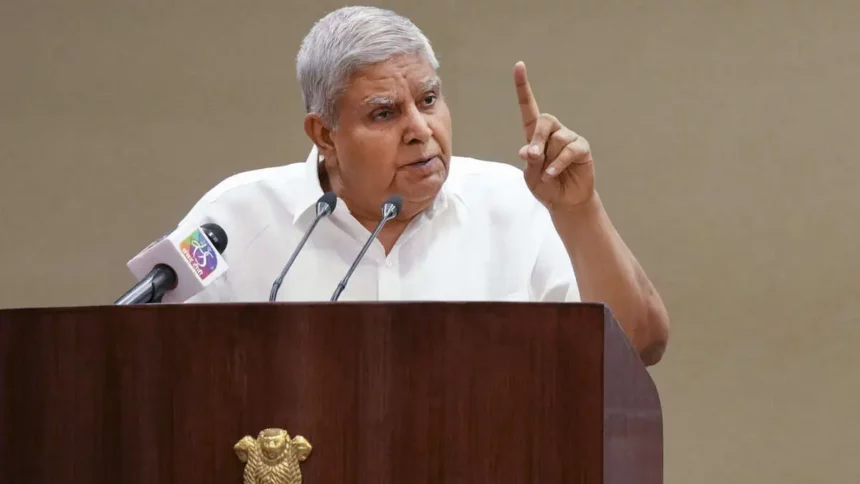
In an escalating debate surrounding judicial overreach, Vice President Jagdeep Dhankhar emphasized that elected representatives, not the judiciary, are the ultimate authority when it comes to constitutional matters. He reaffirmed that Parliament holds supreme power, and there is no authority above it. The Vice President’s remarks came after he criticized the judiciary for acting as a “super-Parliament” and lacking accountability. Jagdeep Dhankhar pointed out that public representatives, including the Prime Minister, are held accountable through elections, unlike the judiciary, which he argued is not.
In his address, Jagdeep Dhankhar recalled historical instances, particularly during the Emergency period of 1975, when fundamental rights were suspended. He highlighted how the Supreme Court upheld the government’s decision to suspend fundamental rights, overruling verdicts from nine high courts that had argued such suspension was unconstitutional. Jagdeep Dhankhar drew attention to the fact that during this time, the Executive was allowed to determine whether fundamental rights applied, a decision that many considered a betrayal of democratic principles.
He also touched on the judicial overreach debate sparked last week, where the Vice President criticized the Supreme Court’s powers. Jagdeep Dhankhar was particularly vocal about a recent ruling that directed the President and Governors to assent to a law within a three-month deadline. The ruling raised concerns among lawmakers and the public about the judiciary’s increasing influence in matters traditionally reserved for the executive and Parliament. Dhankhar questioned the direction the country is heading, warning that such judicial actions threaten to undermine the separation of powers and the democratic process.
The Vice President’s comments serve as a reminder of the ongoing tensions between the judiciary and the executive, and his strong stance against what he views as an overreach by the courts. The remarks come at a time when the judiciary’s role in government affairs is being increasingly scrutinized. Jagdeep Dhankhar’s statement reflects growing concerns over the balance of power in India’s democratic framework, with many questioning whether the judiciary’s expanding role could encroach upon the authority of elected representatives.
The debate over judicial overreach continues to be a contentious issue in India’s political landscape, with strong opinions on both sides. While the judiciary asserts its role in protecting fundamental rights and upholding the Constitution, critics, like Vice President Jagdeep Dhankhar, argue that the courts should refrain from intervening in matters outside their jurisdiction. This ongoing debate is shaping the future of India’s democratic processes and the relationships between the different branches of government.