For more than five decades, Tamil Nadu’s political identity was shaped by the alternating dominance of DMK and AIADMK. Elections typically resulted in cyclical shifts in power between these two Dravidian giants, each deeply rooted in ideological traditions, welfare politics, and charismatic leadership. However, the 2026 verdict has decisively disrupted this binary structure. The electorate has signaled not just dissatisfaction with established parties but also a willingness to embrace new political alternatives that promise change, efficiency, and accountability.
The final tally underscores this transformation. TVK stands at 107 seats, followed by DMK with 59, AIADMK with 47, and the Indian National Congress securing just 5 seats. While TVK falls short of the majority mark of 118, it occupies a commanding position in the assembly. The immediate political focus now shifts to post-election negotiations, where alliances with smaller parties and independent legislators could determine the formation of the next government.
A Break from the Dravidian Political Tradition
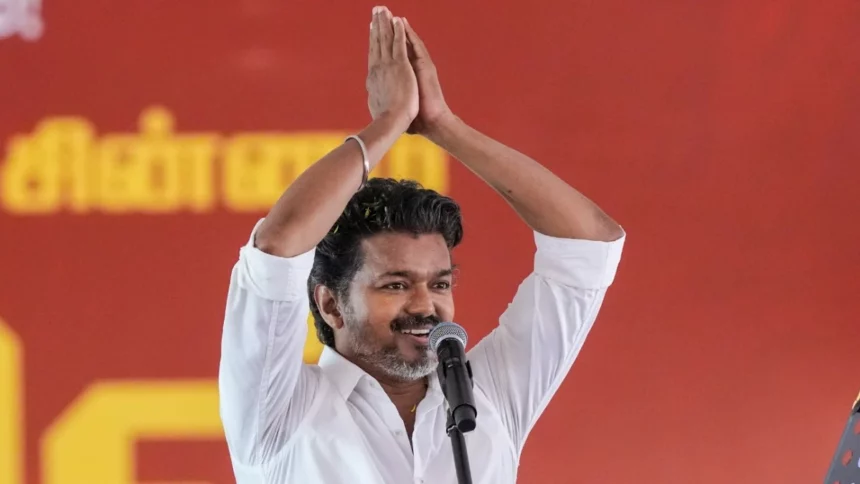
The rise of Vijay represents a significant turning point in Tamil Nadu’s political narrative. The state has a long history of film personalities transitioning into politics, with figures like M.G. Ramachandran and J. Jayalalithaa having previously leveraged cinematic popularity into political success. However, Vijay’s emergence reflects a more contemporary evolution of this phenomenon—one shaped by digital communication, grassroots mobilization, and issue-based campaigning.
Unlike earlier eras, where charisma and personality often dominated electoral discourse, Vijay’s campaign blended mass appeal with a structured narrative centered on governance reform. His messaging emphasized transparency, administrative efficiency, and citizen participation, resonating strongly with a population that has become increasingly politically aware and digitally connected. Social media platforms, targeted outreach, and data-driven campaigning played a crucial role in amplifying his message, particularly among urban and semi-urban voters.
A defining feature of this election has been the decisive role played by young voters. Tamil Nadu’s demographic profile is undergoing a gradual shift, with a growing proportion of first-time voters entering the electoral process. This group, shaped by access to information and exposure to national and global trends, demonstrated a clear preference for change. Issues such as employment opportunities, quality education, technological advancement, and transparency in governance emerged as key electoral drivers.
TVK’s strategy of fielding candidates from diverse backgrounds further strengthened its appeal. By prioritizing grassroots leaders, professionals, and individuals with local credibility, the party positioned itself as a platform for inclusive representation. This approach contrasted with the perceived centralization and hierarchical structures of traditional parties, allowing TVK to build a broader and more relatable connection with the electorate.
Collapse of Established Strongholds
One of the most striking developments of the election was the defeat of M. K. Stalin in his stronghold constituency. This result carried symbolic weight, signaling not just a local electoral upset but a broader rejection of entrenched political leadership. Stalin’s loss reflects the depth of voter discontent and highlights the challenges faced by established parties in retaining their traditional support bases.
Similarly, the performance of AIADMK under Edappadi K. Palaniswami revealed structural weaknesses within the party. Once a dominant force in Tamil Nadu politics, AIADMK struggled to adapt to the evolving expectations of voters. Organizational fragmentation, leadership challenges, and a lack of compelling narrative contributed to its diminished performance.
The limited success of the Bharatiya Janata Party (BJP) further reinforces the uniqueness of Tamil Nadu’s political landscape. Despite its growing influence at the national level, the BJP has historically faced difficulties in gaining a substantial foothold in the state. The 2026 results reaffirm that regional dynamics, linguistic identity, and state-specific issues continue to play a dominant role in shaping voter behavior in Tamil Nadu.
For DMK and AIADMK, the election outcome represents a moment of critical introspection. Both parties must now confront the reality of a transformed political environment where legacy alone is insufficient to secure electoral success. Rebuilding organizational strength, redefining leadership strategies, and reconnecting with an increasingly discerning electorate will be essential for their future relevance.
The Road Ahead: Governance and Expectations
While the electoral victory of TVK marks a historic achievement, the transition from opposition politics to governance presents a new set of challenges. With 107 seats, the party requires additional support to cross the majority threshold. The process of securing alliances or external backing will test the political acumen of Vijay and his leadership team. Negotiations with smaller parties and independents are likely to play a निर्णing role in determining the stability of the government.
Beyond government formation, the larger challenge lies in meeting the high expectations generated during the campaign. Electoral success often raises public hopes, and the ability to translate promises into tangible outcomes will be critical. Governance demands a different skill set—one that involves administrative coordination, policy implementation, and consensus-building across diverse stakeholders.
Vijay’s emphasis on transparency and efficiency will now be scrutinized in practice. Delivering on commitments related to employment, education, and public services will require not only vision but also institutional capability. Building a competent administrative framework, ensuring policy continuity, and maintaining fiscal discipline will be key factors in sustaining public trust.
At the same time, the emergence of TVK signals a broader generational shift in Tamil Nadu’s political culture. Younger leaders, new candidates, and fresh ideas are gaining prominence, reflecting the aspirations of a population that is increasingly engaged and demanding of accountability. This shift suggests a move toward a more dynamic and responsive governance model, where performance and results carry greater weight than legacy and rhetoric.
The implications of this election may extend beyond Tamil Nadu. The success of a relatively new political formation highlights the potential for alternative movements to disrupt established systems. It underscores the importance of effective communication, grassroots engagement, and the ability to address issues that resonate directly with voters. In an era where political awareness is expanding rapidly, the ability to adapt to changing expectations is becoming a defining factor in electoral success.
However, the durability of this transformation will depend on how effectively TVK navigates the challenges ahead. Sustaining momentum requires more than electoral victories; it demands consistent governance, institutional stability, and the capacity to respond to evolving public needs. The coming months will be crucial in determining whether this shift represents a long-term realignment or a transitional phase in Tamil Nadu’s political journey.
As alliances take shape and governance structures are established, the state stands at the threshold of a new era. The 2026 election is not merely a change in leadership but a redefinition of political identity. It reflects a society that is increasingly open to new ideas, willing to challenge established norms, and eager for a future shaped by accountability and progress.
Tamil Nadu’s political landscape has entered uncharted territory—one defined by change, aspiration, and the promise of a different kind of leadership. Whether this moment becomes a lasting transformation will depend on the choices made in the years ahead, both by those in power and those seeking to reclaim it.