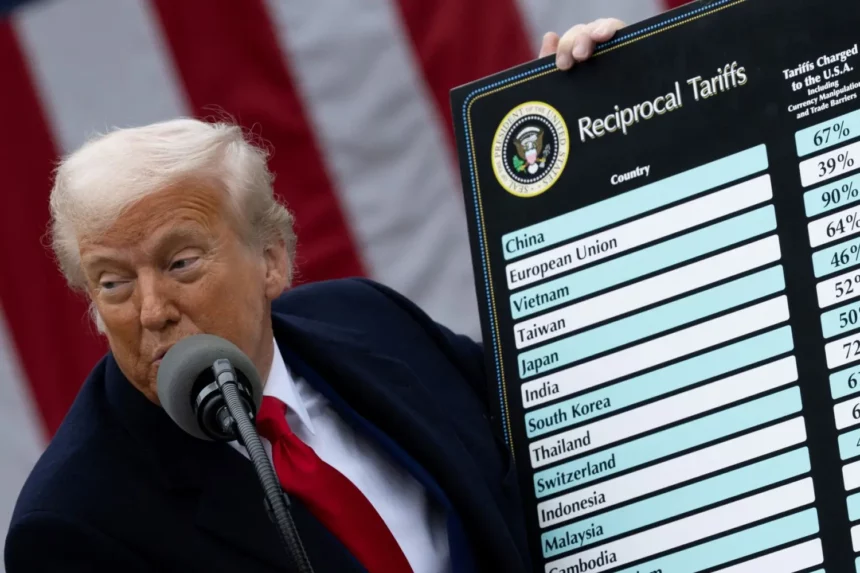
The recent attempt by the United States government to impose significant tariffs on major trading partners to boost domestic manufacturing seems to have hit a roadblock, at least for now. Following a series of announcements about imposing new reciprocal tariffs, market volatility and the looming threat of a recession have forced US President Donald Trump to pause the implementation of these tariffs on most countries, except China, for three months—just a week after the tariffs were initially announced.
While Trump celebrated April 2nd as a “liberation day,” proclaiming it as the rebirth of US industry, the new tariffs, set at a minimum baseline of 10% for countries with a trade deficit with the US, were far from universally applied. Many of the US’s largest trade partners, such as the European Union (EU), Japan, South Korea, India, and Vietnam, faced tariffs significantly higher, with some countries like China facing punitive tariffs as high as 125%. These tariffs exceeded even the rates implemented by the Smoot-Hawley Tariff Act of 1930, which is widely blamed for exacerbating the Great Depression.
The Argument Behind the Tariff Strategy
The US government’s rationale for introducing these tariffs is rooted in its growing concern over its massive trade deficits, particularly in merchandise, which they argue has eroded the manufacturing sector. The share of US manufacturing in global output has fallen from 28.4% in the early 2000s to about 17.4% today, a shift that the US sees as detrimental not only to economic growth but also to national security. A robust manufacturing base, the government asserts, is essential for maintaining economic competitiveness and ensuring the supply of critical materials for defense and innovation.
Manufacturing, which now contributes only 11% of the US GDP, remains a crucial sector. It is responsible for over one-third of the productivity growth and nearly two-thirds of US exports. Furthermore, the manufacturing sector is the driver of technological innovation, producing 55% of all patents and accounting for 70% of the research and development spending. The government also argues that each manufacturing job creates multiple jobs in other sectors—between 7 and 12 jobs per manufacturing position.
Implications of the New Tariffs on the US Economy
what will the new tariffs mean for the US economy? A report from the Congressional Budget Office (CBO) in December 2024 outlined the potential impact of these tariffs. It predicted that a 10% tariff on all imports, combined with a 50% tariff on goods from China, would reduce the US budget deficit by $2.9 trillion between 2025 and 2034. However, the CBO also highlighted the downside, predicting that consumer and capital goods would see price increases, which could raise personal consumption by around 1%.
The CBO pointed out that higher tariffs would also likely result in US businesses delaying or abandoning new investments, as well as making costly changes to their supply chains. The reduced competition could negatively impact productivity and resource efficiency. However, proponents of the tariffs argue that these challenges will be mitigated by increased local demand for domestic products and a reduction in government borrowing, which would free up more funds for private investments. As a result, they estimate that the overall impact on real GDP would be a relatively small 0.6%.
Given that the tariffs on major trading partners are significantly higher than those initially forecasted by the CBO, the actual impact on the US economy could be far more severe.
Impact on US Trade Partners
The consequences for countries exporting goods to the US are also substantial. For example, in 2024, China, Mexico, Canada, Germany, Japan, and other nations exported billions of dollars’ worth of goods to the US. Countries like Canada and Mexico, which depend heavily on the US market for their exports, will be especially hard-hit by the new tariffs. In contrast, nations like Japan, South Korea, and India, which rely on the US for around one-fifth of their exports, will also feel the sting.
While the US only accounts for about 10% of China’s merchandise exports, the size of the US economy means that even this relatively small share can have profound implications for Chinese trade. The economic fallout from these new tariffs will ripple through global markets, causing disruptions in supply chains, trade flows, and economic stability.
The Path Forward: Negotiations and Diplomacy
The US government’s decision to pause the reciprocal tariffs for three months offers a chance for negotiation. It is likely that tariff rates will be revised and adjusted as the US engages in discussions with its trade partners. The reality is that rebuilding the US industrial base is not as simple as imposing tariffs or pulling out of multilateral trade agreements. Such unilateral actions only introduce uncertainty into the global economy and destabilize markets.
In an increasingly interconnected world, unilateral trade measures often fail to achieve their intended goals. Instead, a cooperative, multilateral approach to trade reform and economic policy would benefit both the US and its trading partners. Globalization has made economies so mutually dependent that working together through consensual policies is often more effective than imposing arbitrary restrictions.