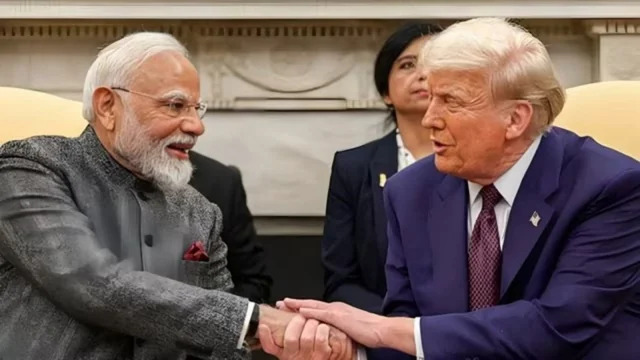
US President Donald Trump has expressed optimism about trade negotiations with India while emphasizing that Prime Minister Narendra Modi is a “very smart man” and a “great friend.” His remarks come at a crucial time when trade discussions between the two nations are ongoing, particularly on the issue of tariffs. US President Donald Trump’s statement also follows his administration’s decision to impose a 25% tariff on all imported vehicles entering the United States, a move expected to significantly impact global automobile trade.
During a recent media interaction, US President Donald Trump acknowledged India’s high tariffs but indicated that discussions with PM Modi were progressing positively. “Prime Minister Modi was here just recently. We’ve always shared a strong friendship. India is one of the highest tariff-imposing nations in the world—it’s brutal. But he is a very smart man and a great friend of mine, and we had very good talks. I believe it’s going to work out very well for both India and the United States,” he said.
The US President’s remarks reflect the ongoing negotiations between Washington and New Delhi, particularly concerning trade imbalances and tariff structures. His latest announcement of a 25% tariff on imported vehicles, effective from April 2, has stirred global trade discussions. This decision is expected to impact nearly half of all vehicles sold in the US, including those produced by American companies but assembled overseas. While this move aims to protect American manufacturing, it has raised concerns among international trade partners, including India.
US President Donald Trump has previously pointed out India’s high tariffs on several occasions, often citing them as a barrier to fair trade. In February, he reiterated his administration’s stance on reciprocal tariffs, stating, “We will soon impose reciprocal tariffs—they charge us, we charge them. If a country like India or China imposes high tariffs on our products, we will do the same to ensure fairness.”
PM Modi’s visit to Washington DC earlier this year played a pivotal role in shaping trade discussions. During his visit, both nations reaffirmed their commitment to strengthening economic ties and fostering a trade environment that prioritizes fairness, national security, and job creation. A key outcome of the discussions was the launch of ‘Mission 500’—a new bilateral trade target aimed at increasing two-way goods and services trade to $500 billion by 2030.
As trade talks continue, both nations remain focused on finding a balanced approach that benefits their economies. While differences on tariffs persist, US President Donald Trump’s praise for Modi signals a willingness to engage in constructive dialogue, fostering hope for a mutually beneficial trade agreement.