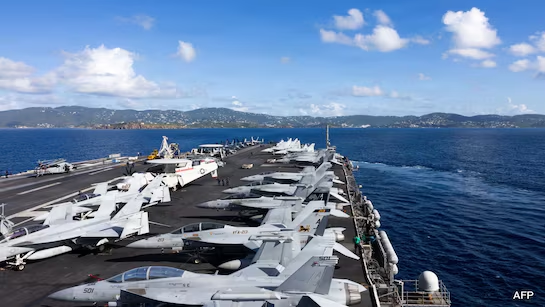
Washington: The United States is sending a second aircraft carrier group — led by the USS Gerald R. Ford, the U.S. Navy’s most advanced and largest carrier — to the Middle East, according to U.S. officials and media reports. The move is intended to increase pressure on Iran even as Washington continues diplomatic engagement.
The Gerald R. Ford strike group, currently operating in the Caribbean Sea, will be redeployed to join the USS Abraham Lincoln and other U.S. naval assets already in the region. Officials say the deployment will enhance U.S. military options if diplomacy with Tehran does not succeed.
President Donald Trump told reporters that the second carrier group is being dispatched “in case we don’t make a deal” with Iran, though he added that the ship’s deployment would proceed even if negotiations are successful.
Strategic Context and Military Build-Up
The decision comes amid heightened tensions between Washington and Tehran over Iran’s nuclear activities, ballistic missile programme and wider regional behaviour. Trump has publicly reiterated that he wants to secure a deal with Iran soon and hopes agreements can be reached in the coming weeks.
Despite these diplomatic efforts, Trump has not ruled out military options. Pentagon planning reflects expanded U.S. military presence in the region, with multiple surface warships and aerial assets already deployed under U.S. Central Command. The USS Abraham Lincoln strike group arrived in the Indian Ocean and Arabian Sea last month, and U.S. forces engaged an Iranian drone near the carrier during transit.
Officials said the Gerald R. Ford and its escort ships may take about a week to reach the Middle East from the Caribbean, where they have been stationed amid a broader U.S. security focus since late 2025.
Trump’s Position on Diplomacy and Force
Trump has repeatedly emphasised the desire to reach a diplomatic settlement with Iran, even as he strengthens U.S. military options. He told reporters he believes both sides “want to make a deal” and warned of “very steep” consequences if talks fail.
At the same time, the administration’s military build-up — which now includes two carrier strike groups — signals broadened U.S. capacity for sustained air operations or strategic deterrence. Military analysts note that dual carrier deployments can significantly increase the number of aircraft and munitions available for combat or deterrent missions in a crisis.
Regional and Global Implications
The deployment underscores Washington’s strategic posture in the Middle East at a time of widespread regional volatility. Gulf Arab states have cautioned that any military escalation could accelerate instability in an already tense environment. Meanwhile, indirect talks between U.S. and Iranian representatives are reportedly continuing with third-party facilitation.
The expanded deployment is expected to act as both a deterrent and leverage in negotiations, signalling U.S. readiness for any eventuality.