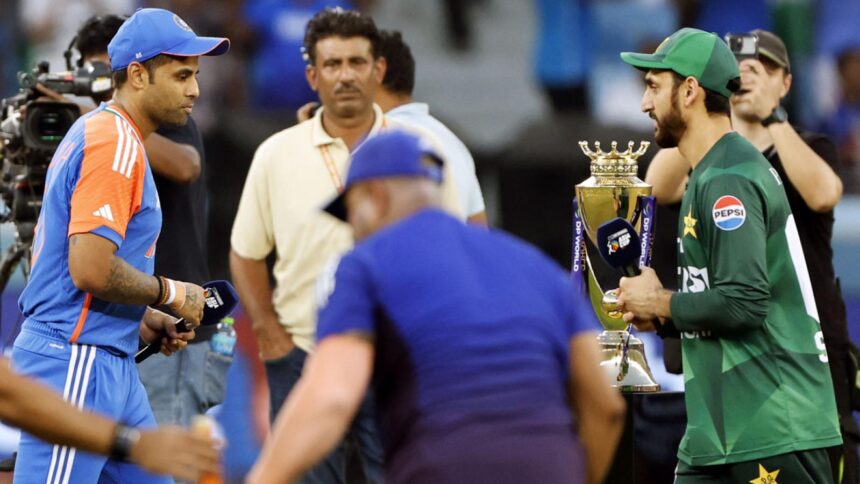
Colombo: The build-up to the marquee India–Pakistan encounter in the T20 World Cup has once again extended beyond cricket, with both captains addressing questions surrounding the now widely discussed handshake protocol at the toss.
Pakistan captain Salman Ali Agha and India skipper Suryakumar Yadav offered measured responses during their respective pre-match press conferences, choosing to emphasise cricketing priorities over off-field narratives.
Salman Ali Agha Stresses ‘Spirit of the Game’
Responding to questions about whether he would follow the customary handshake tradition, Salman Ali Agha avoided direct commentary on the gesture itself, instead highlighting the broader ethos of competition.
“We want the game to be played in good spirits. The game should be played like it has been played since it started,” Agha said.
He further dismissed suggestions that pre-match rituals or the toss would influence outcomes.
“Toss cannot decide the game. If you play good cricket, you’ll win. Cricket will matter, toss won’t.”
‘Past Records Don’t Matter’
Addressing Pakistan’s historical World Cup record against India, Agha acknowledged previous results while projecting confidence ahead of the contest.
“Past records don’t matter. It will be a new day. You cannot change history, but we can try to perform well and win this time.”
Pakistan’s struggles against India in global tournaments have often shaped narratives, though players and management have consistently sought to frame matches as standalone contests.
Backing Babar Azam’s Form
Questions were also raised regarding the form of senior batter Babar Azam, a key figure in Pakistan’s batting lineup.
“Babar Azam is not a concern for us. He has been scoring runs. Hopefully, he’ll score runs and help us tomorrow,” Agha stated.
He also ruled out significant batting order reshuffles.
“We don’t want to change the batting position too much.”
Usman Tariq Labelled ‘Trump Card’
Agha strongly defended mystery spinner Usman Tariq, whose unconventional bowling action has drawn attention during the tournament.
“For us, every player is equal. You guys have made Usman Tariq this big. He has been bowling well. He is our trump card,” Agha said.
He added that the spinner had been cleared by the ICC on previous occasions.
“He has been cleared by the ICC earlier. I don’t know why there is talk about his action.”
The tournament marks Usman Tariq’s debut appearance in a T20 World Cup.
Fitness Concerns Around Abhishek Sharma
Agha also addressed questions regarding Indian opener Abhishek Sharma, who missed India’s previous match due to stomach-related illness.
“We can’t help with the weather. I hope Abhishek Sharma plays tomorrow. I hope he’s recovering well. We want to play against the best.”
Suryakumar Yadav’s ‘Wait for 24 Hours’ Response
India captain Suryakumar Yadav responded to repeated questions about the handshake issue with a restrained yet pointed remark.
“Wait for 24 hours. We’ll play good cricket, then decide on it. Sleep well and eat good. Wait for 24 hours.”
The comment reflects India’s consistent stance of prioritising on-field performance amid external distractions.
India Confirm Abhishek Sharma’s Availability
Suryakumar also confirmed that Abhishek Sharma would be available for selection.
“If you want him to play, we will play him tomorrow.”
The opener was observed training intensively during India’s net sessions in Colombo.
Preparation Against Usman Tariq’s Bowling
Speaking on Usman Tariq’s bowling style, Suryakumar used an analogy to describe India’s tactical preparations.
“Sometimes there is a question in the exam which is out of the syllabus. You cannot leave that question. To tackle that, you have to adopt your own way.”
Team sources indicated that Suryakumar replicated Tariq’s bowling action during practice sessions to help batters prepare for the spinner’s variations.
Handshake Debate Rooted in Asia Cup Controversy
The handshake discussion traces back to developments during the Asia Cup 2025. India had declined post-match handshakes following heightened geopolitical tensions and security concerns.
India’s stance was linked to tributes for victims of the Pahalgam terrorist attack and expressions of solidarity with the armed forces during Operation Sindoor.
The issue has since resurfaced at subsequent India–Pakistan encounters.