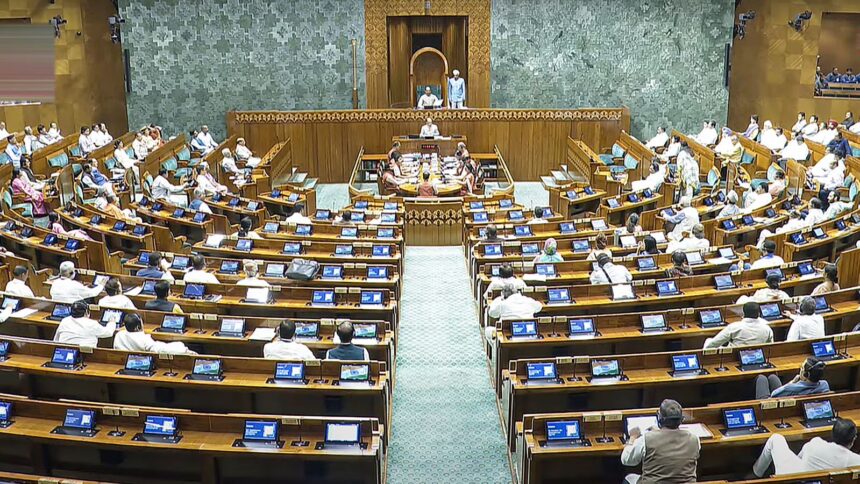
The Union Government is set to move a landmark legislative proposal in the Lok Sabha on Wednesday with the introduction of the Constitution (130th Amendment) Bill, 2025, aimed at ensuring accountability among ministers at both the state and central levels. The bill seeks to remove any Central or State Minister facing serious allegations of corruption or criminal offenses if they have been detained for a period of 30 consecutive days. The move comes amid long-standing public and political debates over maintaining constitutional morality, good governance, and public trust in elected representatives, highlighting the need for stricter mechanisms to prevent misuse of office and protect the integrity of constitutional institutions. The proposed legislation also reflects the government’s response to past controversies involving ministers who faced legal scrutiny, including the high-profile case of V Senthil Balaji in Tamil Nadu, and aims to codify a uniform procedure for removal to avoid ambiguity and political complications.
Strengthening Governance Through Constitutional Amendment
The 130th Constitutional Amendment Bill seeks to amend Article 75 of the Constitution, which primarily deals with the appointment, tenure, and responsibilities of the Council of Ministers, including the Prime Minister. Under the provisions of the bill, any minister who is arrested and detained for at least 30 consecutive days on allegations of committing an offense punishable by imprisonment for five years or more will be automatically removed from office by the President on the advice of the Prime Minister. This provision underscores the government’s commitment to ensuring that ministers maintain standards of conduct beyond reproach and that elected representatives serve the public interest without compromising constitutional trust.
The bill’s statement of objects and reasons highlights that ministers facing serious criminal allegations, while being detained, may hinder the principles of constitutional morality and good governance, potentially eroding the public’s confidence in the democratic process. By introducing this amendment, the government aims to reinforce the principle that public office is a trust and that elected representatives should rise above political interests, focusing solely on public welfare and service. This framework would not only enhance accountability but also provide clarity in situations where legal proceedings intersect with the tenure of ministers, reducing ambiguity about the appropriate course of action.
The move is a response to previous instances where ministerial arrests created political and administrative controversies. In 2023, V Senthil Balaji, a minister in Tamil Nadu’s DMK government, was arrested in a money laundering case, leading to his removal by the Governor. Subsequently, the Supreme Court granted bail, and the Chief Minister reinstated him, which triggered concerns regarding the constitutional propriety of reinstating a minister facing serious charges. Ultimately, Balaji was removed following a reshuffle after the apex court expressed reservations. The bill seeks to eliminate such ambiguities by establishing a clear, time-bound procedure for the removal of ministers, ensuring consistency in governance and maintaining public trust.
In addition to codifying procedures, the proposed legislation strengthens the constitutional framework by emphasizing that ministers are expected to maintain conduct free from suspicion. Elected representatives, as custodians of public hopes and aspirations, must act in the public interest and uphold principles of integrity, impartiality, and accountability. By formalizing these expectations, the bill seeks to harmonize ethical standards with legal enforcement, ensuring that ministers do not exploit political power or procedural loopholes to evade accountability.
Implications for States, Union Territories, and Political Dynamics
While the 130th Amendment applies uniformly to all states, Union Territories are governed through distinct legislative frameworks. For Union Territories, the government is simultaneously moving amendments to the Government of Union Territories Act, 1963, and the Jammu and Kashmir Reorganisation Act, 2025. These parallel legislative efforts are designed to bring UT laws into conformity with the amended constitutional provisions, given that UTs are administered directly by the central government through appointed Lieutenant Governors or Administrators. By addressing states and Union Territories separately but in a coordinated manner, the government ensures that constitutional accountability mechanisms are applied consistently across different administrative structures.
The proposed amendment also intersects with broader political discourse and debates on the powers of governors and the scope of constitutional discretion. Article 164 (1) currently stipulates that the Chief Minister is appointed by the Governor, and other ministers are appointed by the Governor on the advice of the Chief Minister, holding office at the Governor’s pleasure. Court rulings over the years have emphasized that the Governor’s powers are primarily exercised based on the “aid and advice” of the Council of Ministers. However, situations involving the detention of ministers have often led to legal and political uncertainty. By codifying removal procedures through this amendment, the government aims to reduce discretionary ambiguity and streamline constitutional mechanisms, providing clarity for both executive and judicial authorities.
The political ramifications of the bill have already generated discussion among opposition leaders. Congress MP Abhishek Singhvi criticized the proposed law, arguing that it could be used to destabilize opposition governments by facilitating arbitrary arrests of incumbent Chief Ministers or ministers. Singhvi pointed out that such provisions could allow central agencies to target political opponents while leaving ruling party ministers unaffected, raising concerns about the potential misuse of the legal framework for political advantage. These reactions underscore the sensitive balance between enforcing accountability and safeguarding against politically motivated interventions, which will likely be central to parliamentary debates once the bill is introduced.
In practical terms, the government has also requested leniency in the Lok Sabha’s procedural rules to facilitate the introduction of the bill without the usual prior notice, citing the limited time remaining in the ongoing Monsoon session, which concludes on August 21. Rules 19A and 19B of the Lok Sabha mandate prior circulation of government bills to all members to allow for review and discussion. By seeking procedural flexibility, the government aims to expedite the legislative process for the 130th Amendment alongside other bills, including the Government of Union Territories (Amendment) Bill, the Jammu and Kashmir Reorganisation (Amendment) Bill, and the Promotion and Regulation of Online Gaming Bill. The coordinated introduction of multiple legislative measures highlights the government’s focus on governance reform, legal clarity, and regulatory updates across diverse sectors.
The broader implications of the bill are significant for governance, legal oversight, and democratic accountability. By establishing a clear, time-bound mechanism for the removal of ministers facing serious allegations, the legislation reinforces the principle that public office is a trust and cannot be exploited for personal gain or political maneuvering. It provides constitutional and administrative clarity, strengthens ethical expectations for elected officials, and aims to prevent situations where ministers facing serious legal scrutiny continue to hold office due to procedural ambiguities. This legislative initiative reflects a broader trend of emphasizing accountability, transparency, and the rule of law within the political framework of the country.
Furthermore, the proposed amendment may influence future debates on the role of constitutional institutions, the responsibilities of elected representatives, and the balance between executive discretion and judicial oversight. As ministers play a pivotal role in shaping public policy, implementing programs, and managing administrative functions, their accountability is directly linked to the efficacy of governance and the credibility of democratic institutions. The 130th Amendment seeks to codify this accountability, ensuring that ministers cannot remain in office if detained for serious offenses, thereby reinforcing public confidence in constitutional governance.
As the bill moves toward formal introduction in the Lok Sabha, it is expected to be referred to a joint parliamentary committee for detailed scrutiny and discussion, particularly in light of its legal, administrative, and political implications. This process will allow lawmakers, experts, and stakeholders to examine the amendment’s provisions, assess potential challenges, and recommend adjustments to ensure that the law achieves its intended objectives while maintaining fairness and balance in the application of constitutional powers.