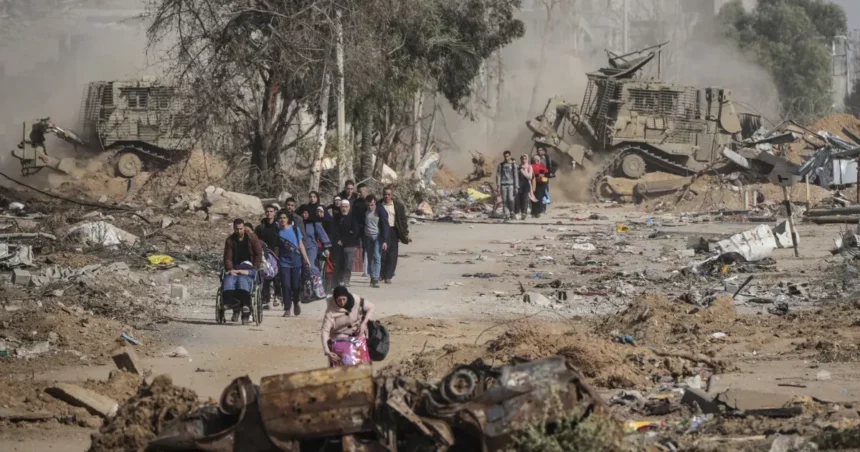
In a powerful call to action, a coalition of international legal experts, academics, and human rights advocates has urged the United Nations to deploy a multinational military protection force in Gaza. This demand, issued by the Gaza Tribunal Project, comes as Israel’s ongoing 22-month assault on the besieged territory has entered what observers describe as its deadliest and most destructive phase. The tribunal argues that the international community’s failure to enforce international law has left Palestinians facing mass atrocities without meaningful protection, prompting calls for the UN General Assembly to invoke the “Uniting for Peace” resolution and act decisively where the Security Council has failed.
Gaza Tribunal Demands Enforcement of International Law and Responsibility to Protect
The Gaza Tribunal Project, founded in late 2024 amid mounting global frustration over the international community’s inaction on Gaza, held a press conference in Istanbul on Monday to deliver its urgent appeal. Richard Falk, the tribunal’s president and a former UN special rapporteur on Palestinian rights, delivered a blunt assessment: international law has failed because it has not been enforced.
Speaking before an audience of journalists, scholars, and rights campaigners, Falk emphasized that Palestinians remain unprotected despite overwhelming evidence of atrocities, including large-scale civilian killings, forced displacement, famine, and the systematic destruction of Gaza’s infrastructure. He urged the international community to revive and implement the Responsibility to Protect (R2P) doctrine, an international legal principle adopted in 2005 to prevent and stop genocide, war crimes, ethnic cleansing, and crimes against humanity.
“The law has failed because it has not been enforced,” Falk declared. “It is time to use the Responsibility to Protect framework as a guide for action. Palestinians have been subjected to mass atrocities, and the international community cannot continue to stand by while Gaza is reduced to rubble and its population decimated.”
The tribunal’s statement specifically called upon the UN General Assembly to invoke the 1950 Uniting for Peace Resolution (377(V)), which allows the Assembly to act when the Security Council is paralyzed by vetoes from permanent members. This mechanism, the tribunal argued, is the only viable way to authorize a multinational armed protection force in Gaza, given the consistent deadlock at the Security Council due to U.S. vetoes shielding Israel from accountability.
According to the tribunal, the protection force should remain in Gaza until several key conditions are met: Israel’s withdrawal from the territory, the lifting of the blockade, the unimpeded flow of humanitarian aid, and the guarantee of internationally supervised Palestinian elections.
This call comes at a moment of unprecedented humanitarian catastrophe. Israel’s bombardment of Gaza has displaced the entire population of 2.3 million multiple times, while more than 60,000 Palestinians — the vast majority women and children — have been killed since the war began following Hamas’s 7 October 2023 attacks on southern Israel.
International Legal Frameworks, Political Obstacles, and Growing Calls for Palestinian Statehood
The tribunal’s appeal for action under the Responsibility to Protect doctrine and the Uniting for Peace mechanism is rooted in the failure of traditional diplomatic channels to prevent or halt mass atrocities in Gaza. The R2P principle, unanimously adopted at the 2005 UN World Summit, is enshrined in paragraphs 138 and 139 of the Summit Outcome Document. Since then, it has been invoked in over 95 UN Security Council resolutions addressing crises from Libya to Syria and South Sudan. Its clearest application was in 2011, when the Security Council authorized military intervention in Libya to protect civilians from Muammar Gaddafi’s regime.
Yet, in the case of Gaza, the Security Council has remained immobilized. Repeated U.S. vetoes have blocked resolutions calling for ceasefires or investigations into war crimes, leading critics to argue that the Council has abdicated its responsibility to uphold international peace and security. By urging the General Assembly to act, the Gaza Tribunal is seeking to bypass this paralysis and assert that the world’s collective responsibility cannot be held hostage to political alliances.
At the Istanbul press conference, Falk acknowledged that some European nations had recently announced plans to recognize Palestinian statehood at the upcoming UN General Assembly session in September. Countries such as Australia, Canada, and France have also expressed intentions to formally support Palestinian recognition. The United Kingdom has stated it would consider recognition if Israel fails to meet conditions including a ceasefire agreement.
While welcoming these developments, Falk cautioned that symbolic gestures of recognition are insufficient without concrete measures to halt the ongoing destruction of Gaza. He lamented what he described as “half-hearted measures” by Israel’s closest allies, including their reluctance to impose sanctions or apply meaningful political pressure on Prime Minister Benjamin Netanyahu’s government.
“The recognition of Palestinian statehood is significant, but it does not stop bombs from falling or children from starving,” Falk said. “Without sanctions, without accountability, without protection, Palestinians remain exposed to mass atrocities. International law is not a rhetorical exercise — it must be enforced through action.”
The tribunal’s statement also criticized the absence of political will within Israel itself, noting that Netanyahu’s government continues to face little domestic resistance to its military campaign. The lack of internal pressure, Falk argued, is another factor that emboldens Israel to escalate its operations without fear of consequences.
The Gaza Tribunal includes a distinguished roster of international figures, such as Hilal Elver, Penny Green, Michael Lynk, Cornel West, Naomi Klein, and former UK Labour leader Jeremy Corbyn. Collectively, they represent a diverse coalition of voices united by a common conviction: that the international community has failed Gaza, and only bold, decisive action can prevent further atrocities.
In its statement, the tribunal described Israel’s current military push into Gaza City and central Gaza as “the deadliest phase of the conflict,” putting nearly one million civilians at immediate risk. It warned that a full occupation of Gaza would further devastate humanitarian conditions, unleashing famine, disease, and the collapse of basic survival systems.
This dire assessment underscores the urgency of the tribunal’s call for international intervention. For them, the choice is stark: either the world acts decisively to protect Gaza’s civilians, or it becomes complicit in one of the gravest humanitarian catastrophes of the 21st century.