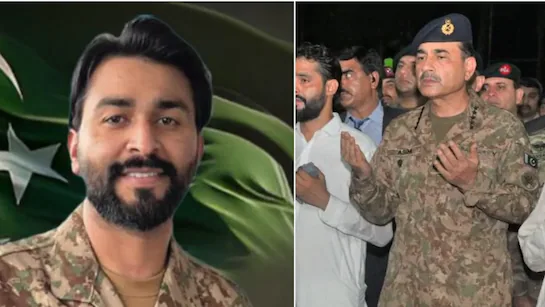
In a moment resonating with grief and symbolism for Pakistan, Army Chief Field Marshal Asim Munir attended the funeral of Major Syed Moiz Abbas Shah, an officer once linked to the capture of Indian Air Force pilot Abhinandan Varthaman in 2019, who was recently killed during a clash with Taliban militants at the Pakistan-Afghanistan border. Praising his “ultimate sacrifice,” Munir stated that Pakistan owed an “eternal debt” to its martyrs, framing Syed Moiz Abbas Shah’s death as a moment of both national sorrow and pride.
Munir Praises Major Syed Moiz Abbas Shah’s Sacrifice
Major Syed Moiz Abbas Shah, an officer of Pakistan Army’s elite Special Services Group (SSG), was killed during an operation against Tehreek-e-Taliban Pakistan (TTP) militants in South Waziristan’s Sararogha area, where eleven militants were also killed. Commissioned in 2011, Syed Moiz Abbas Shah had been part of several operations and was regarded within Pakistan’s military ranks as a committed officer. During his funeral at Chaklala Garrison in Rawalpindi, Asim Munir praised his bravery, stating that the blood of Pakistan’s martyrs formed the foundation of the nation’s strength, according to a statement from the Inter-Services Public Relations (ISPR).
Munir’s statement reflected Pakistan’s focus on framing security challenges as moments of national unity, with the Army Chief noting that the entire nation “stood united in grief and pride” while saluting Syed Moiz Abbas Shah’s sacrifice for defending the country’s borders. The ISPR added that Syed Moiz Abbas Shah “fought bravely in the face of resistance and ultimately laid down his life in the line of duty, upholding the highest traditions of bravery, sacrifice, and patriotism.”
Link to Abhinandan’s Capture in 2019
Major Syed Moiz Abbas Shah’s name resurfaced in India due to his link to the 2019 capture of Wing Commander Abhinandan Varthaman during heightened tensions following the Pulwama attack and India’s Balakot airstrike. After India targeted a Jaish-e-Mohammad training camp in Balakot on February 26, 2019, Pakistan retaliated with airstrikes, leading to a 10-minute aerial dogfight on February 27. Abhinandan, flying a MiG-21 Bison, shot down a Pakistani F-16 before his own aircraft was hit and he ejected into Pakistan-occupied Kashmir.
Abhinandan was captured by Pakistan, and his image with tea in hand while in custody became a widely circulated symbol before his release after around 60 hours on March 1, 2019. Major Syed Moiz Abbas Shah, at the time, was among those who claimed responsibility for the capture, making him a figure of note in the narrative surrounding the 2019 Indo-Pak tensions.
Taliban Clashes and Security Tensions
The recent operation in which Syed Moiz Abbas Shah was killed occurred amid ongoing security concerns in Pakistan’s tribal regions, particularly as the Taliban’s presence across the border in Afghanistan continues to affect regional stability. The Pakistani military has frequently launched operations in South Waziristan and surrounding areas to target TTP militants, who continue to pose challenges for the country’s internal security despite repeated claims of successful operations.
Syed Moiz Abbas Shah’s death, coupled with his historical connection to a high-profile moment in India-Pakistan military tensions, has brought his name back into the regional spotlight. For Pakistan, the incident is framed as a reaffirmation of the military’s ongoing operations against terrorism, while for observers, it underscores the volatility and human costs of regional security challenges that continue to impact South Asia.