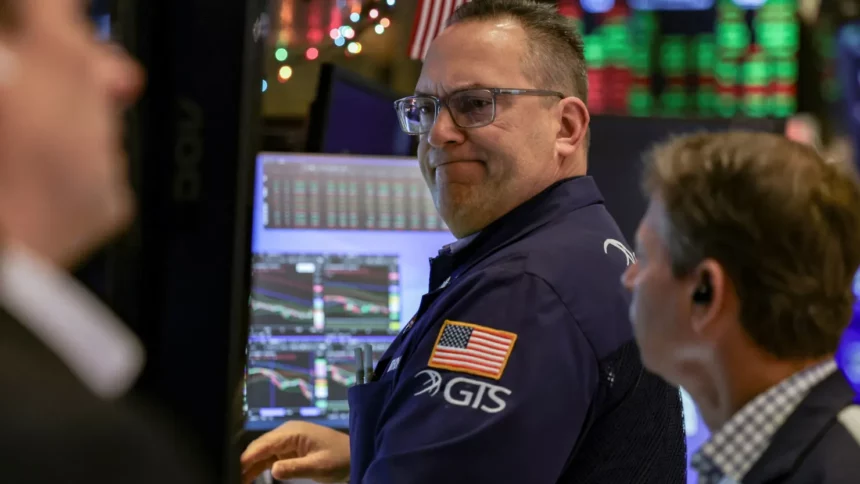
U.S. equity markets showed remarkable calm after President Donald Trump’s extraordinary action in Venezuela, with investors largely brushing aside geopolitical anxiety and instead doubling down on a long-held belief that such shocks rarely derail long-term stock market momentum, especially when economic fundamentals remain supportive.
Despite the scale of the development — including the U.S. intervention in Venezuela and the capture of its long-time leader Nicolas Maduro — Wall Street reacted with only modest moves, signalling that investors do not expect the situation to escalate into a prolonged global conflict. Instead, markets rallied, reinforcing the view that geopolitical events often produce short-term volatility but rarely alter the broader bullish trajectory when growth, earnings, and policy conditions remain favourable.
The muted reaction stood out given Venezuela’s strategic importance as a country with the world’s largest proven oil reserves and a long history of geopolitical tension involving the United States. Yet traders appeared confident that the episode would remain contained, interpreting Trump’s actions and rhetoric as decisive but limited in scope rather than the beginning of an extended military or economic confrontation.
why investors see limited geopolitical risk and a familiar market pattern
On Monday, the Dow Jones Industrial Average climbed 343 points, or 0.7%, while the S&P 500 and Nasdaq Composite rose 0.6% and 0.8% respectively. The gains came even as headlines around Venezuela dominated global news cycles, underscoring how desensitised markets have become to geopolitical surprises.
Market participants pointed to history as the primary reason for their composure. According to analysis cited by UBS, a review of the last 11 major geopolitical events showed that the S&P 500 was, on average, just 0.3% lower one week after such shocks and 7.7% higher twelve months later. Even events widely considered severe at the time, including U.S. military action in the Middle East, ultimately failed to produce lasting damage to equity markets.
This historical resilience has shaped investor psychology. Rather than reacting emotionally to breaking news, traders increasingly assess whether an event is likely to disrupt global supply chains, monetary policy, or corporate earnings in a sustained way. In the case of Venezuela, the prevailing judgement on Wall Street has been that the risks are manageable and the economic transmission channels limited.
A key factor behind this assessment is Trump’s own foreign policy track record. Investors recall his repeated criticism of long, drawn-out conflicts in Iraq and Afghanistan and believe that this stance reduces the likelihood of a prolonged engagement. As a result, many see the Venezuela action as a contained operation rather than a prelude to wider regional instability.
Jay Woods, chief market strategist at Freedom Capital Markets, captured this sentiment by noting that while short-term volatility was possible as headlines continued to emerge, markets appeared “relatively unfazed.” In his view, the perception of a quick resolution with minimal escalation threat has calmed investor nerves, at least for now.
There are, of course, global ramifications being closely watched. Some countries have gone on heightened alert, and reactions from major powers have been cautious rather than confrontational. Analysts highlighted Denmark’s heightened security posture following renewed U.S. focus on Greenland, while Russia’s response to Maduro’s ouster has so far been measured. These responses have reinforced the belief that major powers are seeking to avoid escalation rather than provoke it.
Importantly, investors also noted that Venezuela’s current oil exports are relatively modest compared to global supply, limiting the immediate economic shock. While the country’s long-term energy potential is enormous, rebuilding infrastructure and restoring production would take years, making the implications more structural than sudden.
Matthew Aks of Evercore ISI argued that Trump’s statements about the U.S. “running” Venezuela should be interpreted less as literal policy and more as a negotiating tactic designed to pressure remaining elements of the Maduro regime. In his view, the rhetoric is dramatic but unlikely to translate into immediate, large-scale military or economic action that would meaningfully disrupt markets.
energy stocks benefit while investors stay anchored to earnings and ai optimism
While the broader market response was restrained, certain sectors did see a more direct impact. Energy stocks provided a notable boost to indices, supported by a modest rise in oil prices and expectations that political change in Venezuela could eventually benefit major oil and gas producers.
Shares of Chevron, which already has an established presence in Venezuela, surged more than 7%. Exxon Mobil climbed over 4%, as investors speculated that regime change could open the door to asset recovery, new investments, or improved operating conditions in the oil-rich nation. Despite this optimism, crude prices themselves rose only modestly, reinforcing the view that the market does not foresee immediate supply disruptions.
Beyond energy, however, investor focus remained firmly on fundamentals rather than geopolitics. Many market participants continue to view artificial intelligence-driven productivity gains, resilient corporate earnings, and the prospect of easier monetary policy as the dominant forces shaping equities in early 2026.
UBS highlighted that global earnings growth is expected to approach 10% for both 2026 and 2027 across the MSCI All Country World Index. Such forecasts underpin a constructive outlook for stocks, even in the face of geopolitical uncertainty. Ulrike Hoffmann-Burchardi, global head of equities at UBS Financial Services, said that while developments in Venezuela could cause episodic volatility — particularly in oil markets — they are unlikely to derail the broader trend.
Against this backdrop, UBS continues to rate global equities as attractive and has advised underexposed investors to consider reallocating excess cash, bonds, or high-yield credit into stocks. At the same time, the firm maintained that gold should remain part of diversified portfolios, reflecting a balanced approach to risk rather than outright complacency.
The market’s reaction also reflects a broader shift in how investors process geopolitical news. Rather than viewing such events as automatic triggers for risk-off moves, many now evaluate them through the lens of probability, duration, and economic relevance. In the Venezuela case, the consensus has been that while the situation is extraordinary, it does not materially alter the near-term outlook for U.S. growth, corporate profitability, or monetary policy.
As trading desks returned their attention to earnings forecasts, interest rate expectations, and technological innovation, Venezuela faded into the background of market decision-making. This does not mean investors are dismissing geopolitical risk altogether, but rather that they are calibrating it against stronger and more immediate drivers of asset prices.
For now, Wall Street’s message is clear: unless geopolitical shocks threaten to spiral into prolonged conflict or directly undermine economic fundamentals, they are unlikely to derail a market environment still buoyed by growth optimism, structural investment themes, and expectations of supportive policy conditions.