The sudden dismissal of Ruben Amorim as manager of Manchester United after just 14 months in charge has laid bare the unresolved tensions between performance expectations, internal governance, and communication at one of world football’s most scrutinised clubs, turning what was meant to be a long-term rebuild into another abrupt managerial reset.
Amorim’s departure, confirmed on January 5, 2026, followed a turbulent period marked by inconsistent results, public criticism of the club’s recruitment structure, and growing frustration on both sides of the relationship. Although United sit sixth in the Premier League, an improvement on their disastrous 15th-place finish at the end of the 2024–25 season, the club’s leadership ultimately decided that progress was insufficient and the working relationship had deteriorated beyond repair. The decision, taken hours after a fiery press conference, reflected not just dissatisfaction with league position but deeper concerns about alignment, authority, and stability during a crucial phase of the season.
From optimism to tension: how trust eroded between amorim and united’s hierarchy
When Ruben Amorim arrived at Old Trafford, he was viewed as a bold appointment, a modern coach with a clear tactical identity and a reputation for discipline and structure. At just 40, he represented a break from the club’s recent pattern of appointing either short-term caretakers or managers with vastly different philosophies. United’s hierarchy spoke of patience, long-term planning, and a shared vision aimed at restoring the club to elite European contention.
For a time, that vision appeared to be taking shape. United’s league position improved steadily, performances became more organised, and the side looked harder to beat. However, beneath the surface, cracks were forming. Amorim grew increasingly frustrated with what he perceived as a lack of support in key areas, particularly recruitment and squad planning. Injuries and suspensions exposed the thinness of the squad, and the manager privately, then publicly, questioned whether the club was fully committed to backing his project.
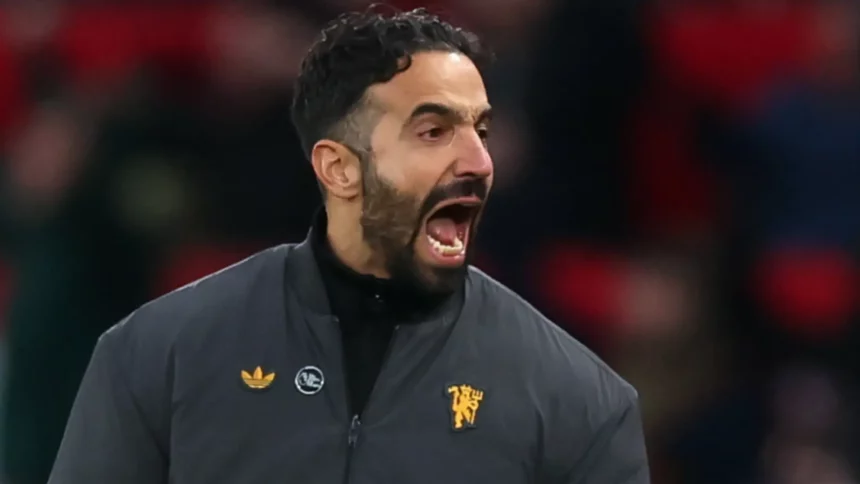
The breaking point came during a tense press conference, where Amorim bristled at questions about his future and pushed back strongly against suggestions that his job was under threat. In doing so, he openly criticised the club’s scouting operation and told the football leadership, including director of football Jason Wilcox, to “do their job.” While Amorim framed his comments as a defence of his authority and a call for accountability, senior figures at United reportedly viewed them as unacceptable, public challenges to the club’s internal structure.
Amorim also revealed that there had been no meaningful discussions about strengthening the squad during the January transfer window, despite the team’s evident need for reinforcements. This disclosure intensified concerns within the hierarchy that internal disagreements were spilling into the public domain, risking further instability and undermining confidence among players and supporters alike.
Although Amorim insisted he had no intention of resigning and declared that he would continue “until another guy is coming here to replace me,” the damage had already been done. The relationship between manager and club leadership, strained by months of misalignment, reached a point where trust appeared irreparably broken. Within hours, United’s board moved decisively, concluding that a change was necessary to protect what remained of the season and prevent further erosion of authority.
Results, rigidity, and reaction: why progress was not enough
On paper, Ruben Amorim’s record at Manchester United was not disastrous. In 14 months, he oversaw 24 wins, 18 draws, and 21 losses across competitions. The team’s sixth-place standing in the Premier League represented a notable recovery from the previous season’s collapse, and United remained competitive in most matches. Yet at a club defined by its history and expectations, improvement alone was never going to be sufficient.
United’s ambition was clear: secure a place in the UEFA Champions League and re-establish themselves among England’s elite. Under Amorim, that goal remained elusive. The team struggled for consistency, particularly against well-organised opponents, and entered the new year with just one win from their last five league matches. Performances often followed a familiar pattern—solid structure, flashes of quality, but an inability to dominate or impose themselves decisively.
Critics also pointed to Amorim’s tactical rigidity. His commitment to a defined system, while admired by some, was seen by others as an unwillingness to adapt to the Premier League’s demands. Former United defender Rio Ferdinand argued that Amorim’s refusal to adjust his approach was his biggest mistake, suggesting that flexibility was essential in a league known for its physicality and tactical diversity. Ferdinand also indicated that the timing and tone of Amorim’s recent comments likely accelerated the club’s decision, describing the sacking as swift and reactive.
Another club legend, Gary Neville, observed that Amorim appeared increasingly frustrated in the weeks leading up to his dismissal. He noted that the manager was “starting to unleash,” with remarks that hinted at dissatisfaction within the hierarchy. For Neville, the need to read between the lines suggested a manager who felt isolated and unsupported, a dangerous position at a club where unity is often as important as tactics.
Amorim’s final match in charge, a 1–1 away draw against Leeds United on January 4, 2026, encapsulated his tenure. United were competitive but not dominant, organised but lacking cutting edge. The result did little to ease pressure, and within 24 hours, his fate was sealed.
In announcing the decision, Manchester United said the change was made reluctantly but was necessary to give the team “the best opportunity of the highest possible Premier League finish.” The statement was brief and measured, thanking Amorim for his contribution and wishing him well, but it also signalled a desire to move on quickly and refocus attention on the remaining months of the season.
Former United midfielder and academy head coach Darren Fletcher was appointed interim manager with immediate effect, a choice that underscored the club’s preference for familiarity and internal stability during a turbulent period. Fletcher’s task is to steady the squad, restore clarity, and keep United in contention for a strong league finish while the club assesses long-term options.
Amorim’s dismissal adds another chapter to Manchester United’s post-Sir Alex Ferguson narrative, one defined by frequent managerial changes, shifting strategies, and the constant tension between patience and pressure. For Amorim, the exit is likely to be a temporary setback rather than a terminal blow. His tactical reputation and prior success suggest he will remain in demand across Europe.
At Old Trafford, however, his tenure will be remembered as a period of partial recovery overshadowed by unresolved structural issues and a public breakdown in trust. The decision to sack him was not driven by a single result or comment, but by the cumulative weight of unmet expectations, strained relationships, and a sense within the club that progress, while real, was not happening on their terms.