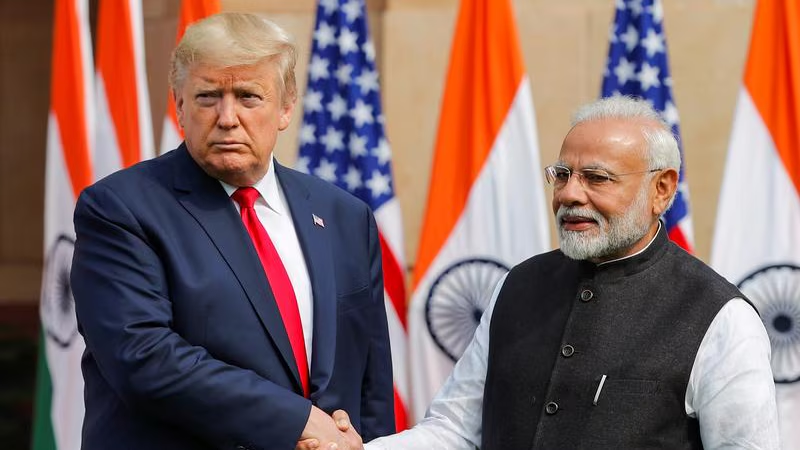
US President Donald Trump’s decision to impose a steep 25% additional tariff on Indian imports, raising the total duty to 50%, has triggered concern across India’s trade and economic ecosystem. But industrialist Anand Mahindra sees this moment not as a crisis, but as a rare opportunity for deep reform and strategic repositioning. In a post that drew parallels with India’s 1991 economic crisis—a turning point in the country’s liberalisation story—Mahindra urged that India can extract “Amrit” from this global “Manthan” over tariffs by acting decisively. He called for transformative steps to boost India’s ease of doing business and unlock tourism as a powerful foreign exchange engine, while pushing for structural reforms across critical sectors.
Reform Doing Business Landscape to Attract Global Capital
According to Anand Mahindra, India must rise above incremental changes and initiate bold reforms to improve its business environment. He advocated for a genuinely effective single-window clearance system for investment approvals—a mechanism long promised but often mired in bureaucratic inertia. In his view, simplification and speed in regulatory processes can position India as a preferred investment destination in an increasingly fragmented global economy.
He suggested that though several investment-related regulations are controlled by individual states, a coalition of willing states could be mobilised to adopt and align with a national single-window platform. Such a model, he argued, could offer predictability, transparency, and efficiency, thus appealing to global investors who are actively scouting for alternative and trustworthy destinations amid shifting geopolitical and trade dynamics.
The Mahindra Group Chairperson emphasised that if India manages to demonstrate its intent through visible execution on this front, the country can become an “irresistible magnet” for global capital. This, he warned, is not the time for half-measures. The tariff shock may hurt in the short term, but it offers India the urgency needed to fast-track long-delayed reforms.
Harness Tourism as a High-Potential Economic Lever
Mahindra also spotlighted tourism as a vastly underexploited source of foreign exchange and employment. He argued that India has barely scratched the surface of its tourism potential, despite having a rich historical, cultural, and geographical heritage. By streamlining visa processes, enhancing tourist experiences, and investing in sanitation and security infrastructure, India could position itself as a globally competitive tourism hub.
He proposed the creation of “dedicated tourism corridors” centered around existing hotspots, which would offer assured security, hygiene, and convenience to domestic and international travellers. These corridors could be model zones that inspire other states and regions to replicate similar standards.
From a policy standpoint, Mahindra suggested that facilitating faster visa processing and better tourist facilitation services could have a double impact: attracting foreign visitors and generating employment, especially in semi-urban and rural areas where tourism potential often remains untapped.
He framed this approach as a strategic foreign exchange engine that could significantly contribute to India’s external account stability at a time when exports may be challenged due to rising global protectionism.
Beyond these two primary recommendations, Mahindra called for broader policy interventions to respond meaningfully to the global shift in trade attitudes. He stressed the need for:
* Stronger support mechanisms for micro, small, and medium enterprises (MSMEs), who often bear the brunt of external shocks;
* Faster rollout and implementation of infrastructure projects to boost investor confidence and reduce logistical inefficiencies;
* Expansion of the Production Linked Incentive (PLI) schemes to invigorate manufacturing and create scale;
* Rationalisation of import duties in key sectors to make Indian products more competitive in global markets.
While the US tariff decision may appear unilateral and disruptive, Mahindra urged Indians not to react with retaliation or resignation. Instead, he said, the challenge should galvanise the country into crafting intentional, home-grown solutions that will have long-lasting structural impact.
In what may resonate with many policy watchers, Mahindra noted, “We cannot fault others for putting their nations first. But we should be moved to make our own nation greater than ever.”
His statement subtly reflected the broader call for self-reliance, without falling into the trap of isolationism. Rather, it suggested that India should make itself globally indispensable by being more open, more efficient, and more ambitious.
Amid rising nationalism and protectionism worldwide, his message is a reminder that India’s best response lies not in confrontation but in confident, inward-looking reform—the kind that makes the country stand taller in a more divided global order.
The moment, he believes, demands a mindset shift: away from defensiveness and towards bold, transformative intent. If India chooses to act with clarity and urgency, the Trump tariff challenge could end up being the wake-up call the country never knew it needed.