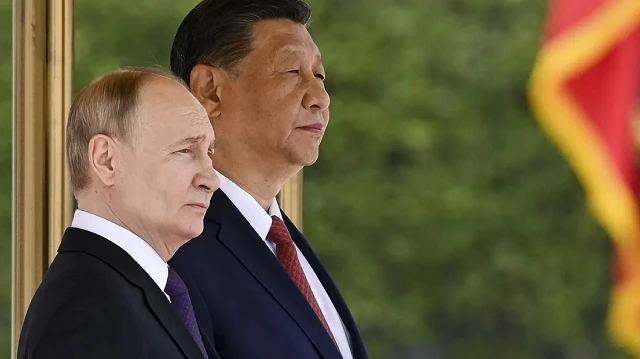
Russian President Vladimir Putin arrived in Beijing for a highly significant two day summit with Chinese President Xi Jinping at a time when global geopolitical tensions continue reshaping international diplomacy. The visit comes only days after United States President Donald Trump concluded a major diplomatic trip to China, placing Beijing at the center of a rapidly evolving global power equation.
The summit between Putin and Xi is being closely watched worldwide because it highlights China’s increasingly complex balancing strategy between its deepening partnership with Russia and its efforts to stabilize relations with Washington. Beijing now finds itself navigating one of the most sensitive geopolitical environments since the end of the Cold War while trying to maintain strategic flexibility with both global powers.
Russian officials described the summit as an important step toward strengthening the “privileged and strategic partnership” between Moscow and Beijing. Kremlin spokesperson Dmitry Peskov stated before the meeting that Russia had serious expectations from the discussions, particularly regarding economic cooperation, energy security, trade expansion, and geopolitical coordination. The language used by Moscow underlines how critical China has become for Russia following the Ukraine conflict and the economic pressure created by Western sanctions.
Since the beginning of the Ukraine war in 2022, Russia has increasingly depended on China for trade, financial cooperation, industrial support, and energy exports. Western sanctions isolated Moscow from many traditional markets and financial systems, forcing Russia to pivot more aggressively toward Asia. China emerged as the most important economic lifeline for the Russian economy during this period.
The summit also demonstrates how Beijing has transformed into one of the most influential diplomatic centers in the modern international order. Hosting leaders from both the United States and Russia within days of each other reflects China’s growing ability to position itself as a central actor in global politics. Chinese state media described the consecutive visits as evidence of Beijing’s rising diplomatic importance and its role as a pivotal power capable of engaging with competing global blocs simultaneously.
China’s leadership faces a difficult challenge in managing these relationships. On one side, Beijing values its strategic partnership with Russia because both countries share concerns about Western influence, security alliances, and the global dominance of the United States. On the other side, China also understands the importance of maintaining stable economic relations with Washington, especially given the deep interconnectedness between the Chinese and American economies.
The timing of Putin’s visit is particularly important because it follows recent diplomatic engagement between Beijing and Washington. Donald Trump’s China visit reportedly produced several major economic agreements including agricultural purchases, aircraft deals, and future bilateral meetings. Those developments signaled attempts by both sides to prevent further deterioration in relations despite ongoing competition over trade, technology, security, and geopolitical influence.
For Moscow, the summit with Xi Jinping serves several strategic objectives. Russia seeks reassurance that improving ties between China and the United States will not weaken the close coordination that currently exists between Beijing and Moscow. Russian policymakers understand that China’s economic interests with the United States remain substantially larger than its trade relationship with Russia. This creates concerns within Moscow that Beijing could eventually prioritize stability with Washington over deeper strategic alignment with Russia.
Analysts believe the summit will therefore focus heavily on maintaining trust and long term coordination between the two countries. Russia sees China not only as a major trading partner but also as a geopolitical counterweight against Western pressure. The concept of a “strategic triangle” involving Russia, China, and the United States remains central to Moscow’s diplomatic calculations.
Energy cooperation is expected to dominate the summit agenda. China has become the largest buyer of Russian oil and natural gas after European demand collapsed following sanctions and the Ukraine war. Russian energy supplies are being sold to China at discounted rates, creating mutual economic benefits for both countries. Beijing secures stable and affordable energy imports while Moscow receives critical revenue needed to sustain its economy and finance government operations.
Recent instability in global energy markets and concerns over maritime supply routes have further increased China’s interest in securing long term energy partnerships. The possibility of disruptions in key shipping corridors has strengthened Beijing’s determination to diversify energy imports and reduce vulnerability to geopolitical crises. Russian pipeline energy offers China a relatively stable alternative to sea based imports.
Vladimir Putin recently indicated that Russia and China are close to finalizing major agreements in the oil and gas sectors. According to Russian officials, discussions may involve expanded pipeline infrastructure, increased export volumes, and broader long term energy arrangements. Such agreements could deepen economic interdependence between the two countries for decades.
Trade between Russia and China has expanded dramatically since 2022. China now absorbs more than one quarter of Russian exports while supplying Moscow with industrial products, machinery, electronics, and consumer goods. Bilateral trade has reached record levels as both countries attempt to reduce dependence on Western dominated financial systems and supply chains.
Chinese investment in Russian industries is also expected to feature prominently during the summit. Russia hopes to attract greater Chinese involvement in infrastructure, energy production, manufacturing, transportation, and technology sectors. However, Chinese companies remain cautious because of concerns over secondary sanctions from Western governments.
The United States and European countries are expected to closely monitor the outcomes of the summit. Western governments have repeatedly accused Chinese firms of providing dual use goods and technologies that indirectly support Russia’s military capabilities. NATO previously described China as a “decisive enabler” of the Ukraine conflict because of alleged economic support for Moscow. Beijing has rejected those accusations and maintains that it supports dialogue and diplomatic solutions rather than direct military involvement.
The summit also reflects broader transformations in the international system. The world is increasingly moving toward a more multipolar structure where major powers compete for influence through economic partnerships, energy cooperation, technological alliances, and regional diplomacy. China’s ability to engage simultaneously with both Russia and the United States demonstrates its ambition to shape this evolving order according to its own strategic interests.
Xi Jinping’s foreign policy approach has emphasized strengthening China’s role as an independent global power capable of balancing relations with multiple countries while protecting Chinese economic and security priorities. Maintaining ties with Russia allows Beijing to secure energy resources, strengthen geopolitical coordination, and challenge Western influence in international institutions. At the same time, preserving stable communication with Washington remains essential for China’s trade driven economy.
Observers believe Beijing will continue pursuing a careful balancing strategy rather than fully aligning with either side. China benefits from maintaining strategic ambiguity because it allows flexibility in responding to changing global circumstances. This approach also enhances Beijing’s diplomatic leverage by positioning China as an indispensable participant in major international negotiations.
The Ukraine conflict remains a central factor shaping Russia China relations. Western sanctions and diplomatic isolation pushed Moscow closer to Beijing than at any time in recent decades. For Russia, Chinese economic support has become essential for limiting the impact of international restrictions. For China, the partnership provides strategic advantages but also carries risks related to tensions with Western governments.
Economic pressures inside Russia are another important backdrop to Putin’s visit. Russian authorities recently reduced growth forecasts amid damage to energy infrastructure, financial uncertainty, and continued military spending. The Kremlin therefore views stronger economic ties with China as critical for stabilizing domestic conditions and sustaining long term resilience.
Meanwhile, China itself faces economic challenges including slowing growth, export pressures, property sector weakness, and competition with Western economies. Expanding cooperation with Russia offers opportunities for securing energy supplies and opening additional markets, although Beijing remains cautious about avoiding excessive confrontation with the United States and Europe.
The symbolism surrounding the summit is equally important. Consecutive visits by Donald Trump and Vladimir Putin illustrate Beijing’s unique diplomatic position in today’s fragmented global environment. China is increasingly presenting itself as a central power capable of maintaining dialogue with competing geopolitical camps while advancing its own national interests.
As global tensions continue evolving, the Putin Xi summit may significantly influence future alignments involving energy markets, sanctions policy, trade networks, and geopolitical alliances. The outcomes could affect not only Russia and China but also broader international relations involving Europe, the United States, and emerging economies across Asia and the Global South.
The Beijing summit therefore represents far more than a routine bilateral meeting. It reflects the changing architecture of global power where economic dependence, strategic rivalry, and diplomatic balancing increasingly shape international politics. China’s challenge now lies in maintaining strong ties with Russia without undermining its vital economic relationship with the United States, a balancing act that may define global diplomacy in the coming years.