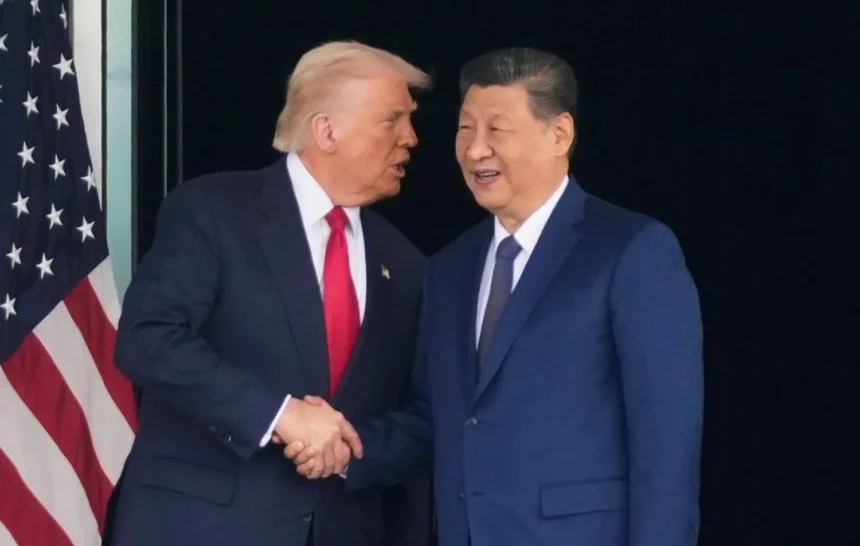
U.S. President Donald Trump and Chinese President Xi Jinping held a closely watched high-stakes summit in Beijing on Thursday, as global tensions surrounding trade disputes, the Iran conflict, and Taiwan security concerns dominated discussions between the world’s two most powerful leaders.
The meeting took place at the iconic Great Hall of the People following a formal state welcome ceremony hosted by Xi Jinping. The summit is being viewed as one of the most consequential diplomatic engagements of 2026, with analysts across the world closely examining every signal emerging from the talks.
The discussions come at a time of heightened geopolitical uncertainty. The United States and China remain locked in strategic competition over economic influence, technological dominance, military positioning in the Indo-Pacific, and competing visions for global governance. At the same time, escalating instability in the Middle East, particularly involving Iran, has added urgency to diplomatic efforts between major world powers.
The Beijing summit marks Donald Trump’s most significant diplomatic engagement with China since returning to high-level international negotiations, and expectations are high that the meeting could shape the future direction of U.S.-China relations for years to come.
Trade Tensions Return to the Center of U.S.-China Diplomacy
Trade relations between Washington and Beijing once again emerged as a central focus of the summit. Both countries have spent years navigating disputes involving tariffs, market access restrictions, technology transfers, semiconductor controls, and industrial competition.
President Trump entered the talks emphasizing fair trade practices and stronger protections for American economic interests. His administration has repeatedly argued that existing trade structures disproportionately benefit Chinese manufacturing and technological expansion at the expense of U.S. industries.
China, meanwhile, has sought to project confidence and openness. During the summit, Xi Jinping signaled Beijing’s willingness to further open Chinese markets to American businesses, an effort widely interpreted as a strategic gesture aimed at stabilizing economic ties and reassuring international investors.
Economic analysts note that both countries face growing pressure to avoid deeper trade disruptions. The global economy remains vulnerable to inflationary pressure, supply chain instability, and slowing industrial growth, making cooperation between Washington and Beijing increasingly important.
Financial markets around the world reacted cautiously to the summit, with investors awaiting concrete policy outcomes or joint statements that might signal progress toward easing trade tensions.
Iran Conflict Adds New Diplomatic Complexity
The ongoing conflict involving Iran became another major topic during the summit, reflecting broader concerns about regional instability and its potential consequences for global security and energy markets.
The United States has continued pressing for stronger international coordination to contain military escalation in the Middle East. Washington remains deeply concerned about the possibility of wider regional conflict involving strategic allies and shipping routes critical to global oil supplies.
China, which maintains important economic and energy relationships with Iran, has advocated diplomatic engagement and restraint. Beijing has consistently called for political dialogue rather than military escalation, positioning itself as a supporter of negotiated solutions.
Trump’s discussions with Xi are believed to have included efforts to secure Chinese cooperation in reducing tensions and encouraging regional stability. Analysts say China’s influence with Tehran gives Beijing an important diplomatic role in any broader de-escalation strategy.
The issue also highlights how U.S.-China relations increasingly intersect across multiple global crises beyond bilateral disputes, forcing both nations to cooperate even amid strategic rivalry.
Taiwan Remains the Most Sensitive Flashpoint
Taiwan once again emerged as one of the most delicate issues discussed during the Beijing summit.
Chinese leadership has repeatedly described Taiwan as a core national interest and has warned against foreign interference in what it considers an internal matter. Xi Jinping is expected to have reiterated Beijing’s firm position during discussions with Trump, emphasizing that Taiwan remains non-negotiable.
The United States continues to maintain unofficial ties with Taiwan while supporting the island’s defensive capabilities under long-standing strategic frameworks. This balancing act has become increasingly difficult amid rising military activity in the Taiwan Strait and heightened tensions between Chinese and American naval forces in the Indo-Pacific.
Trump’s position on Taiwan has often drawn international scrutiny, particularly given his history of direct and sometimes unpredictable diplomatic messaging toward China.
Observers believe both leaders likely sought to reduce immediate tensions while preserving their strategic positions. However, few expect any major breakthrough on the issue, which remains one of the most entrenched disagreements in U.S.-China relations.
Security analysts warn that Taiwan continues to represent the most serious long-term flashpoint capable of triggering broader regional instability if tensions escalate.
Symbolism and Strategic Messaging from Beijing
The carefully choreographed ceremony at the Great Hall of the People reflected China’s effort to project diplomatic strength and stability.
By personally hosting Trump with full state honors, Xi Jinping signaled Beijing’s willingness to engage directly at the highest political level while reinforcing China’s image as a confident global power.
For Trump, the summit offers an opportunity to demonstrate international leadership and reinforce his administration’s strategic approach to managing relations with China through direct negotiation.
Political analysts note that symbolism matters greatly in U.S.-China diplomacy. Every gesture, statement, and visual detail from such meetings is carefully interpreted by international observers looking for clues about future policy direction.
The summit also takes place as China seeks to expand its influence across Asia, Africa, and the Global South through economic partnerships and strategic investments. Strengthening dialogue with Washington allows Beijing to project itself as a responsible major power despite ongoing rivalry.
Global Implications of the Trump-Xi Summit
The outcome of the Beijing summit will likely influence global diplomacy well beyond the immediate issues discussed.
A positive diplomatic tone could help calm financial markets, reduce fears of economic confrontation, and create opportunities for future cooperation on global challenges such as climate change, technological governance, and regional security.
Conversely, visible disagreement or hardline rhetoric could intensify uncertainty and deepen strategic divisions between the world’s two largest economies.
International allies and rivals alike are closely watching the summit for signs of shifting power dynamics. European governments, Asian security partners, and Middle Eastern stakeholders all have strategic interests tied to the direction of U.S.-China engagement.
While no immediate breakthroughs were expected, the fact that both leaders chose to meet at such a tense geopolitical moment reflects recognition that dialogue remains essential.
As the summit concludes, the world will now wait for concrete outcomes and official statements that could offer insight into whether this meeting marked a step toward stability or simply another chapter in an increasingly complex superpower rivalry.