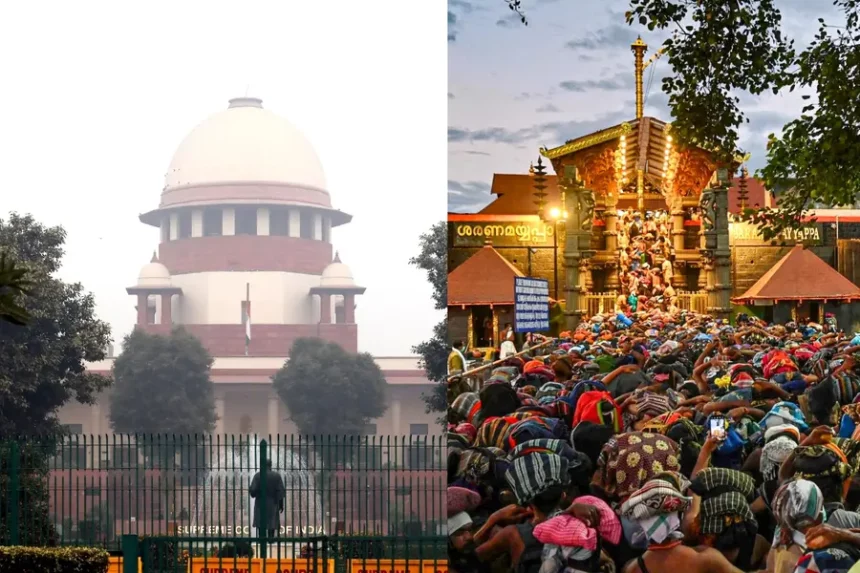
The long-pending Sabarimala review case is set to return to the national spotlight as the Supreme Court of India prepares to begin hearings before a nine-judge Constitution Bench from April 7, 2026. The case, which concerns the entry of women into the Sabarimala Temple, is expected to become one of the most significant constitutional and religious freedom debates in recent Indian judicial history.
A Bench led by Chief Justice Surya Kant, along with Justices Joymalya Bagchi and V. M. Pancholi, issued listing directions for the matter, officially reviving proceedings that have remained pending for nearly six years.
The Sabarimala dispute first drew nationwide attention in 2018 when the Supreme Court ruled that the centuries-old restriction preventing women of menstruating age from entering the temple was unconstitutional. The verdict triggered intense political, religious, and social debates across India, particularly in Kerala, where the temple is located.
The current proceedings stem from review petitions filed against that landmark judgment, raising larger constitutional questions involving religious freedom, equality, and judicial intervention in matters of faith.
Constitutional Questions at the Heart of the Case
The upcoming hearings are expected to examine some of the most sensitive constitutional issues related to religion and fundamental rights in India. The nine-judge Constitution Bench will deliberate on seven major legal questions that could reshape the interpretation of religious freedoms under the Indian Constitution.
Among the key issues before the court is the relationship between Articles 25 and 26 — which guarantee freedom of religion and rights of religious denominations — and other fundamental rights provided under Part III of the Constitution.
The court will also examine whether constitutional morality can override religious customs and traditions, an issue that became central during the original 2018 judgment. Another major question concerns the extent to which courts can review and define “essential religious practices,” a doctrine that has repeatedly influenced constitutional rulings involving faith-based traditions.
The Bench is also expected to consider whether individuals outside a religious denomination can challenge the practices of that denomination through public interest litigation. This issue has broader implications for future cases involving religious customs across multiple communities.
Legal experts believe the final judgment may establish new constitutional standards governing the balance between religious autonomy and fundamental rights in India’s secular democracy.
Wider Impact Beyond Sabarimala Temple
Although the proceedings are centered around the Sabarimala Temple case, the outcome is expected to affect several other sensitive religious matters currently linked to the review.
According to the court record, around 66 matters have been tagged with the Sabarimala review proceedings. These include petitions related to Muslim women’s entry into mosques, the rights of Parsi women entering Fire Temples after marrying outside the community, and the controversial practice of female genital mutilation among the Dawoodi Bohra community.
Because these matters involve overlapping constitutional principles, the Supreme Court’s interpretation in the Sabarimala review could become a legal benchmark for future rulings involving gender rights and religious practices.
The broad constitutional implications have made the case one of the most closely watched judicial proceedings in the country. Constitutional scholars and legal observers believe the hearings may significantly influence how Indian courts approach the intersection of faith, equality, and judicial review going forward.
Arguments Scheduled Throughout April 2026
The Supreme Court has now laid out a detailed hearing schedule for the proceedings. Parties supporting the review petitions will present arguments between April 7 and April 9, 2026. Those opposing the review and defending the 2018 judgment will argue from April 14 to April 16.
The court has also allocated April 21 for rejoinder submissions, while the appointed amicus curiae will conclude arguments on April 22.
Senior Advocate K. Parameshwar and Advocate Shivam Singh have been appointed as amicus curiae to assist the court in navigating the constitutional complexities involved in the matter.
Despite announcing the hearing timeline, the Supreme Court is yet to formally notify the complete composition of the nine-judge Constitution Bench that will hear the case.
A Case That Redefined National Debate
The original 2018 Sabarimala judgment marked a turning point in India’s legal and social discourse. Supporters of the verdict hailed it as a victory for gender equality and constitutional rights, while critics argued that the decision interfered with long-standing religious traditions and the autonomy of Hindu denominations.
The ruling triggered widespread protests and political tensions in Kerala, with demonstrations taking place both in favor of and against women’s entry into the temple. The issue also became politically sensitive, influencing public discourse far beyond the state.
In November 2019, the Supreme Court decided to review the verdict and referred broader constitutional questions to a larger bench. In February 2020, a nine-judge Bench upheld that referral, paving the way for the current proceedings.
However, the case remained pending for several years before finally being listed again in 2026.
The revival of hearings now comes at a time when debates surrounding constitutional morality, religious identity, and individual rights continue to dominate India’s legal and political landscape.
Constitutional Bench Hearing Likely to Shape Future Jurisprudence
Legal analysts believe the eventual ruling may become one of the defining constitutional judgments of the decade. The court’s interpretation of religious freedom, essential religious practices, and judicial intervention could influence multiple future disputes involving faith and social reform.
The case also reflects the evolving role of the judiciary in balancing deeply rooted religious traditions with modern constitutional values. Whether the Supreme Court chooses to reaffirm, modify, or overturn aspects of the 2018 judgment, the decision is expected to carry long-term implications for constitutional law in India.
As hearings begin in April 2026, national attention is likely to return sharply toward the Sabarimala issue, with religious groups, legal experts, civil society organizations, and political stakeholders closely monitoring every stage of the proceedings.
The Supreme Court’s final ruling could ultimately redefine the relationship between religion and constitutional rights in contemporary India.