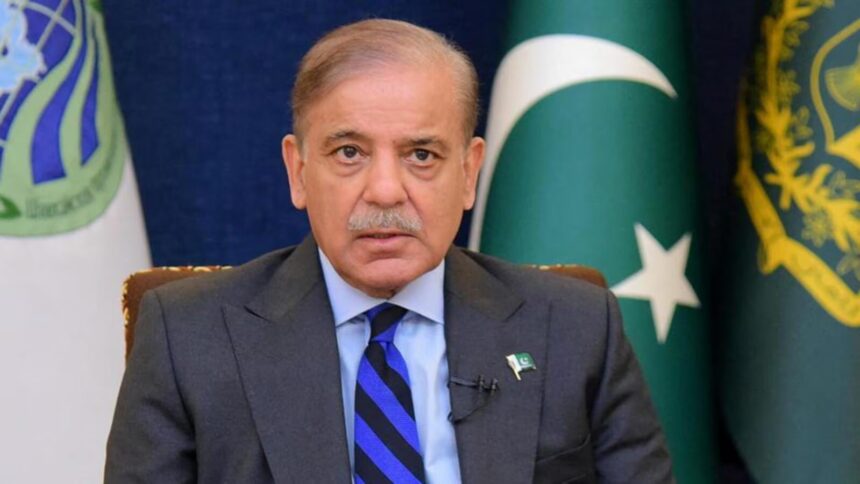
Pakistan Prime Minister Shehbaz Sharif addressed the United Nations General Assembly, raising concerns over the Indus Waters Treaty and reiterating claims that former US President Donald Trump played a pivotal role in facilitating a ceasefire with India earlier this year. In his speech, Sharif framed India’s military operations as “unprovoked aggression” while highlighting Pakistan’s commitment to dialogue and diplomacy. His address combined criticism of New Delhi’s recent counter-terror actions with praise for international intervention, notably attributing the prevention of escalation to Trump’s involvement. Sharif’s remarks come amid ongoing tensions between India and Pakistan, stemming from terrorist attacks and subsequent military operations that have significantly impacted bilateral relations.
Shehbaz Sharif and the Indus Waters Treaty dispute
A central theme of Sharif’s UN address was the Indus Waters Treaty, the historic agreement governing the sharing of six rivers between India and Pakistan. Sharif asserted that any violation of the treaty by India would amount to an “act of war.” He positioned the treaty as a cornerstone of peace and mutual cooperation, framing Pakistan’s stance as protective of both legal commitments and regional stability. According to Sharif, suspension or unilateral action by New Delhi regarding water sharing constitutes a serious provocation, threatening to destabilise relations and escalate tensions further.
However, India maintains that its suspension of participation in the treaty followed the Pahalgam terror attack in May 2025, which resulted in the deaths of 26 civilians. In response, India launched Operation Sindoor, targeting terrorist infrastructure in Pakistan and Pakistan-occupied Kashmir. From New Delhi’s perspective, these actions were a sovereign response to cross-border terrorism and a means to hold Islamabad accountable for its continued support of terrorist networks. The Indian government has consistently rejected Pakistan’s framing of these events as “aggression,” asserting that national security and counter-terrorism imperatives necessitated decisive action.
Sharif’s speech presented India’s actions in a contrary light, characterising them as an unprovoked attack on Pakistani cities and civilians. He claimed that Pakistan confronted aggression from the “eastern front” and responded appropriately in self-defence, asserting that Indian forces were repelled and sent back “in humiliation.” This narrative, however, contrasts sharply with publicly available reports and statements from Indian officials, who emphasise the limited and targeted nature of Operation Sindoor, which focused on dismantling terrorist networks rather than targeting civilian populations.
By foregrounding the Indus Waters Treaty, Sharif sought to link military confrontations to broader regional frameworks, portraying Pakistan as a defender of both water security and international law. He warned that any perceived breach of the treaty by India could escalate into a full-scale conflict, underscoring the sensitive nature of water-related disputes in South Asia. Analysts note that this framing reflects Pakistan’s longstanding strategy of leveraging water politics to generate international attention while simultaneously contesting India’s counter-terrorism measures.
Praise for Trump and claims of ceasefire facilitation
Another prominent aspect of Sharif’s address was his repeated acknowledgment of former US President Donald Trump for playing a critical role in defusing the crisis. Sharif stated that Trump facilitated a ceasefire between India and Pakistan, hinting that the intervention prevented possible escalation into a nuclear confrontation. “The ceasefire was facilitated by President Trump. Who would have lived to tell what happened,” he remarked, emphasising the gravity of the situation and the perceived risk of regional conflict.
Sharif’s narrative credits Trump with de-escalating tensions following Operation Sindoor and the Pahalgam attack, a claim that the US President himself has frequently repeated. Nevertheless, New Delhi has consistently denied any third-party intervention or mediation facilitated by Trump, asserting that India’s actions were sovereign responses to terrorist provocations. The repeated attribution of the ceasefire to Trump reflects Pakistan’s attempt to frame international opinion in its favour, presenting itself as a cooperative actor while portraying India as the aggressor.
Sharif’s address also stressed Pakistan’s commitment to diplomacy, mutual respect, and conflict resolution through dialogue. He presented Pakistan as a country adhering to international norms, even while accusing India of targeting civilian populations and escalating tensions unilaterally. By combining legal, political, and diplomatic arguments, Sharif sought to construct a narrative in which Pakistan’s actions are both defensive and principled, with the Indus Waters Treaty and international mediation serving as central pillars of this positioning.
The speech highlights the enduring complexity of India-Pakistan relations, where historical grievances, cross-border terrorism, and strategic vulnerabilities intersect with international diplomacy. Sharif’s emphasis on Trump’s role underscores Pakistan’s reliance on global actors to amplify its perspective and to seek leverage in disputes that India frames as matters of sovereign security. In contrast, India continues to emphasise that its operations are targeted, justified, and necessary to protect its citizens from ongoing terrorist threats emanating from Pakistan-based groups.
Sharif’s UN address, therefore, illustrates the dual strategy Pakistan has long employed: combining legal frameworks like the Indus Waters Treaty with global diplomacy, while seeking international validation for its narrative of victimhood and self-defence. By linking water security, cross-border terrorism, and third-party facilitation, Sharif crafted a speech aimed at both domestic and international audiences, reinforcing Pakistan’s stance in ongoing disputes with India and shaping perceptions of regional stability.