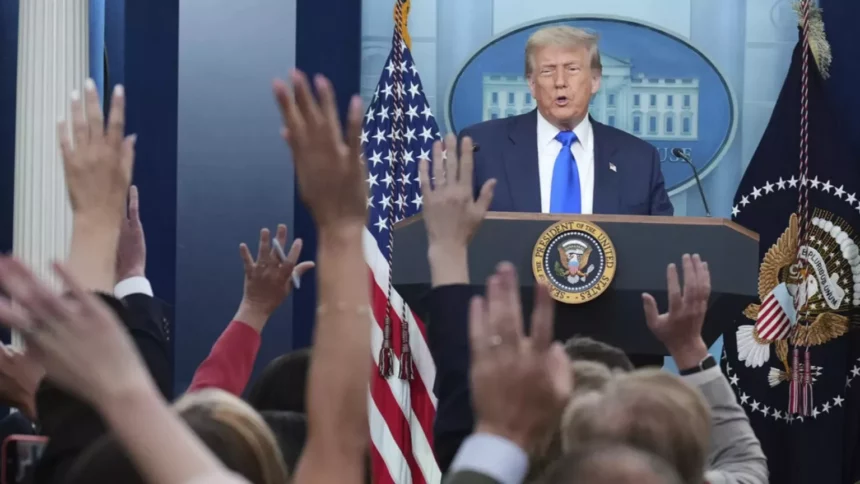
U.S. President Donald Trump has firmly denied reports claiming that his administration considered offering Iran up to $30 billion to support a civilian nuclear energy program in exchange for halting uranium enrichment, calling the allegations a “hoax” and dismissing them as fake news. The reports, which surfaced on CNN and NBC News, come at a delicate moment as the United States and Iran have been engaged in indirect diplomatic talks to address Iran’s nuclear program while managing broader regional tensions.
Donald Trump Calls Reports a ‘Hoax’
On Friday night, Donald Trump took to Truth Social to refute the claims, posting, “Who in the Fake News Media is the SleazeBag saying that ‘President Donald Trump wants to give Iran $30 Billion to build non-military Nuclear facilities.’ Never heard of this ridiculous idea.” His statement was in direct response to some reports stating that the Donald Trump administration had recently explored the idea of offering economic incentives to Iran if it agreed to curb its uranium enrichment activities.
The reports had cited anonymous sources suggesting the proposal could have included financial access to facilitate Iran’s development of a civilian nuclear energy program. This would have marked a significant shift in Washington’s approach towards Tehran, which the U.S. has long accused of seeking to develop nuclear weapons under the guise of a civilian program, an allegation Iran has consistently denied, insisting that its nuclear program is intended solely for peaceful energy purposes.
Diplomatic Talks and Regional Ceasefire
Since April, indirect negotiations between the U.S. and Iran have been ongoing in search of a diplomatic resolution to longstanding disputes over Tehran’s nuclear ambitions. Washington has repeatedly stated that its goal is to ensure Iran never acquires nuclear weapons, while Tehran has maintained that its nuclear activities comply with international regulations and are geared towards peaceful energy development.
Earlier in the week, Donald Trump announced a ceasefire agreement between Israel and Iran, aiming to de-escalate a conflict that erupted on June 13 when Israel launched strikes on Iranian targets. The Israel-Iran conflict has heightened concerns in a region already on edge due to Israel’s ongoing war in Gaza, which began in October 2023.
The ceasefire, if it holds, may create a temporary window for diplomatic efforts, allowing both the U.S. and regional players to navigate the complex dynamics involving Iran’s nuclear program and its geopolitical ambitions in the Middle East. However, Donald Trump’s swift dismissal of the reports regarding the $30 billion aid for Iran’s civilian nuclear program underscores the sensitivity surrounding U.S.-Iran negotiations and the challenges in managing domestic political narratives while handling delicate foreign policy engagements.
The Donald Trump administration’s stance aligns with Washington’s long-standing position of cautious engagement with Tehran, focusing on negotiations that ensure transparency and compliance while leveraging sanctions and diplomatic pressure. Despite the reports, there has been no official confirmation from U.S. government agencies indicating that such a financial package for Iran was under serious consideration.
With the region’s fragile security environment and the global community’s focus on preventing nuclear proliferation, any discussions around aiding Iran’s nuclear ambitions, even for peaceful purposes, are likely to remain contentious. As indirect diplomatic channels continue to explore possible frameworks for reducing tensions and resolving nuclear issues, both Washington and Tehran face the complex task of addressing internal pressures, regional alliances, and global scrutiny while attempting to maintain stability and prevent further escalation in the Middle East.